
Arimaspians: Mysterious Mighty Warriors With One-Eye
A. Sutherland - AncientPages.com - The Arimaspians were a tribe of ordinary human-sized horsemen with only one eye in the middle of their forehead. Based on ancient records, they inhabited land at the foot of the Riphean (Rhipaion) Mountains, a mountain range located far north of Eurasia.
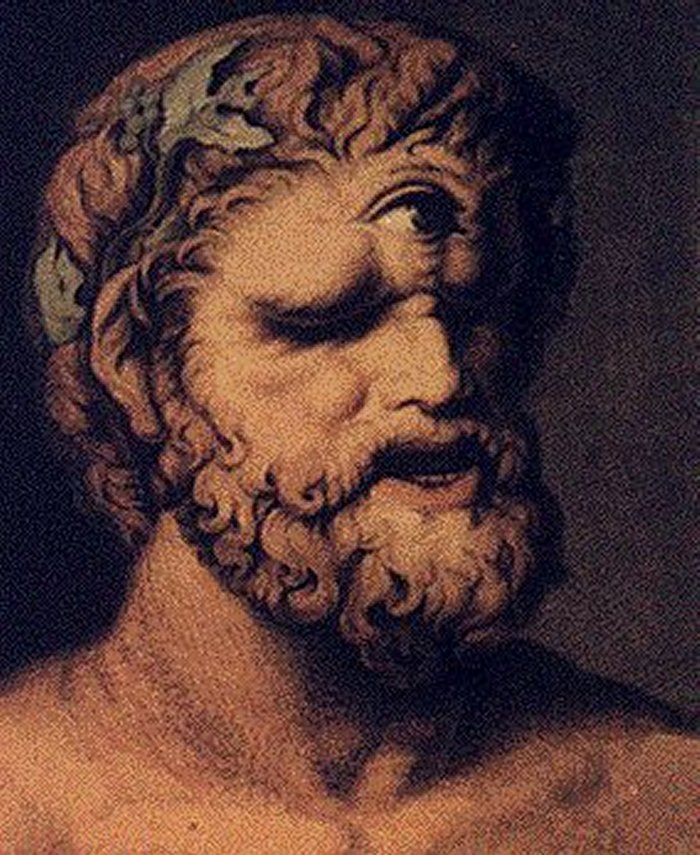
Polyphemus, by Johann Heinrich Wilhelm Tischbein, 1802
Greek records, for example, mention the Inner Asian Arimaspians and refer to them as one-eyed beings in the Inner Asian tradition, found in the works of geographers from India and China, who wrote about the nomadic peoples of the steppe regions.
These people were involved in a long-lasting and practically never-ending struggle against griffins, legendary powerful creatures both feared and respected guardians of gold and treasures.
Herodotus gave information about the Arimaspians from the Argipeans, who inhabited the mountainous areas between the Scythians and the Issedones. He is not the first source of information about the mysterious Arimaspians.
In "The Discovery of America" Vol. 1 (of 2) by John Fiske, we read that "the first mention of these mythical people seems to have been made by Greek travelers in Scythia as early as the seventh century before Christ; and they furnished Aristeas of Proconnesus, somewhat later, with the theme of his poem "Arimaspeia," which has perished, all except six verses... quoted by Longinus. The notion of the Arimaspians seems to have passed to Herodotus (iii. 116; iv. 27).
It is in the third book of the Histories (116) that Herodotus makes his first mention of the Arimaspians — a race of beings deeply connected to tales of the abundance of gold in the "northern" parts of "Europe." However, he does not seem convinced of these mythical one-eyed men's existence.
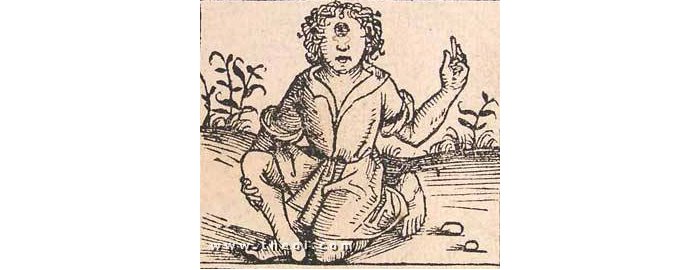 Arimaspian from the Nurenburg Chronicle, 1493. Image source
"In this matter again I cannot say with assurance how the gold is produced, but it is said that one-eyed men called Arimaspoi (Arimaspians) steal it from griffins," writes Herodotus in his Histories III. 116.
Also in Herodotus' History IV. 13, there is a reference to mysterious one-eyed Arimaspians, who lived to the east of the Issedones, the latter living near the present Hami. However, there are also similar records in the "Hainei Beijing" of the Shanhai Jing: "Gui (ghost) State is north of Erfu's Corpse. These things have a human face and one eye. Some say Erfu Spirit is to the east, and that these things have a human face and snake body…"
The Arimaspians were also described by Aristeas of Proconnesus (mentioned by Herodotus in his Histories 4. 13. 1.), who was a legendary wisdom figure associated with the cult of Apollo and probably lived ca. 690 BC.
Also, "Book of the Suda", Byzantine lexicon from the tenth century AD, states that Aristeas was the author of the poem "Arimaspea" in three volumes.
Aristeas gives his account of journeys into the lands that ancient Greeks considered the "North" — beyond the Scythian nomads as far as the country of a people called the Issedones (IV. 13,16). These Issedones were most likely another nomadic tribe, which informed Aristeas of the many mythic races that had their settlements just beyond their borders.
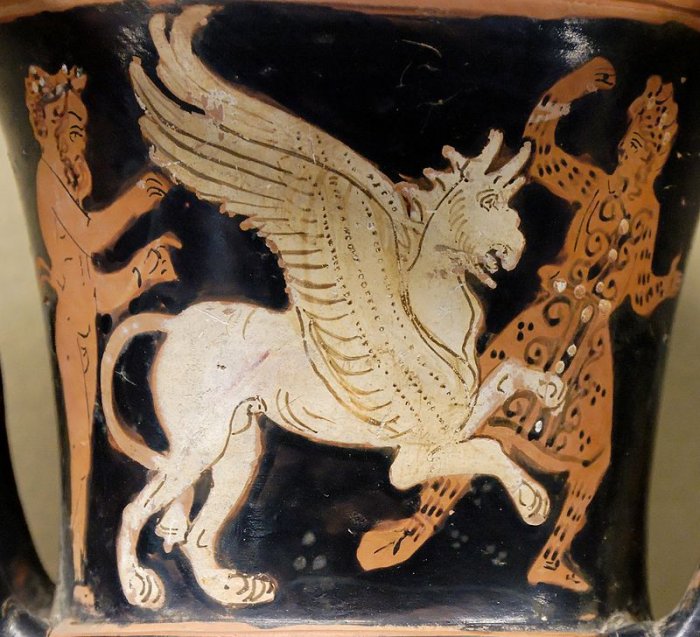
Credit: Public Domain
The Issedones and Arimaspians had most probably their prototypes in the authentic tribes of Siberia a very long time ago.
The Arimaspians conflicted with other neighboring tribes, for example, the Issedones, driven out of their land by the Arimaspians; the Scythians, on the other hand, were in conflict with the Issedones, "and the Cimmerians dwelling by the "southern sea," being pressed upon by the Scythians, left behind their own land...(Herodotus. IV.13)
Based on fragments of Aristeas' work, the Issedones praised the Arimaspians as real warlike people of very noble character, covered with shaggy hair, who possess plenty of livestock. Their only genuinely remarkable and unusual characteristic was the presence of a single eye in the middle of their foreheads.
Aristeas writes as follows:
"…There are men who neighbor them, up above Boreas (the north wind); Warriors many in number and powerful; Rich in horses and possessing many herds of cattle. They have a single eye in the middle of their fair forehead(s), They are shaggy with hair, and the toughest of all men." (Tzetz. Chil. VII. 686–92) 29.
Herodotus also gives an explanation (most probably also taken from the poem of Aristeus) of the word "arimasp," which in Scythian means "one-eyed" ("Arima" is one, "spu" is an eye).
The earliest reference to Arimaspians, besides Herodotus, comes from 'Prometheus Bound,' written by Aeschylus, an ancient Greek tragedian (c. 525/524 – c. 456/455 BC), who says:
"The sharp-toothed, unbarking hounds of Zeus;
The gryphons — beware them, and also the one-eyed cavalry horde
Of the Arimaspians, who dwell by the font
Of Plouton's stream, which flows with gold.
Do not approach them. "(Aesch. PV. 803–6)"
It is not precisely known who the Arimaspians really were, but myths and legends are still alive. It does not mean that we know much about them and will ever do.
Written by A. Sutherland - AncientPages.com Staff Writer
Updated on November 8, 2023
Copyright © AncientPages.com All rights reserved. This material may not be published, broadcast, rewritten or redistributed in whole or part without the express written permission of AncientPages.com.
Expand for referencesMore From Ancient Pages
-
 Faces Of Queen Nefertiti And King Akhenaten Reconstructed Using Artificial Intelligence
-
 What Is The Meaning Of Ankh – Ancient Egyptian Symbol
-
 12,000-Year-Old Burial Of Female Shaman Unearthed In Turkey
-
 Tomb of the 26th dynasty vizier of Upper Egypt discovered in South Assassif, Luxor
-
 Mysterious Stone Table Found At Biblical Temple In Jerusalem – Evidence Of The Ark Of The Covenant?
-
 On This Day In History: Captain James Cook Spotted The East Coast Of Australia – On Apr 19, 1770
-
 Paleolithic Humans May Have Understood The Properties Of Rocks For Making Stone Tools
-
 A Scientific Surprise: Bering Land Bridge Formed Late During Last Ice Age
-
 Newly Unearthed Colossal Statue Probably Depicts King Psammetich I And Not Ramses II
-
 Humans Lived In Rainforests At Least 150,000 Years Ago In Africa
-
 Secrets Of Mica Chambers Of Teotihuacan
-
 Bill Of Rights 1689 – Enormous Historical Moment In English History
-
 First Egyptian Middle Kingdom Tomb Unearthed In South Asasif Necropolis In Luxor
-
 Archaeologists Investigate A Fascinating Ice Age Mystery In A Cave Beneath A British Castle
-
 DNA Study Sheds Light On The Mysterious Picts Of Scotland
-
 European Mythical Creatures Encountered In The Witcher Series
-
 On This Day In History: ‘The Wars Of The Roses’ – Fighting For The Throne Of England At Tewkesbury – On May 4, 1471
-
 Mystery Of Ancient Beehive Tombs Around The World
-
 First Genome-Wide Ancient Human DNA From Sudan Shines New Light On Nile Valley Past
-
 Somalia’s Legacy: Laas Geel Caves Covered With At Least 5,000-Year-Old Paintings

