
Surya: Hindu Sun God Who Illuminates The World, Our Lives And Disperses Darkness, Destroys Diseases, And Enemies
A. Sutherland - AncientPages.com - In Mahabharata, one of the major Sanskrit epics of ancient India, Surya is the "eye of the universe, soul of all existence, origin of all life, and symbol for freedom and spiritual emancipation.
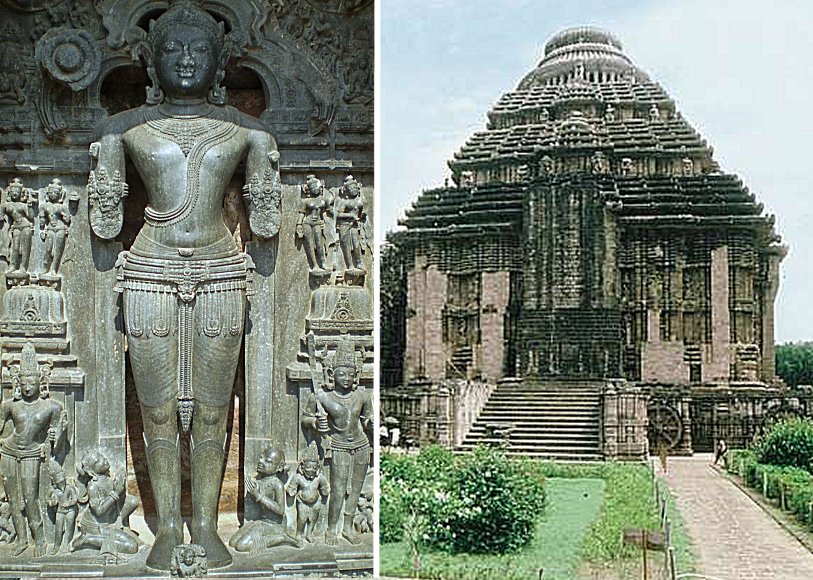
Left: A secondary statue of the Sun god, source; Right: Surya Deula (Sun Temple), Konark, Odisha, eastern India. Frederick M. Asher, source
In Hindu beliefs, Surya - the god of the sun and the sun itself - represented the physical sun and personified the sun as a deity. In the early Hindu scripts, this god was considered one of the most important deities.
Surya's main action is the pouring out of light. He illuminates the world, our lives, and disperses the darkness, destroys diseases and enemies.
In a chariot harnessed by seven red mares or by a mare with seven heads, he travels across the sky or the space around Mount Meru, later called Mount Kailasha. It was the abode in the mountains where the gods dwelt, ruled over by Varuna, guardian of the cosmic order. Surya was the sun god, Agni the god of fire, Indra the god of war, Yama the god of death, and Soma, the god of vitality.
Surya is the one who spends every day in the sky, like Shamash, the god of the sun in Mesopotamian beliefs, or Apollo called Phoebus (the 'Shining-One') by the Greeks, which originally was the god Helios' name, but later both gods became one. In early Greek myths, it was Helios who guarded the chariot of the sun across the sky every day, and later, Apollo became identified as Helios Apollo, and from then on, his duty was to ride the chariot in the sky.
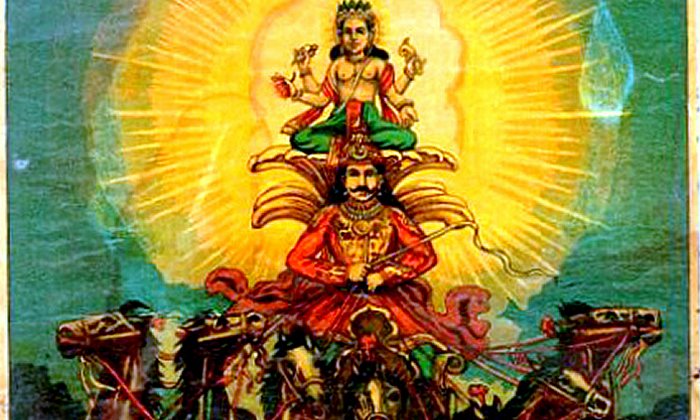 Aruna, the divine charioteer of Surya. source
In Vedic times, three ancient gods were of significant value in people's beliefs, and they were Surya, Vayu, who represented air, and Agni, a powerful god that symbolized fire. All three of them formed one of the Vedic trinities. Surya used to appear in three forms, like the Egyptian god Ra. It represented the forces of the rising sun (Vivasvat) and the setting sun (Savitri), which - as the all-powerful sun - stimulated life on our planet.
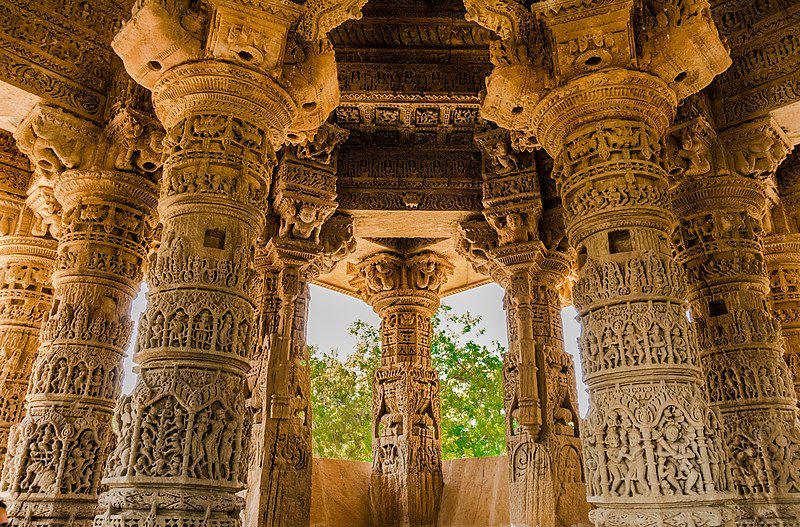
Intricate Pillars of Modhera Sun Temple. Image credit: Jmadhu - CC BY-SA 4.0
One of the few significant Sun temples across India, this Sun Temple at Modhera will fascinate with its inverted lotus design on a plinth, long and short pillars, semicircular and triangular ‘Torana’ archways. The outer walls with 12 niches representing the months with different images of Surya carved on them. The walls and pillars are decorated with sculptures of the gods, celestial nymphs, animals, and scenes from the great epics Ramayana, Mahabharatha, and scenes from the life of Sri Krishna.
In the Rigveda texts, the god Surya was described as a "beautiful-looking bird" or as "moving on a chariot drawn by one, seven, or many fast and strong horses
In early depictions, Surya had golden arms, golden hair, and golden tongues.
 Surya In his chariot, from the Kailasa Temple, in Ellora, ( published on the book Indian Myth and Legend, by Donald Alexander Mackenzie) source
In art depictions, Surya is depicted as a dark-red man with three eyes and four arms, holding lotuses, riding a chariot drawn by seven horses. Different characteristics are attributed to Surya in Hindu texts. He is sometimes described as having two hands and wearing a crown, and another time, the sun god has four hands of which two keep lotus flowers, and the other two hold a pen, a staff, and palm leaf.

Sun temple in Gujarat, India dedicated to Hindu Sun God Surya. Credit: Adobe Stock - viktorov.pro
The god is accompanied by two goddesses of dawn, Usha and Pratyusha, and these two are busy shooting arrows and challenging darkness. However, the rich iconography related to the sun god Surya varied over time; it has shown Greek, Persian influences.
The worship of the Sun is very ancient and has played an important role in many cultures. The Rigveda - the oldest of the Hindu sacred books, composed between 1500 and 1000 BC - has hymns dedicated to the Sun and proclaims it as the only God.
The Puranas, on the other hand, are the stories of kings and gods and refer to Surya as Aditya, son of Aditi and sage Kashyapa, one of the Saptarishis, the seven ancient sages of the Rigveda, as well as many other Sanskrit texts and Indian mythologies.
 The Wheel of Konark. The Sun Temple at Konark, Orissa built in the 13th century, is one of the most famous monuments of stone sculpture in the world. Source
Surya’s most celebrated temple is located at Konarak, Orisha in northeast India, but this god was widely worshiped across India. The architecture is also symbolic with the chariot's twelve pairs of wheels, approximately 12 feet in diameter, pulled by seven horses, corresponding to the 12 months of the Hindu calendar, each month paired into two cycles (Shukla and Krishna).
Written by – A. Sutherland - AncientPages.com Senior Staff Writer
Copyright © AncientPages.com All rights reserved. This material may not be published, broadcast, rewritten or redistributed in whole or part without the express written permission of AncientPages.com
Expand for referencesReferences:
Rapson, E.J. Ancient India
Dutt, Romesh Chunder, History of India From the Earliest Times to the Sixth Century BC
More From Ancient Pages
-
 Halloween: Facts And History About All Hallows’ Eve And Its Connection With Samhain – An Ancient Celtic Festival
-
 Pharaoh Hor Aha – 1st Dynasty Ruler Of Ancient Egypt Who Founded The City Of Memphis And May Have Been The Legendary Menes
-
 Ancient People In The Tibetan Plateau Had More Cultural Exchanges Than Previously Thought
-
 Incredible Technology In Mysterious Huashan Caves, China
-
 Legendary Brahan Seer Of The Clan Mackenzie (Coinneach) – The Scottish Nostradamus
-
 Ancient Egyptians Invented World’s Oldest Egg Ovens And They Are Still In Use
-
 Intriguing El Tajin – Pre-Hispanic Ceremonial Site Dedicated To Totonac Rain God
-
 Ingenious Paleolithic 3D Map Was Discovered In The Ségognole 3 Cave South Of Paris, France
-
 Rare Stories Of Merlin And King Arthur Discovered In Medieval Manuscript Hidden In Plain Sight
-
 How Great Emperor Ashoka Realized And Showed All Living Beings Matter
-
 Vikings Feared Climate Change 1,200 Years Ago – Famous Rök Stone Reveals
-
 Who Can Solve The Shackleton Scribble Mystery?
-
 Stunning Well-Preserved Larger Than Life Statue Of Hercules Discovered In Philippi, Greece
-
 Ancient Parthian City With Hundreds Of Artifacts Unearthed In Iraq
-
 New Study: Middle Neolithic Circular Enclosure Of Goseck – Sacred Place And Astronomical Observatory
-
 Why Is Europe Called Europe?
-
 Chalchihuitlicue: Beautiful, Dangerous, Changeable And Unpredictable Water Goddess In Aztec Mythology
-
 Remains Of Medieval Port Discovered In Eindhoven
-
 Discovery Of Fortified Villages And Earthworks Re-Writes Ancient History Of Amazon
-
 Human Ancestors Preferred Mosaic Landscapes And High Ecosystem Diversity – New Study

