
Are The Baffling La Marche Cave Paintings Authentic Or Cunning Forgeries?
Ellen Lloyd - AncientPages.com - Every now and then, we come across strange and controversial archaeological discoveries that are naturally of great interest to all truth-seekers. In most cases, investigating the unusual findings can be difficult because sometimes ancient objects are “lost” or misplaced.
This problem is not present in cave paintings because engravings cannot be easily “removed” out of sight. This brings us to today’s subject, which concerns very unusual cave paintings in France.
Few European places have caused controversy like the strange La Marche cave. Scientists continue to argue over the unorthodox cave paintings that challenge our knowledge of ancient history. Are the extraordinary cave paintings authentic or cunning forgeries?
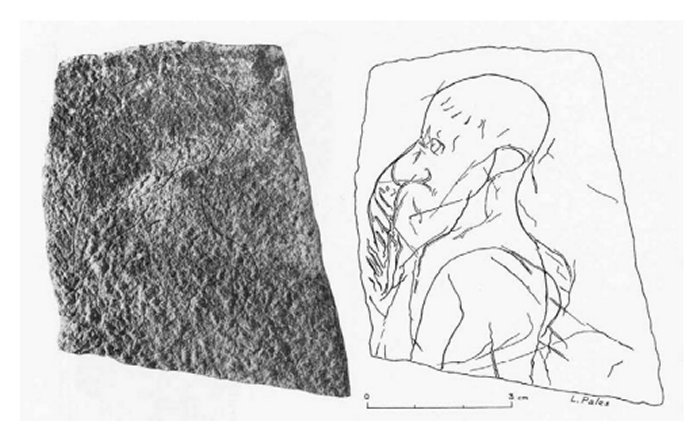
Faces carved on the floor of a cave at La Marche. Credit: Fuentes Oscar
Frankly, in this case, we must say that these baffling cave paintings seem almost too good to be true. Did someone commit a horrible archaeological crime by deliberately creating these paintings? If so, then for what reason?
La Marche is a cave located near the village of Lussac-les-Châteaux, Vienne, in western France. It is one of the most important archaeological sites for stone carvings from the Magdalenian period, 17,000 - 12,000 years ago.
Between 1937 and 1940, Léon Péricard and Stéphane Lwoff discovered the cave complex, which contained approximately 1,500 limestone stones with carvings depicting bears, lions, antelopes, and horses, as well as 155 curiously realistic human figures.
The humans depicted on the cave walls are puzzling. They are very different from other Paleolithic drawings and resemble caricatures of real people: old men, children, men whose faces are shaved, and women (often obese), sometimes dressed in coats and with hats and boots. Several of them have ornaments on their bodies that can be interpreted as paintings or perhaps tattoos.
The interpretations of these remarkable carvings are controversial and still disputed. Many scientists consider them forgeries because the ‘real’ people in La Marche Cave resemble modern art.
The carvings are also difficult to interpret because sometimes one image overlaps with another or several of them.
The depictions date back to about 15,000 - 13,000 B.C., and we know that at the time, Europe was largely under the weight of glaciers. It was before great civilizations appeared.
If the paintings are authentic, one must question the existence of primitive man as we know it. However, it’s hard to imagine the drawings are real because nothing similar has been found elsewhere in Europe.
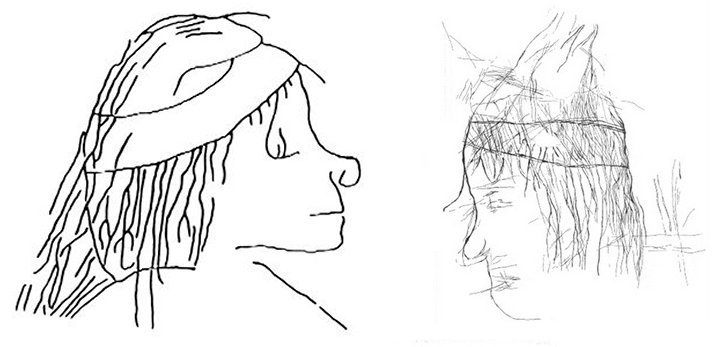
The La Marche cave paintings are intriguing, but are they authentic? Credit: Fuentes Oscar
The Lascaux cave, located on a hill at Dordogne, near Montignac, in southern France, is famous for its outstanding Magdalenian paintings, but the images we come across there certainly do not resemble anything we find in the La Marche cave.
Ancient Pages explained previously, the “brilliant prehistoric paintings of Lascaux, with their anatomically perfect details of all depicted animals, are rendered with great art skills like shadowing, highlighting, stenciling, and the use of perspective, a technique that was not rediscovered until the Golden Age in Greece.

Lascaux cave paintings depicting animals. Credit: Public Domain
However, looking at the millennia-old Paleolithic artwork of Lascaux, where only simple stick figures represent a man, we cannot tell if the artists were a Neanderthal man or Cro-Magnon man or perhaps someone else.”
Compared to the Lascaux cave paintings, the carved etchings at La Marche appear crude and far too modern.
It’s also worth noting that people depicted on the walls at La Marche are dressed in rather modern clothes. This may perhaps not be so surprising considering ancient figurines of men and women wearing modern-day clothes have been previously encountered in Europe.
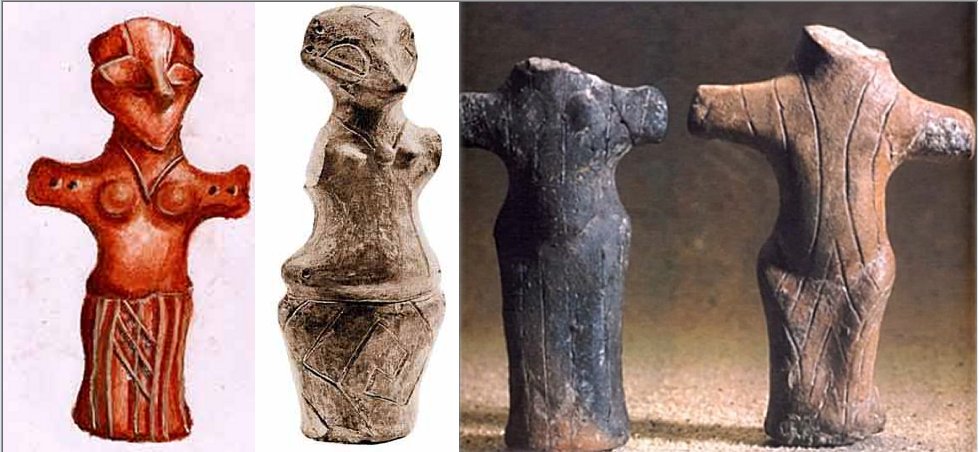
The Vinca figurines.
“The Vinca legacy includes among others, curious masks and the most informative costumed figurines depicting women in extremely modern clothes like narrow skirts, and sleeveless upper-body panels, complimented with hip belts, aprons, jewelry, shoes, caps, hairstyles, bracelets, necklaces, and medallions.”
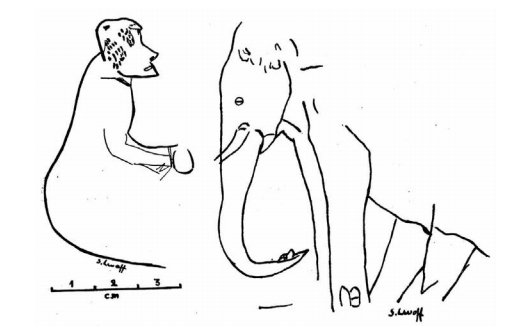
Is this an authentic carving of a woman who lived during the Magdalenian period? Credit: Fuentes Oscar
However, the Vinca culture in southeastern Europe, present-day Serbia, and smaller parts of Bulgaria, Macedonia, and Romania flourished from about 6000 BC to 3000 B.C.. Though Vinca's living style reminds us of our own, it cannot be compared to the engravings found inside the La Marche cave.
Some scientists think the La Marche cave paintings are authentic, but there are also many experts who doubt the engravings were produced during the Magdalenian period.
Regarding the La Marche cave paintings, the verdict is still out there.
Updated on July 31, 2024
Written by Ellen Lloyd – AncientPages.com
Copyright © AncientPages.com All rights reserved. This material may not be published, broadcast, rewritten or redistributed in whole or part without the express written permission of AncientPages.com
Expand for referencesFuentes, Oscar & Lucas, Claire & Robert, Eric. (2017). An approach to Palaeolithic networks: The question of symbolic territories and their interpretation through Magdalenian art. Quaternary International. 503. 10.1016/j.quaint.2017.12.017.
More From Ancient Pages
-
 World’s First ‘Cash Machine’ Discovered In A Wall Of An Ancient Bakery
-
 Investigation Of A 2.9-Million-Year-Old Site Reopens Case Of Who Made First Stone Tools
-
 Unique 17th Century Silk Dress Found At Bottom Of The Wadden Sea Goes On Display
-
 Mysterious Ancient Sculptures Of Unakoti And The Curse Of God Shiva
-
 Bayeux Tapestry: Original Location Of Remarkable Romanesque Art – Finally Solved
-
 Bronze Age Vatya Culture: ‘Urnfield’ Cemetery And Remains Of A High-Status Woman
-
 Amazing Time Capsule – La Roche-Cotard Cave Sealed For 50,000-Years Offers Evidence Neanderthals Were The World’s First Artists
-
 On This Day In History: Favorite Ship Of King Henry VIII ‘Mary Rose’ Sank – On July 19, 1545
-
 ‘Golden Man’ – Sak Warrior Covered With Thousands Of Pieces Of Gold – More Light On Gold Techniques Used In Kazakhstan
-
 Discovery Of Ancient Sarcophagus And 14 Stone Pillars Covered With Inscriptions In Eastern Mongolia
-
 Selah – Mysterious Biblical Word Of Unknown Meaning
-
 Ancient Indian Text Re-Writes History Of Number Zero And Mathematics
-
 Mystery Of The Tower Of Babel – The Mountain Of God Or A Symbol Of Chaos And Ignorance?
-
 Evidence Humans Have Visited Caves Of Nerja For 41,000 Years – Found!
-
 LIDAR Data Helped To Discover Unexplored Region Of Maya World In Campeche, Mexico
-
 The Assyrian Siege Ramp And Breached Walls At Canaanite City Of Lachish – Studied
-
 Enigma Of The Mysterious Ancient Shining Twins – Were They With Humans From The Beginning Of History? Part 1
-
 How Pre-Industrial Communities in Northeastern Europe Adapted to Climate Changes Over the Past Two Millennia
-
 Four Canopic Jars Dated To The 26th Dynasty Unearthed At South Asasif Necropolis, Luxor
-
 Blood Of St. Januarius – One Of The Most Remarkable Christian Relics

