
Norse Shamanism: A Völva And Her Prophecies Were Feared Among Norse Gods And Vikings
Ellen Lloyd - AncientPages.com - The Völva was a mighty female shaman and seer in Norse mythology.
She held an important place in the ancient Viking society, and her powers were considered so strong that not only Vikings feared her prophecies.
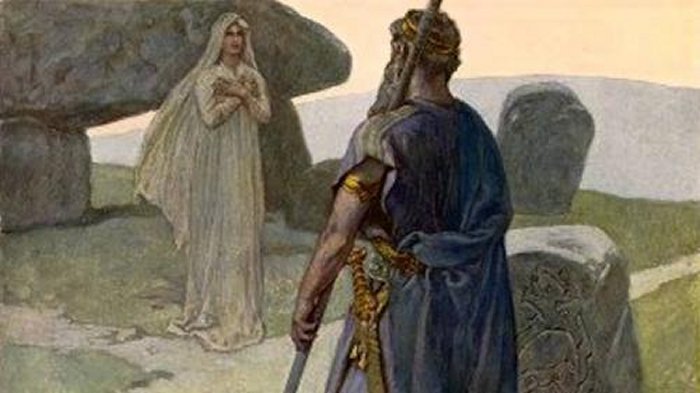
“Odin and the Prophetess” by Emil Doepler (1910)
But there were also other Norns, both benevolent and malevolent, who had enough power to reverse a person’s fortune.
Even Odin, the greatest of all Norse gods, consulted her to learn about his future and other divinities.
In Völuspa, Odin offered the völva his necklace and rings as payment for telling him the future. She foretold the creation of the world, the first gods, the first people, and Ragnarök – the end of the world.
What Is Norse Shamanism?
The Völva was considered a Seiðr (sometimes anglicized as seidhr, seidh, seidr, seithr, seith, or seid) is an Old Norse term for a type of sorcery that was practiced in Norse society during the Late Scandinavian Iron Age.
According to Norse mythology, the Norns were shapers of destiny and recorded days in a person's life. They were the foremost masters of seidr.
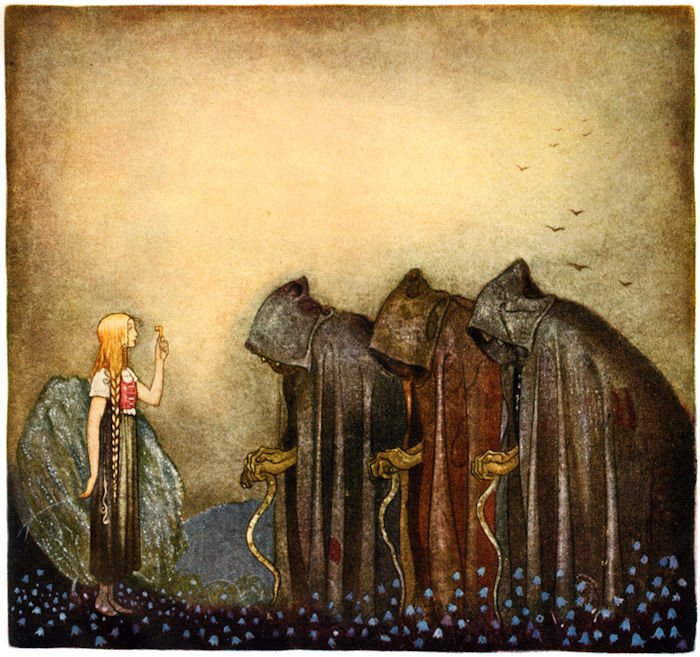 Guldnyckeln by John Bauer (1882–1918). Credit: Public Domain
A Seiðr could not only foretell the future but also raise storms, journey or battle in animal form, send a nightmare to kill someone by suffocation in his sleep, and cast love spells.
But there were also other Norns, both benevolent and malevolent, who had enough power to reverse a person's fortune.
In his book Viking Way: Religion and War in Late Iron Age Scandinavia, archaeologist Neil Price writes:
"There were seiðr rituals for divination and clairvoyance; for seeking out the hidden, both in the secrets of the mind and in physical locations; for healing the sick; for bringing good luck; for controlling the weather; for calling game animals and fish.

Goddess Freya was the most powerful völva. - Credit: Public Domain
Importantly, it could also be used for the opposite of these things – to curse an individual or an enterprise; to blight the land and make it barren; to induce illness; to tell false futures and thus to set their recipients on a road to disaster; to injure, maim and kill, in domestic disputes and especially in battle."
The name Völva (vǫlva) is Old Norse and means "wand carrier" or "carrier of a magic staff." In Norse Sagas, a völva is often described as an older woman who appears late at night. She is dressed in a dark foot-length cloak and holds a magical staff in her hand.
In some Norse myths and sagas, it is written that the wand she held had the power of causing forgetfulness in anyone who tapped it three times on the cheek.
Freya: Norse Goddess Who Was The Most Prominent Völva
The art of prophecy was a divine gift that the Norse goddess Freya taught Odin and the Aesir, Norse gods associated with war, magic, and the sky.
In Norse mythology, Freya is a powerful goddess. She belongs to a group of Gods and Goddesses known as the Vanir, associated with nature, wild places and animals, and unseen realms.
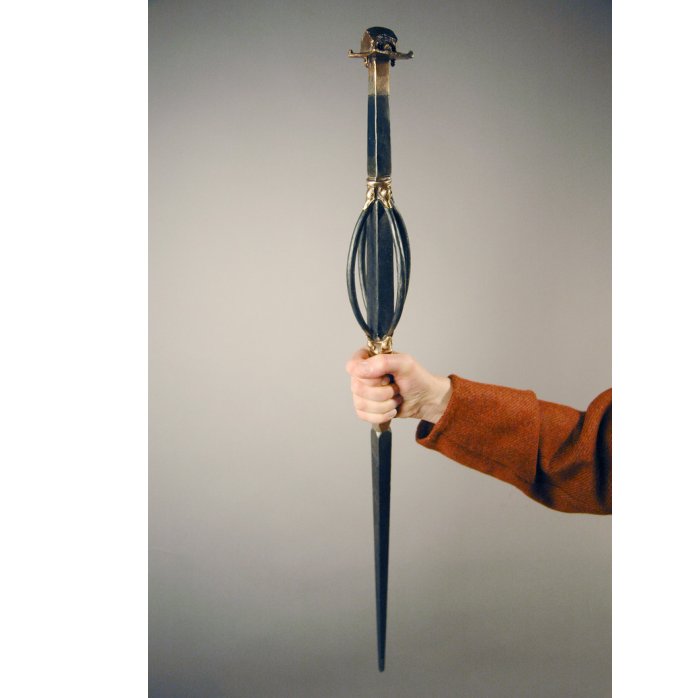
Reconstruction of Klinta rod, a völva staff. Photo: Oskar Kullander / SHM
She is considered to be the goddess of Love and Beauty but is also a warrior goddess and one of great wisdom and magic. Freya, who always had a wand in her hand, was the most prominent völva.
A Völva Needed Her Magical Staff To Foretell The Future
The most detailed account of such a woman and her craft comes from The Saga of Erik the Red. In the saga, a Völva comes to a settlement in Greenland to prophesy for the community. The völva wandered from town to town and farm to farm, performing commissioned acts of magic in exchange for room, board, and other forms of compensation.
Archaeologists have discovered ancient artifacts that might be a wand carried by the Norse female shamans.
The most delicate ancient rod - found in a Viking woman's grave on Öland - is stored at the Historical Museum in Sweden.

Finds from a vǫlva's grave in Köpingsvik, Öland. There is an 82 cm long wand of iron with bronze details and a unique model of a house on the top. Image credit: Swedish History Museum in Stockholm.
. The rod is about one meter long and interrupted at one end. It is made of iron with bronze details. A house in miniature crowns a top. Perhaps it is a symbol of Freya's house, "Folkvang." In the tomb, other items showed that the dead woman had a special status. Maybe the deceased woman was a völva.
A völva needed the magical staff to foretell the future. While excavating some ancient graves in Scandinavia, scientists have also discovered traces of cannabis and other drugs most likely used during the rituals.
A völva was just as respected as much as her prophecies were feared. Like many other shamans in ancient cultures, the Norse völva was set apart from her wider society, both in a positive and a negative sense.
Updated on December 22, 2023
Written by Ellen Lloyd – AncientPages.com
Copyright © AncientPages.com All rights reserved. This material may not be published, broadcast, rewritten or redistributed in whole or part without the express written permission of AncientPages.com
More From Ancient Pages
-
 Major Underwater Archaeological Find On The Western Coast Of Sicily – Artifacts From The Battle Of The Egadi Islands?
-
 Rare Viking Graffiti And Artifacts Found In Dublin – Depiction Of God Odin Riding Sleipnir Followed By Huginn And Muninn?
-
 Mystery Of Europe’s Bog Body Phenomenon Solved By Scientists
-
 Tabula Peutingeriana: Huge Ancient Roman Map Created By Unknown Cartographer
-
 Ancient Mosaics Dated To The First Century Discovered In Southern Turkey
-
 LIDAR Disovers 2,000-Year-Old Roman Temple Under Church In Danilo, Croatia
-
 Mystery Of The Lost Biblical Kadesh Where Moses Was Punished By God
-
 Hundreds Of Thousands Of Sumerian Artifacts Have Been Stolen From Iraq’s Museums And Archaeological Sites
-
 Loss Of Rainforests, Grasslands In Southeast Asia Caused Extinction Of Megafauna And Ancient Humans
-
 Our 7-Day Week Can Be Traced To Babylonians Who Started Using It 4,000 Years Ago
-
 Roman Copper-Alloy Tortoise Figurine Discovered In Suffolk, UK
-
 Riddle Of The Indo-European Language – Which Of The Two Hypotheses Is Correct?
-
 The Battle Of The ‘Cloudships’ – Strange And Unexplained Sightings In The Skies
-
 Nicolas Bourbaki: The Greatest Mathematician Who Never Was
-
 Wupatki Ruins And Sacred Sunset Crater Of Ancestral Puebloans In Arizona
-
 Mini-Pyramid Discovered In South Saqqara, Egypt
-
 Owain Glyndwr: Famous Medieval Welsh Warrior Prince And Symbol Of Independence
-
 DNA Reveals The History Of Modern And Archaic Humans Is Much Longer And More Complicated Than Previously Thought
-
 Beautiful Legend Of La Befana – Witch Who Delivers Gifts To Children In Italy On Epiphany – Twelve Days After Christmas
-
 Paleoindian Ochre Mine Found In Submerged Caves In Mexico’s Yucatan Peninsula

