
Ancient Egyptian Cosmetics – Why Was It So Important To Both Men And Women?
Conny Waters - AncientPages.com - Ancient Egyptians had several achievements in chemistry and cosmetology. They produced creams, perfumes, and facial colors. They created beautification techniques, and special soap to wash corpses as part of mummification.
The use of cosmetics was very important in ancient Egypt and makeup was used by both men and women.
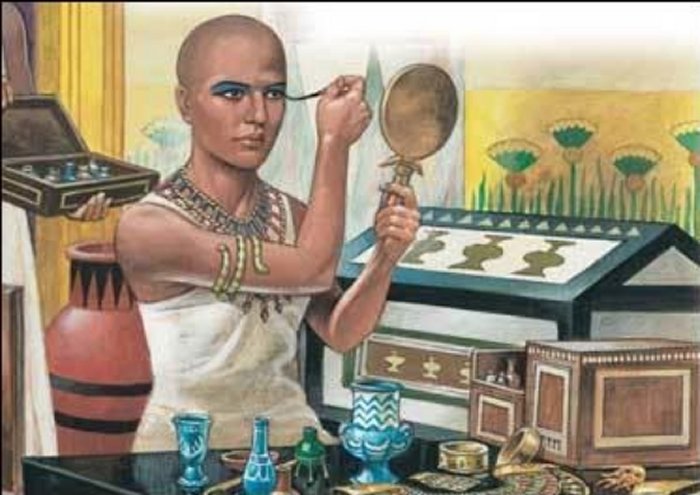
4,000 years ago, the Egyptians used some kind of toothpaste or bleach (a person with bleached teeth looks healthier), which was made from ground pumice added to soap, scrubs, and other natural cosmetic recipes to provide exfoliation to the skin.
Makeup was once an important part of everyday life in Egypt and it was not only used to look better. There was a much more important purpose behind the use of cosmetics in ancient Egypt. Cosmetics was sacred to ancient Egyptians and used not only for aesthetic purposes but rather for magical and religious purposes.
Frescoes discovered in ancient Egyptian temples illustrating daily life reveal men often wore makeup. In fact, it’s almost impossible to find a portrait of an ancient Egyptian whose eyes are not decorated.
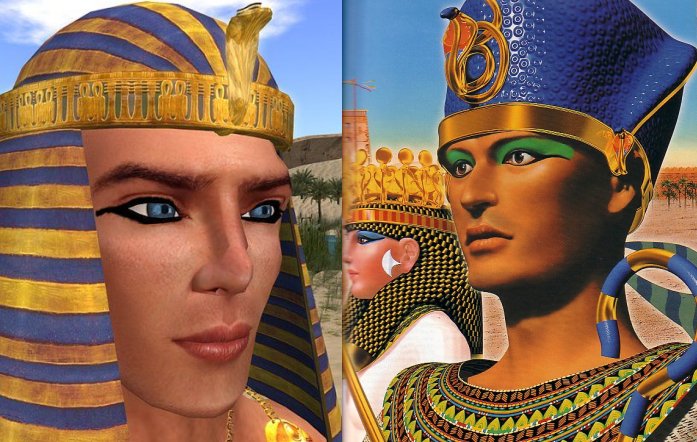
Men wore makeup in ancient Egypt.
During all periods and dynasties, eye makeup was a daily prerequisite for both men and women.
The use of cosmetics differed slightly between social classes. Higher class and wealthier individuals could afford more make-up.
Ancient Egyptians used a variety of cosmetics such as eye makeup, rouge, and perfumed oils that softened the skin and prevented burning in the sun and damage from the sandy winds. Galena powder possesses disinfectant and fly-deterrent properties. It is believed to offer the eyes protection from the intense sun.
In Ancient Egypt, the image of an individual often acted as a substitute for the body in the afterlife. Therefore, in funerary paintings, both males and females are shown in their best clothes, wigs, and makeup.
Ancient Egyptians often shaved their head because of lice infestations. People wore wigs made of real human hair that was adorned with flowers and braid.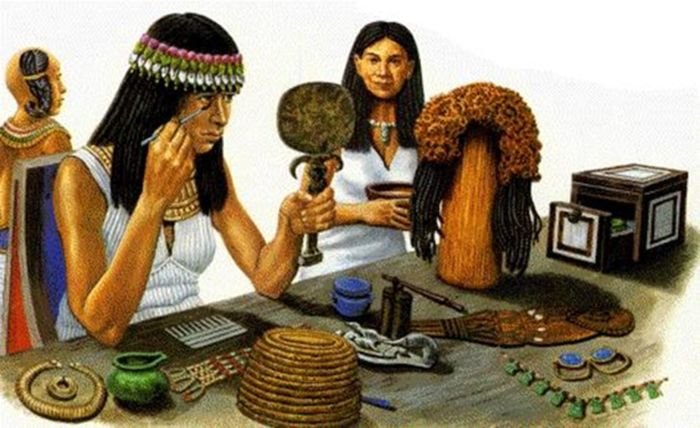
Makeup tools and accessories were very important too. Precious oils were stored in cosmetics jars made from glass, faience ceramics, and stone. The mirror was made of bronze and often carved in the form of an Egyptian goddess.
Ancient Egyptians used a variety of pigments to adorn the face. Most important of all was kohl, which was used to line the eyes. Kohl came from two sources: a green eye paint made of mineral malachite and a black liner derived from galena, a form of lead ore. Women used red ochre to form a light blush for cheeks and lips, while henna was used to paint the nails and dye the hair.
Cosmetics had also a religious resonance. The ancient Egyptians regarded beauty as a sign of holiness. In the holy sanctuary of the temple, the god was anointed with makeup as a symbol of celestial regeneration. This took place every day.
Written by Conny Waters – AncientPages.com Staff Writer
Copyright © AncientPages.com All rights reserved. This material may not be published, broadcast, rewritten or redistributed in whole or part without the express written permission of AncientPages.com
More From Ancient Pages
-
 Rare Ancient Gold Coin Depicting Emperor Heraclius And Hill Of Golgotha Discovered In Israel
-
 Major Underwater Archaeological Find On The Western Coast Of Sicily – Artifacts From The Battle Of The Egadi Islands?
-
 Legacy Of Queen Hatshepsut’s Temple In Luxor – New Valuable Finds Announced
-
 Secrets Of Cheops’ Pyramid: Does The Newly Found Chamber Contain An Iron Throne?
-
 Radiocarbon Dating Sheds Light On Historical Events In The Ancient City Of Gezer
-
 Why Is The Battle Of Gaugamela Called Broken ‘Camel’s Back’?
-
 Why Does The Inner Ear Of Neanderthals Pose An Evolutionary Riddle?
-
 Excavations Of 7th Century Shipwreck In Israel Reveal Christian And Muslim Symbols
-
 Mysterious La Berta – ‘Petrified’ Stone Head And The Curse Of Cecco d’Ascoli Who Was Burned At The Stake
-
 The Sumerian King Who Received A Divine Tablet With Secrets Of The Gods And Changed History Of Mesopotamia
-
 Discovery: Massive Gawro Wall Dated To The Antique Age: Was It A Symbolic Or Defensive Structure?
-
 Function Of “Chopping Tools” Found At Prehistoric Site Of Revadim Israel – Studied
-
 Ancus Marcius: Semi-Legendary Fourth King Of Rome Obliged To Make War To Defend And Expend Territories
-
 35 Secret Underground Passageways Discovered Beneath Chavín De Huántar Temple Complex In Peru
-
 Deception And Hidden Truth – Ancient Struggle Of The Eagle And Serpent – Part 3
-
 Mysterious Runic Inscription Found In Mighty Viking Ship Burial Surprises Archaeologists
-
 Cornucopia – ‘Horn Of Plenty’ – Ancient Symbol And Its Almost Forgotten Meaning
-
 Ancient Mediterranean Mystery In The Himalayas Puzzles Archaeologists – Can DNA Or Legends Solve The Riddle?
-
 Linked Human Skeletons Lying In Spiral Circle Unearthed In Pre-Aztec Burial Pit Near Mexico City
-
 Mystery Of The Bizarre Dark Figure Vanishing Into Thin Air Seen By Hotel Guests And Staff

