
Queen Mama Ocllo: Legendary Wife Of Sapa Inca Manco Capac In Beliefs Of Andean People
A. Sutherland - AncientPages.com - She is an important figure in the Inca's ancient beliefs. Ocllo (or Mama Uqllu) was worshipped by the Incas of Central and Southern Andes, South America, from 1197 to 1532. Ocllo and her divine brother Manco Capac are involved in the Inca's legendary story of the creation of Cuzco.

Mama Ocllo, Peru, circa 1840, San Antonio Museum of Art - Public Domain.
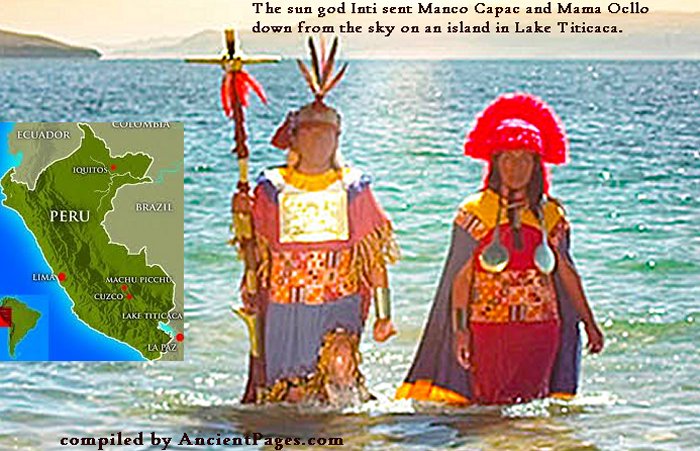
The standard legend of the founding of the Incas has several versions. The most common is that the great god of the sun, Inti, looked at the people who were doing very poorly on earth and decided to help them.
So, he decided to bring order by sending a young Manco Capac and his sister/wife, Mama Ocllo, to Earth and build an empire. The two were sent down from the sky on a sunbeam on an island in Lake Titicaca.
He gave them a magical golden wand to find the perfect place to establish a city capital. The siblings (in some versions of the legend, four brothers and four sisters) began their journey from the sacred Lake Titicaca and reached the area of present-day Cuzco. The wand suddenly plunged into the ground, showing them the ‘chosen land’—the Inca Empire or Tahuantinsuyu (in Quechua: “Realm of the Four Parts”).
Here, the Inca dynasty foundation began to prosper, and several other legendary rulers followed Manco Capac. According to historians, it was simply an Inca ruling caste that most probably grew out of the Quechuas (the indigenous people of South America) who cultivated the Cuzco area.
The Incas considered this particular place—the center—known as the "navel of the world" and built their capital there. Over time, the place took the shape of a puma, an animal that symbolized courage and strength for the Incas.
One legend says that she was a daughter of Inti and Mama Killa ('Mother Moon'), who, according to the Inca beliefs, was the third power and goddess of the moon. However, there are many legends about the Inca divinities, so in another legend, Ocllo was the daughter of Viracocha (Wiraqucha) and Mama Qucha.
However, the legends agree that she was the older sister, wife of Manco Capac, and the mother of Sinchi Roco, the second Sapa Inca of the Kingdom of Cusco.
The Inca worshiped Mama Ocllo as a mother and fertility goddess. She was a very beautiful woman with many abilities and wisdom. She taught women different household chores, such as knitting, housekeeping, and cooking.
Both Manco Capac and Mama Ocllo would teach men the rules of civilized life, to cultivate the land, build canals, raise animals, build houses, and revere their creator god, the Sun.
Mama Ocllo undoubtedly had a preeminent place in the Inca's foundational mythology.
In the Inca's beliefs, there were founding mothers and Mama Ocllo was one of them, the others were Mama Huaco, Mama Ipacura, and Mama Raua, but Mama Ocllo was the first and most important divinity. She was also the 'coya', which means the Inca's wife, (also called ‘wife of a Sapa or high noble’). The ‘coya’ also meant a ‘female shaman-priestess of the sixth level of ancestral Andean initiation.’
This status was highly respected among the ancient Inca, giving her a distinguished place in the Incan rituals and worship of the religion.
Updated on September 21, 2024
Written by – A. Sutherland - AncientPages.com Senior Staff Writer,
Copyright © AncientPages.com All rights reserved. This material may not be published, broadcast, rewritten or redistributed in whole or part without the express written permission of AncientPages.com
Expand for referencesReferences:
de Gamboa, Pedro Sarmiento. History of the Incas
Bonnie G. Smith, The Oxford Encyclopedia of Women in World History, Volym 1
More From Ancient Pages
-
 Famous Viking Ragnar Lodbrok – Legendary Fearless Sea-King Of The North
-
 Motilla del Azuer: Impressive And Unusual 3,200-Year-Old Fortress
-
 Mystery Of The Amazing 2,500-Year-Old Underwater Rochelongue Treasure
-
 Three Roman Shipwrecks Discovered Off Tunisian Coast – One Is 2,000-Year-Old
-
 Ancient Wooden Sculpture Unearthed In Peru’s Chan Chan
-
 Lost Ancient Mayan Cities Lagunita And Tamchen Hidden In The Jungle Reveal Their Secrets
-
 Female Demon-Like Spirits That Can Lure Men Into A Deadly Circle Dance
-
 Strange History Of Safety Coffins: From Ancient To Modern Times
-
 Ishtar Gate, The Eighth Gate Of The Inner City Of Babylon
-
 Anartes: Forgotten Celtic Tribe And The Hercynian Forest With Strange Animals
-
 Stone Toilet Of A First Temple Period Luxury Villa Reveals The Jerusalem Elite Suffered From Infectious Disease
-
 Bartolomeo Colleoni: Most Respected Mercenary General Of The 15th Century Italy
-
 Castro People: Intriguing Life Of The Female-Dominated Society In Ancient Iberia
-
 Long-Lost Shipwreck Koning Willem de Tweede Filled With Treasures Discovered By Marine Archaeologists
-
 2,000-Year-Old Roman Road Discovered In Cluj-Napoca, Romania
-
 LIDAR Technology Reveals Lost Bronze Age Forts In Devon
-
 Unique 2,700-Year-Old Seal That Belonged To ‘Governor Of The City’ Of Jerusalem Discovered
-
 Biblical Vineyard Of Naboth Existed And Has Been Found
-
 New Clues Why Neanderthals Visited La Cotte de St Brelade In Jersey 250,000 Years Ago
-
 A Rare 1,500 Year Old Mosaic That Depicts Ancient Streets And Buildings in Egypt – Discovered

