
Ukko: Karelian-Finnish God Of Thunderstorms, Harvest, Patron Of Crops And Cattle
A. Sutherland - AncientPages.com - In Karelian-Finnish mythology, Ukko ('grandfather 'or 'old man') was responsible for weather, lightning, and thunderstorms. He controlled the clouds and the harvest of the year.
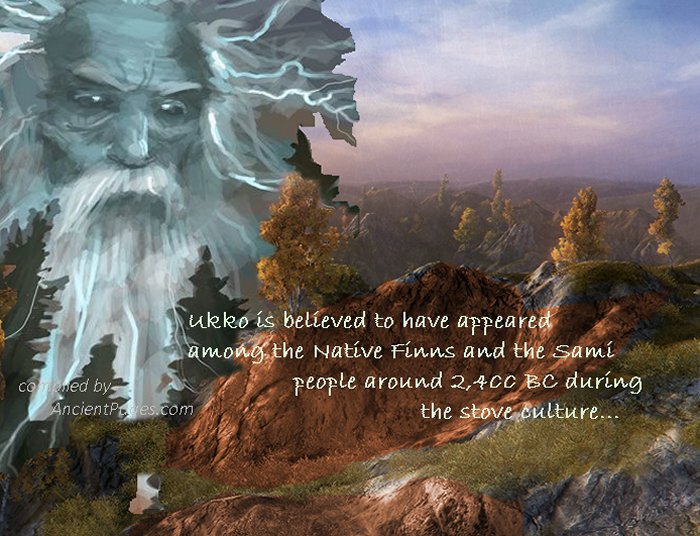
Powerful thunderstorms were heard when the god Ukko drove his chariot through the skies, according to an ancient explanation of this natural phenomenon.
Frost, ice, snow, hail, wind and rain, sunshine, and shadow were believed to come from the hands of Ukko.
Ukko – the "The Pivot of the Heavens" - was often depicted as sitting upon a cloud in the sky's vault and bearing the firmament on his shoulders. As the god of heaven, he was pleased for the harvest to succeed. He was worshiped as the patron saint of crops and cattle.
Ukko created and maintained order in the world, and his act of creation of all things was described in the Finnish epic 'Kalevala':
"Ukko, that supreme Creator, he himself, Ukko, the god of heaven, separated water from heaven, he shared water with land (9: 33-36). "
Ukko Was Known By Many Epithets
In the Finnish epic 'The Kalevala,' Ukko was recognized as "The Leader of the Clouds," "The Shepherd of the Lamb-Clouds," "The God of the Breezes," "The Golden King," "The Silver Ruler of the Air," and "The Father of the Heavens."
The god of thunder has a long tradition in many ancient cultures. Some researchers suggested that Ilmarinen, divine blacksmith, inventor, and sky god, refers to the origin of Ukko because, in some legends, Ukko is the creator and blacksmith. Also, Ukko has counterparts in prominent deities described in Indo-European mythologies, including the Baltic god of thunder, Perkunas, the Norse god Thor, the Slavic god of heaven, and lightning, Perun, and Ukko's closest counterpart in Greek mythology, Zeus.
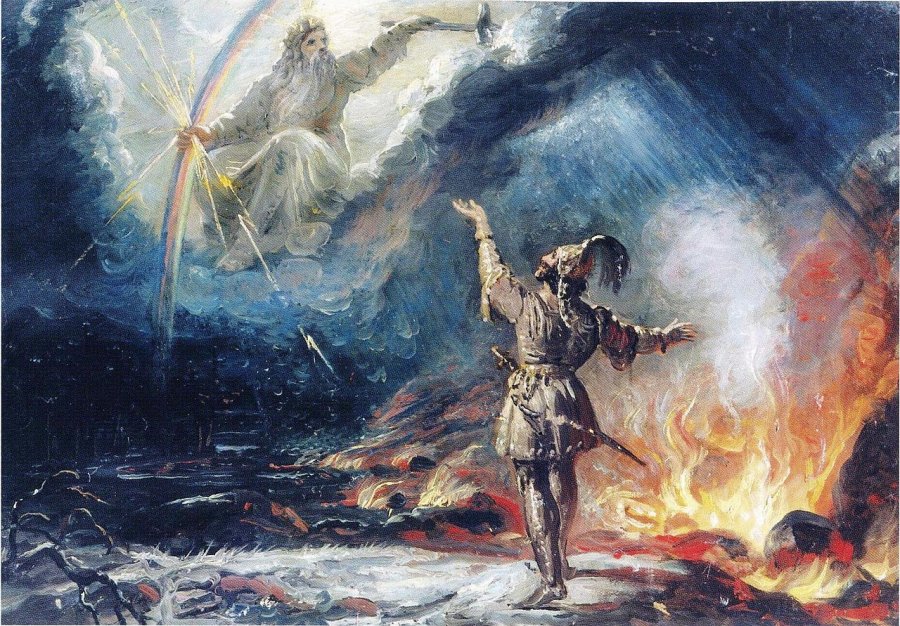 Painting by Robert Ekman in 1867 called Lemminkäinen asks help from Ukko ylijumala with crossing the lake in fire on his route to the wedding at Pohjola. Public Domain
During the stove culture, a strong belief in the Karelian-Finnish god Ukko appeared among the Native Finns and the Sami people around 2,400 BC.
Ukko's Powerful Divine Weapons
According to legends, Ukko presented himself as a broad-axed, older man with a gray beard and white hair, dressed in a blue dress, riding a chariot along the heavenly stone road.
His main attributes were lightning, an ax, a magical hammer ('Ukonvasara' or 'hammer of Ukko'), and a flaming sword, which produced powerful lightning when hitting the ground.
He also had a fiery bow and fire arrows, and by using his tremendous powers, the great Ukko could strike evil spirits in the mountains that could only hide from his attacks in the water.
Numerous abandoned stone weapons were found in Karelia, Finland, at the beginning of the Copper Age. Then, local shamans collected and protected them for many years. These stone artifacts possessed certain heavenly powers to perform cures and heal diseases. The Finnish people called flint 'Ukonkivi' ("Ukkos sten"), or the firestone of the god Ukko" (Ukon pii), and as tradition has it, Ukko carved lightning from it.
Limited Knowledge About Ukko Comes From Poems And Songs
Information about the gods in Finnish mythology has been passed orally through poems and songs. The god Ukko was considered a demon among Christians in the Finnish regions since ceremonies and cults were related to Satan.
In ancient beliefs, the gods were not only good or bad, but forces of good and evil often accompanied them.
In his account of the Bible Book of Psalms from 1551, Mikael Agricola (1510–1555), the 16th century Lutheran bishop and reformer, described the pantheon of gods worshiped by the Finnish people in ancient times. He mentioned the sacred marriage of Ukko and his wife, Rauni. It was believed that when Rauni swears, god begins to get angry, and thunder rumbles just before people saw the flashes of lightning. Finally, the blessed rainfalls provide a harvest.
However, Agricola was a churchman, and the purpose of this description was to criticize and root out pagan customs firmly and not to continue the tradition of old deities.
Juhannus - Midsummer Holiday
Initially, it was a pagan celebration known as Ukon juhla, the celebration of Ukko, the most important god in Finnish mythology. Tradition has it that people place birch bunches of a birch on either side of the front door of their cabins or even on their boats to welcome visitors. In Finland, people still observe the Ukon juhla festival. When Finland became a Christian country, the Pagan festival was officially renamed "Juhannus," held in honor of John the Baptist. During the festival, it's a tradition to large lit bonfires by lakes and the sea.
On June 21, many people worldwide (especially the northern Europeans) celebrate the summer solstice, the so-called Midsummer. The celebrations take place on the day between June 19 and June 25 and the preceding evening. The exact dates vary among different cultures.
Written by – A. Sutherland - AncientPages.com Senior Staff Writer
updated on June 30, 2021
Copyright © AncientPages.com All rights reserved. This material may not be published, broadcast, rewritten or redistributed in whole or part without the express written permission of AncientPages.com
Expand for referencesMore From Ancient Pages
-
 Mystery Of The Ancient Bear Bones In The Aleutian Islands, Alaska
-
 Rare Well-Preserved 2,500-Year-Old Dagger Linked To The Keeladi Civilization Discovered In Tamil Nadu, India
-
 7,000-Year-Old Ibex Remains Found Under The Ice In Italy Are 1,700 Years Older Than Ötzi!
-
 Thermopolium – Ancient Roman Restaurant Offered Fast Food But Was It A Good Idea To Eat There?
-
 Goddess Hestia Who Needed No Temples Or Altars But Whose ‘Eternal Fire’ Was Never Allowed To Fade
-
 A Sensational Bronze Age Grave Of 20-Year-Old Elite Woman Found In Town Of Mány, Hungary
-
 Viking House The Size Of Two Tennis Courts Discovered In Norway
-
 Mystery Of The 2,000-Year-Old ‘Urn Burial’ Ceremonies: 113 Tombs Discovered Near the Ancient City Of Fudi
-
 Fossilized Million-Year-Old Human Skull Of Yunxian Man Excavated In China
-
 Mystery Of The Ancient Talayot Sword
-
 Ancient Icelandic Drinking Horn Reveals An Interesting Story About Saint-King Olaf
-
 The Golden Apple Myth And Norse Goddess Idun
-
 On This Day In History: The ‘Canterbury Tales’ Read For The First Time At Richard II’s Court – On Apr 17, 1397
-
 How The Handbook ‘Hammer Of Witches’ And Then-Existing Networks Inspired Europe’s Witch Craze
-
 Enigmatic Cernunnos – Most Ancient, Stag-Antlered, Peaceful God Of Celtic People
-
 Ancient Astronomical Structure Predating The Solar Observatory Of Chankillo Discovered In Peru
-
 On This Day In History: Aztec Calendar Stone Rediscovered – On Dec 17, 1790
-
 On This Day In History: Leon Trotsky Was Assassinated – On August 20, 1940
-
 Prehistoric Puzzle: Three Gigantic Stone Heads Of Unknown Origin
-
 Medieval Ship Discovered Off The West Coast Of Sweden May Have Been Attacked By Pirates

