
Enigmatic Nok Culture: A Sub-Saharan Archaeological Puzzle
A. Sutherland - AncientPages.com - Some 2,500 years ago, a mysterious Nok Culture emerged in Nigeria. It was discovered in 1928, due to tin mining that was happening in the area.

Nok culture in Nigeria
This society 'without writing' - known for their extremely advanced social system - were the earliest producers of life-sized terracotta figures in the Sub-Sahara and iron in smelting furnaces.
The Nok Culture Created Bizarre Terracotta Statues
Mysterious Nok people had many talented sculptors. They left behind bizarre terracotta statues along with broken pots, other storage vessels, a clay lizard and fragments of clay faces with triangular eyes, immense nostrils.
A terracotta head - evidence of the oldest known figurative sculpture south of the Sahara - was unearthed of the first time in 1943, during tin mining in the vicinity of the village of Nok near the Jos Plateau region of Nigeria. Later, similar heads, figures, animals, and pottery shards have been found in a number of Nigerian sites.
A lack of extensive archaeological study significantly limited our understanding of Nok terracottas. One of the earliest African centers of ironworking and terracotta figure production, the Nok culture remains an enigma.
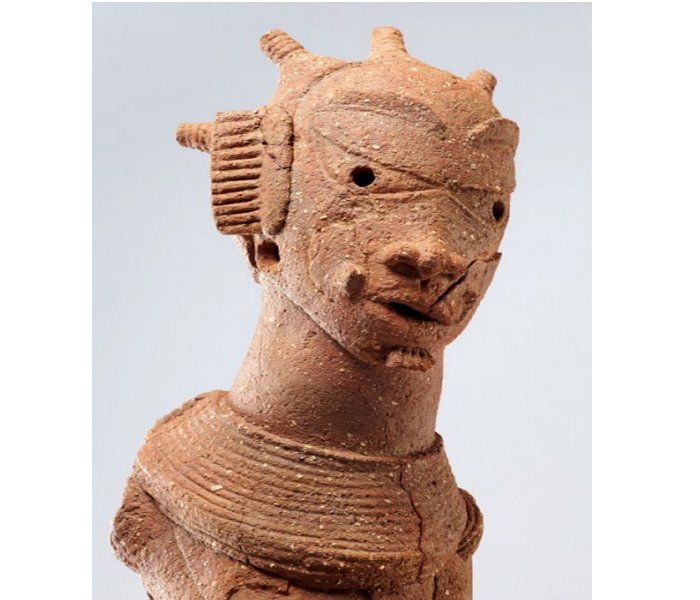
A terracotta piece unearthed from the Daji Gwana site in 2010. It is one of the most complete figures found by the archaeologists of the Goethe University and adorns the cover of the catalog for the exhibition at the Liebieghaus in Frankfurt. Copyright: Peter Breunig
The culture's ancient sites have been regularly researched since 2005, but the study of the Nok Culture has been disturbed by the political situation in the country.
People that had been living a Stone Age-like nomadic existence suddenly settled. Around 500 BC the population of this culture increased, and people who had long lived as nomads during the Stone Age decided to settle.
In their excavations, archaeologists excavated finds such as pottery, stone tools, iron objects, and plant remains, the evaluation of which will provide a comprehensive picture of the Nok Culture.
There are no skeletons preserved in the earth since the acidic soil dissolved all bones. Like their cemeteries, the temples and huts of the Nok have disappeared without a trace. No one knows what their farm animals, streets or religious ceremonies were like. However, archaeological excavations revealed shards of enigmatic, over 2000-year-old clay statues. They were found on rocky slopes, in ancient refuse pits, and in open spaces.
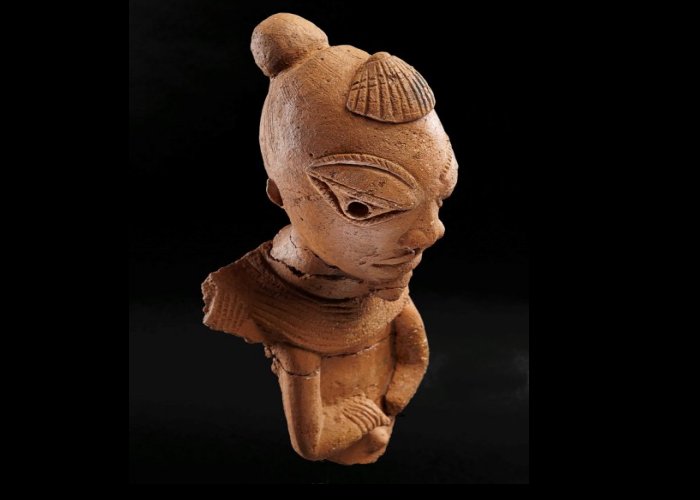
A small terracotta figure of a man, decorated on the forehead with relief in the form of a seashell. Discovered in 2012 at the Pangwari site. Copyright: Peter Breunig
The largest of these impressive figures can stand up to one meter (3.3 feet) tall and resemble what might be kings or members of a social elite. Others wear horned helmets or carved-out gourds on their heads. A third of these figures are women.
Most Nok sculptures are hollow and coil-built like pottery. The eyes are triangular, the pupils are pierced, and the eyebrows are high and arched. Lightning-shaped tattoos adorn their cheeks. The clay figures are uniform, almost as if they had been mass-produced.
The artists sculpted clay bodies in standing, sitting, and genuflecting postures and the Nok head fragments were once part of entire bodies. The heads of Nok terracottas are invariably proportionally large relative to the bodies. The head was widely highlighted in the beliefs and traditions of many African people. One group represents the Yoruba of western Nigeria and the best example is terracotta head from Ife, the so-called Ife Head.
In their beliefs, the Yoruba regard the head (“ori”) as the seat of the divine power of the Supreme Being. In a person’s life, the head is the life source and a vital instrument controlling destiny and personality. The Yoruba people particularly highlighted the head like the crown of the body and the place where the soul dwells.
It is a human head that decides about one’s identity, communication, and perception.

Pangwari site - the terracotta figure. Copyright: Peter Breunig
The Nok Culture, with its enigmatic use of the innumerable terracotta figures, represents a promising example of this development. For example, the ceramic vessels, which differ in form and decoration, allow us to identify developmental stages, which form a basis for the chronology of the Nok Culture," according to researchers.
One particular portion of the project, led by Prof. Dr. Katharina Neumann, is dedicated to the plant remains that are regularly found in the excavation areas. They provide information about the environment and the economy. It is already apparent that only a small number of crops were used during the Nok Culture.
"From the beginning, millet and a type of bean featured, along with various wild fruits; only after the end of the Nok Culture did oil palm and a grain called "fonio" also appear," explains the archaeobotanist Neumann.
"Under the circumstances, the conservative attitude of the people, as demonstrated by their limited crop spectrum and the standardized production of terracotta sculptures, was a reason for the disappearance of the Nok Culture after 300 BC."
Obscure Nok Culture - Who Were The Artists
No sub-Saharan people made anything comparable at the time, according to researchers.
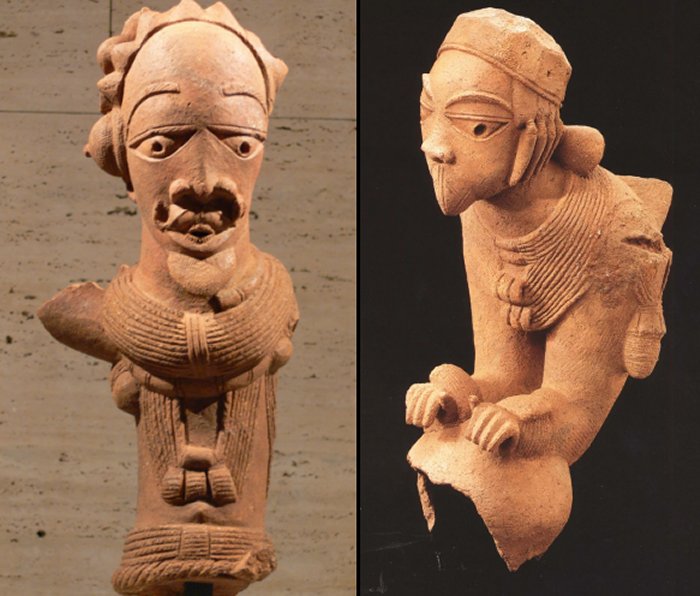
Left: Nok Culture. source; Right: Sculpture of a half-bird half-man figure from the Nok culture (present-day Nigeria). 500 BC to 200 AD. source
The German researchers, which include geologists and paleoethnobotanists, have now used state-of-the-art analytical devices to examine this area. They use X-ray fluorescence devices, for example, to detect shattered bones, and their infrared cameras should make the remnants of buildings visible. In their initial findings, they have learned that the Nok inhabited the tropical region the Nigerian highlands of Jos, spanning more than 80,000 square kilometers (31,000 square miles).
Nigeria's political situation has halted the excavations near the Nigerian highlands of Jos, where the obscure Nok culture once flourished. They lived on cowpeas, millet and an olive-like fruit.
Particularly interesting is to learn how Nok people smelted iron. Excavations revealed arrowheads, knives, and iron bracelets. More research is needed to find more clues to explain this obscure culture, whose artists and craftsmen, for now, remain unknown.
Written by – A. Sutherland AncientPages.com Staff Writer
Copyright © AncientPages.com All rights reserved. This material may not be published, broadcast, rewritten or redistributed in whole or part without the express written permission of AncientPages.com
Expand for referencesReferences:
Fagg, B. E. B. "THE NOK CULTURE IN PREHISTORY." Journal of the Historical Society of Nigeria 1, no. 4 (1959): 288-93.
More From Ancient Pages
-
 Mysterious Chultuns – Ancient Underground Chambers Built By The Maya – But For What Purpose?
-
 Tlayococ Cave’s Hidden Chamber Filled With Rare Pre-Hispanic Artifacts Left By The Extinct Tlacotepehua People
-
 Hathor – One Of Ancient Egypt’s Greatest Female Deities
-
 Unearthing Anatolia’s Ancient City Of Lystra Where History And Faith Converge
-
 Pergamon – One Of ‘Seven Churches Of Asia’ With Great Library And Sophisticated Water Supply System
-
 Nearly 7,000 Years Ago, Dortmund Airport’s Area Was Inhabited By Early Farming Society For Centuries
-
 Mysterious Ancient European Civilization – Puzzling Mysterious Ancient European Civilization – Part 2
-
 Ancient Biblical Manuscript M.910 We Are Afraid To Open May Contain A Surprise
-
 On This Day In History: Copernicus’ s Book Banned By Catholic Church – On Mar 5, 1616
-
 Ancient Pisidia Antiocheia – Excavations In An Important Center Of Early Christianity
-
 Waru Waru – Ancient Andean Irrigation System Brought Back To Life
-
 Why Is The History Of Striped Clothing Dark And Sinister?
-
 Mysterious Ancient Tomb Reveals ‘Impossible’ Cosmic Connection – Wrong Identity – Part 1
-
 Our Lineage’s Species Formation Pattern Was Unlike Anything Else
-
 Amazing Painted Throne Room Of A Powerful Moche Queen And An Unknown Large Structure Discovered In Peru
-
 King Lud – Mysterious Founder Of London And His Connection To The Tuatha De Danann
-
 Ancient Giants In Ecuador Were Killed By Fire From The Sky – Indian Legends Reveal
-
 Humans Lived In The Qal-e Kord Caves 400,000 Years Ago – Oldest Settlement In Iran Found?
-
 Man-Made Square Burial Cave Dated To Rameses II-Era Accidentally Found In Israel
-
 Unusual Ancient Winged Half-Human And Half-Animal Divine Creature With Supernatural Powers

