
Jan Hus: Czech Reformer And Bohemian Religious Leader Was Burned At Stake For Heresy
A. Sutherland - AncientPages.com - Jan Hus (1372 – 1415) was a controversial Czech thinker and reformer in the Roman Catholic Council of Constance (1414–18). He was convicted of heresy and burned at the stake.
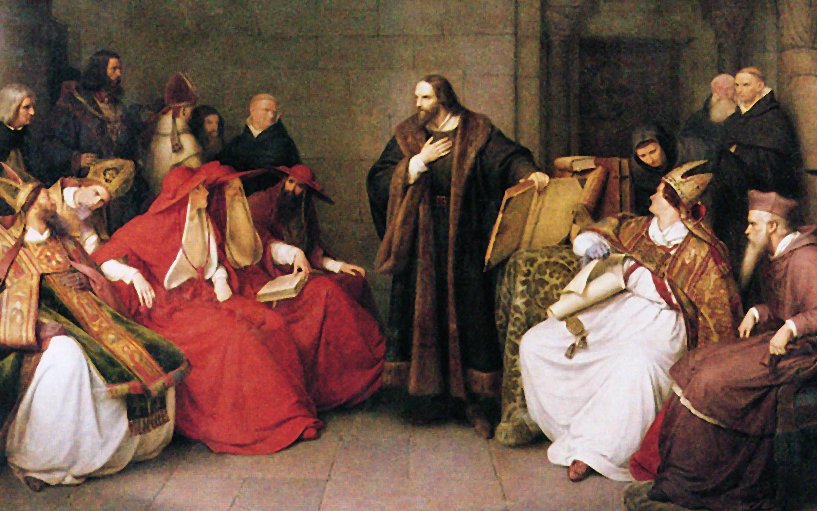 Jan Hus at the Council of Constance, 19th-century painting by Karl Friedrich Lessing. Public Domain
Unfortunately, he was not the only one. The medieval Church struggled violently against rebels who criticized the doctrines of the Catholic Church. This institution controlled the state and the people, regardless of their status.
Jan Hus was among those Christians who – not only theoretically – but openly and publicly disagreed with the Church's teachings. He was a Czech farmer, who studied in Prague, became a master, dean, and finally rector at the University of Prague and the Bethlehem church.
Strongly influenced by the writings of an English scholastic philosopher and thinker, John Wycliffe (c.1329-1384), Hus attacked the world's priesthood and the Church's riches. As his preaching was in the Czech language, it enjoyed great popularity, and he had many listeners and active supporters.
Hus was a brave man who did not hesitate to criticize the Church's different actions and abuses committed by the clergy, especially in granting indulgences.
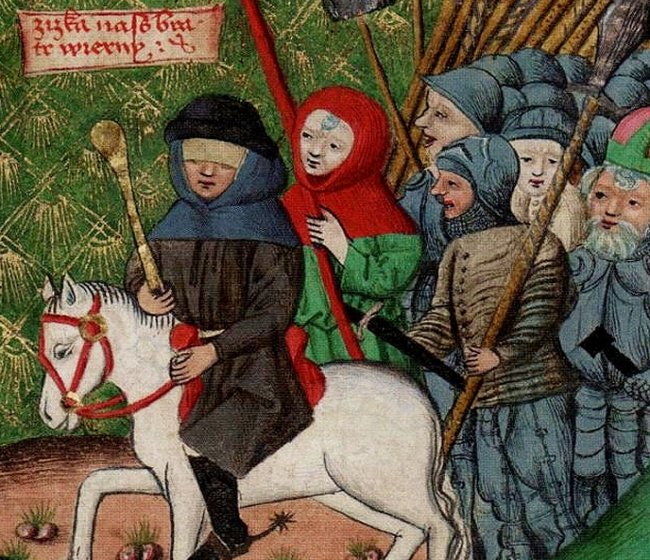 Jan Žižka (c. 1360 – 11 October 1424) - a Czech general, a contemporary and follower of Jan Hus, Hussite military leader, leading troops of Hussites. Janíček Zmilelý / Public Domain
Unlike the vast majority of preachers at the time, Hus was an advocate for women and feminism.
Hus stated that "Women were made in the image of God and should fear no man." He allowed women to preach and serve in battle. Later, since women were allowed to fight, they played a critical role in the Hussite Wars.
When the Council of Constance assembled in 1414, Hus was asked to be there. He was to officially present his religious reform views to church dignitaries at the Council.
Emperor Sigismund of Luxembourg, the spiritual and military leader of several crusades, who reigned from l4l0 to 1437, officially guaranteed Hus' safety at the meeting, or so it seemed. However, Emperor Sigismund was not worthy of Hus' trust. He took part in the capture of the Czech precursor of Protestantism, Jan Hus, which resulted in his being tried and burned at stake.
Immediately after arriving in Constance, Germany, on November 14, 1414, Hus was arrested, and in June 1415, he was brought before the court as a heretic.
According to the Council, John Hus taught, asserted, and preached many errors and heresies of John Wycliffe, which have been condemned.
The prosecutors refused him the right to explain his views, and Hus declined to condemn his thirty theses from the De Ecclesia treatise from 1413, which was considered heretical. Still, some admired his theories.
His teachings were erroneous, others offensive to the ears of the devout, and many of them were seditious. Many of Hus' ideas were considered notoriously heretical and long ago rejected and condemned by the Church. The Council had to forbid them to be preached, taught, or approved.
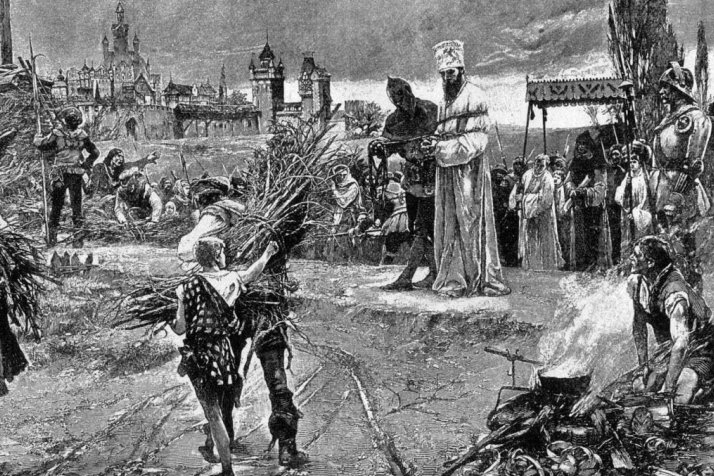 Burning of Jan Hus at the stake at Council of Constance. Carl Gustaf Hellqvist (1851–1890). Public Domain
Therefore, the thinker was deposed and degraded from the order of the priesthood and the other orders he held. The Council voted against him and sentenced him to death at stake.
On July 6, 1415, Hus was burned at the stake for heresy against the doctrines of the Catholic Church. Burning at the stake of Jan Hus was a consequence of Hus' open speech against the Church.
The execution of this brave man sparked anger and revolts and led to the Hussite Wars of 1419–1434. To this day, Hus is considered the national hero of the Czech Republic. When in 1,119 Sigismund I of Luxembourg inherited the Czech crown from his brother, a long and fierce war broke out because the Hussite blamed the emperor for the death of his spiritual leader.
The Hussites were a powerful pre-Protestant Christian movement, and Sigismund I of Luxembourg was forced together with the Church to negotiate with the Hussites. The settlement between the parties concerned was crowned in 1435, in which the Catholic Church officially allowed Bohemia to practice its version of Christianity (Hussitism).
For the first time in history, the Catholic Church caused to coexist in harmony with two faiths on a territory it controlled. Hussitism foreshadowed the European Reformation and became a step forward for religious freedom.
Nearly six centuries later, in 1999, Pope John Paul II expressed "deep regret for the cruel death inflicted" on Hus and added "deep sorrow" for Hus's death and praised his "moral courage."
Written by – A. Sutherland - AncientPages.com Senior Staff Writer
Updated on August 4, 2022
Copyright © AncientPages.com All rights reserved. This material may not be published, broadcast, rewritten or redistributed in whole or part without the express written permission of AncientPages.com
Expand for referencesReferences:
Benazzi N: 1001 faktów z historii Kościoła.
Piskorski J., Polska-Niemcy. Blaski i cienie tysiacletniego sasiedztwa
More From Ancient Pages
-
 Exploring Future Evolution: How Will Humans Change In The Next 10,000 Years?
-
 Ancient Roman Portable Toilets Studied By Scientists
-
 Ancient Greeks Had Great Understanding Of Weather And Climate
-
 Incredible Ancient Star Map Depicting Our Galaxy Is Hidden In Africa
-
 Britain’s Long-Distance Tin Trade Was A Game-Changer For The Bronze Age
-
 Florida’s Ancient Underwater Burial Site Much Older Than Previously Thought
-
 Fascinating Geghard Monastery: Rock-Cut Secret Caves, Passages And Hundreds Of Monk Cells
-
 Scientists Use Ancient DNA To Explore Early European Adaptation
-
 Marriage And Divorce In Ancient Egypt Were Different But Uncomplicated
-
 New Attempt To Solve The Easter Island Mystery – What Did Rapa Nui Look Like Before Europeans Arrived?
-
 Mysterious Lost Kingdom Of Urartu And Its Enigmatic History
-
 Mystery Of The Gotland Grooves – Ancient Astronomical Observatory?
-
 Australia’s First Marine Aboriginal Archaeological Site Questioned
-
 Lady Justice (Justitia): Legal And Philosophical Concept Produced In Remote Antiquity
-
 Ancient Mystery Of The Strange, Small Underground Being Who Secretly Emptied Casks
-
 New Evidence: Earliest Known Battle Fought By Julius Caesar On Dutch Soil
-
 Easter Island’s Statues Reveal Bodies Covered With Unknown Ancient Petroglyphs
-
 On This Day In History: The Battle Of Benevento Was Fought – On February 26, 1266
-
 6,000-Year-Old Submerged Settlement Shows Black Sea Level Was Lower 5,000 Years Ago – ‘Black Sea Deluge’ Theory?
-
 On This Day In History: Astronomer John Couch Adams And The Discovery Of Planet Neptune – On July 3, 1841

