
Aglaonice (Aganice): Female Greek Astronomer From Thessaly Was Believed To Be A Witch
A. Sutherland - AncientPages.com - In ancient sources, Aglaonice (also Aganice) is mentioned as the first Greek female astronomer of the 2nd or 1st century BC and natural philosopher.
Very little is known about her, but it is confirmed that she gained fame because of her ability to predict lunar eclipses, probably, through observations.
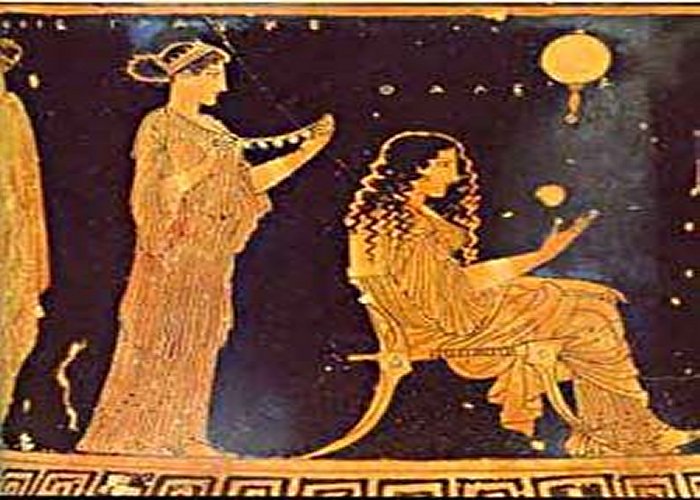
According to Plutarch, Aglaonice made attempts to predict future events by the aid of celestial globes, and by the study of the constellations. Image source
The young woman was a Thessalian stargazer, intensely fascinated with the sky. Aglaonice’ s astronomical knowledge most probably dated back to early Egyptian and Babylonian times, when the stargazing, actively performed in both Egypt and the plains of Chaldea contributed with significant discoveries regarding the laws and movements of celestial bodies.
According to Plutarch (46–after 119 AD), she made attempts to predict future events by the aid of celestial globes, and by the study of the constellations. If so, Aglaonice was somewhat more competent in astrology rather than astronomy as we know it today.
Aglaonice was considered to be Greek and the daughter of king Hegetoris of Thessaly, an isolated region in the vicinity of the Olympus Mountain.
She was contemporary of Eratosthenes of Cyrene (276 BC – c. 195/194 BC) best known for being the first person to calculate the circumference of the Earth. She learned the regularities of the eclipse cycle, but for contemporary people who feared the unknown, such skills attested to the woman’s supernatural abilities.
However, the ability to forecast a lunar eclipse would be possible for anyone who was familiar with the periods of the full moon and the cycles of eclipses (the so-called ‘Metonic cycle’).
Babylonian astronomers were able to predict lunar eclipses and - later – accurate solar eclipses. Their tool was the Saros-cycle - a period of precisely 18 years and 11.3 days after which lunar and solar eclipses repeat themselves. This cycle was also known to Aglaonice.
She is mentioned in the writings of Plutarch, and Apollonius of Rhodes Rhodes (third century BC) as a female astronomer and the daughter of Hegetor (or Hegemon) of Thessaly.
Female Astronomer Was Believed To Be A Witch
She lived among the people who regarded her as a sorceress for her ability to make the moon disappear from the sky, but she ignored them all.
Ancient people did not understand how she could know the time and general area where a lunar eclipse would take place. Several young women who were believed to be sorcerers were associated with Aglaonice. They were known as the "witches of Thessaly" and were also active from the 3rd to 1st centuries BC.
See also:
Paracelsus: Physician, Alchemist, Philosopher Well Ahead Of His Time
Socrates: Great Philosopher And Brave Man Who Still Inspires Many People
Plutarch (46 Ad – 119 AD), Greek biographer and essayist, said once that she possessed knowledge of astronomy and astronomical computation. She was also familiar with the periods of the Full Moon and was able to foretell the exact time and place of lunar eclipses.
Plutarch was not among those who were impressed with Aglaonike’s astronomical skills. She was a dangerous woman because she could persuade other Thessalian women about her unique abilities.
According to him, she was a “witch” who intentionally wanted to deceive women around her because they had no astronomical training. A similar opinion about Aglaonike also had Plato (Gorgias 513), Horace (Epodes 5.45), and Virgil (Eclogues 8.69) and they all called the women of Thessaly - “Thessalian enchantresses,” equipped with magic powers, and with them, these witches were able to manipulate the moon and the sun, and make them disappear.
According to Sosiphanes, tragic poet of the 4th century BC, “every Thessalian maiden with magic songs [is] a false bringer-down of the moon from the sky…”
The ‘procedure’ was called the ‘Thessalian Trick.’
Written by - A. Sutherland - AncientPages.com Senior Staff Writer
Copyright © AncientPages.com All rights reserved. This material may not be published, broadcast, rewritten or redistributed in whole or part without the express written permission of AncientPages.com
Expand for referencesReferences:
Thorburn John E. The Facts on File Companion to Classical Drama
Eileen M. Byrne, Women In Science
Stories of Women Stargazers
http://buhlplanetarium2.tripod.com/bio/heveliuse/Stories_of_Women_Stargazers.pdf
More From Ancient Pages
-
 Climate Played A Crucial Role In Human Migration From Africa – New Study
-
 First Bathrooms Appeared Around 8,000 B.C In Scotland
-
 Castlerigg Stone Circle: One Of Britain’s Most Important And Earliest Stone Circles
-
 Hundreds Of Highly Unusual Burial Gifts Found In Special Viking Chamber Belonging To Woman In Norway
-
 How Did These Five Common Words Enter The English Language?
-
 Rare 3,000-Year-Old Jerubbaal Inscription Of Biblical Judge Discovered In Israel
-
 Three 17th Century Shipwrecks Discovered In Central Gothenburg, Sweden
-
 Byzantine Greek Inscription Of Psalms 86 Found In Hyrcania
-
 Ancient World’s Second Largest Library Of Codices, Manuscripts Reopened In Sinai
-
 Frigg: Chief Norse Goddess Who Knew Secrets Of Humans’ Fates
-
 Why Was The Face Of Mysterious Ust-Taseyevsky Stone Idol Suddenly Changed?
-
 Groundbreaking Study: First Known Case Of Down Syndrome In Neanderthals – Investigated
-
 World’s Oldest Burial Site Reveals Homo Naledi Buried Their Dead 100,000 Years Before Humans
-
 Trident: Powerful Religious Symbol Found In Many Ancient Cultures
-
 Humans Have Been In The Arctic For Over 40,000 Years – New Discoveries Reveal
-
 Judahite Shrine Of Biblical Arad Reveals Ancient Use Of Cannabis And Frankincense
-
 4,500-Year-Old Row Of Giant Monoliths Found – Could Be the Largest In Britain
-
 Civita di Bagnoregio – Magnificent 2,500-Year-Old Etruscan City In The Sky Is Struggling To Survive
-
 War God Ares Was Brutal, Merciless And Disliked By Greeks But Popular In His Love Affairs
-
 Can Pollen Analysis Solve The Ice Age Mystery How And When Homo Sapiens Migrated Across Europe And Asia?

