
AncientPages.com - The naming process, the act of naming the items of the world, is as old as the first words spoken by our ancestors. We can reconstruct the stages of this process through etymology, which studies the historical development of the lexicon of a language.
English words tell a lot of stories. To get back to their origins, linguists apply the comparative method. Languages are not isolated entities, but belong to linguistic families – English is a west Germanic language from the Indo-European family, for example – and their vocabularies are connected.
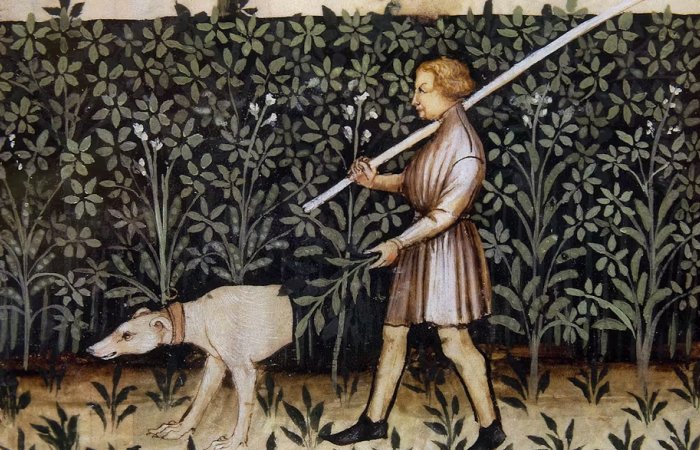
Detail from Tacuinum Sanitatis, a 14th-century handbook of medieval health.
In the comparative method, linguists compare cognates (the same words in different-but-related languages, like mother in English, māter in Latin, and mutter in German) and reconstruct the ways these words were pronounced by ancient speakers.
By doing this, linguists give a voice to our ancestors, travelling back in time towards prehistoric ages with no written records. It’s difficult and complex, but very cool stuff.
However, the process doesn’t always work. The English lexicon includes some terms known as “proper words”, which today apparently exist only in English. Cognates for them cannot be found in any other language.
These are very simple and common words but being unique, we cannot apply the comparative method to them and therefore cannot reconstruct their origins. These “proper words” represent an exciting puzzle of the English language. Here are five examples.
1. Bird
“Bird” sounds Germanic, but doesn’t have cognates in any other Germanic language. It can be found in Old English as a rare variant of bridd, indicating a “young bird”.
Old English speakers used fugel, as in “fowl”, as a standard term for bird. Up to the 15th century, “bird” was used not only to describe a young bird, but also a young animal in general – even a fish or a child.
2. Boy
Who (or what) was, originally, a “boy”? No one knows. In the 13th century, a boie was a servant, but already in that time the provenance of the word was obscure. A century later, the term started being used to indicate a male child. The word doesn’t sound Germanic, but it’s not clear whether it was imported to England by the Normans either.
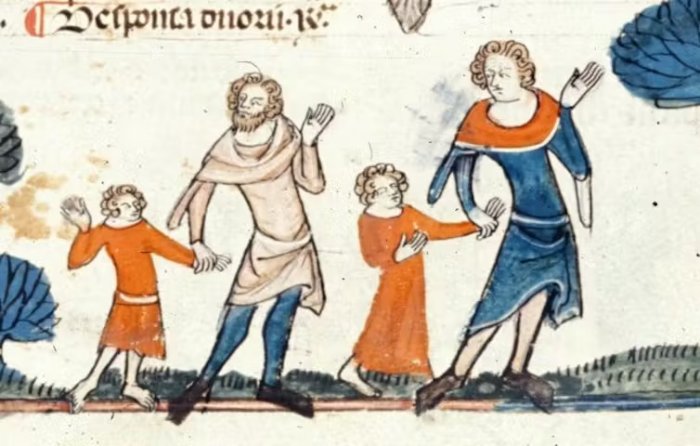
We don’t know the origins of ‘boy’ or ‘girl’. Royal MS 10 E IV f.311v / The British Library
One interpretation traces back the term to an unattested vulgar Latin verb, *imboiare (in etymological notation, the asterisk indicates a word that has been reconstructed on the basis of the comparative method, rather than found in source material), possibly connected with the Latin boia, meaning yoke or collar, and with the concept of slavery.
3. Girl
Since the 14th century, gyrle was a word used to indicate a child, with no gender distinction. Despite the apparent simplicity of the term, so far nobody has been able to reconstruct its origins. Some scholars have connected it with the Old English word gierela, meaning garment, with a semantic transition presumed from “child’s apron (garment)” to, simply, “child”.
Others think that “girl” belongs to a set of words that also includes “boy”, “lass” and “lad”, which could have derived from other terms that cannot be directly linked to them any more. Whatever the truth is, the mystery of “girl” persists.
4. Dog
“Dog” comes from Old English docga, a very rare word later used in Middle English to depict a specific, strong breed – the mastiff.
In Old English, hund was the general Germanic word until the term docga replaced it almost completely in the 16th century. Now, “hound” is semantically specialised and indicates a hunting dog. So far, nobody has been able to reconstruct the etymological root of docga, and no ancient English word appears to be related to it.
“Dog” is therefore a true lexicological mystery of the English vocabulary. Probably the breed it was originally indicating became popular enough to be identified with the notion of “dog” in itself, but this doesn’t explain the provenance of the word.
The same puzzling origins are shared by other zoological terms in the English lexicon, like “pig, "stag” and “hog”, which are all etymologically unclear. Interestingly, the widespread word for “dog” in Spanish, perro, is also completely obscure in its origins.
5. Recorder
“Recorder” is something of an intruder in this list of etymological oddities, because we know its origins. It comes from the Middle French verb “recorder”, which meant to relate, repeat or recall, which in turn comes from the Latin recordārī.
However, the recorder I am referring to is not the device used to record but the “straight flute”, a musical instrument. Despite its very recognisable origins, no one knows why in English, the “straight flute” – flauto dolce, in Italian, flûte à bec in French, and blockflöte in German – is called a “recorder”. It certainly doesn’t record anything.
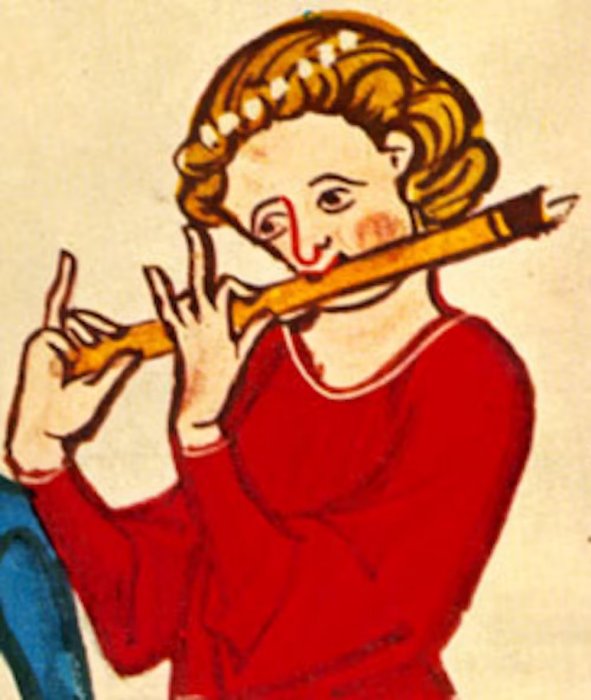
A Spanish medieval flute (early 14th century). Manessische Liederhandschrift 848, fol. 423v.
Historical sources have been confused since its first attestations. The earliest appearance of the word is from 1388, in a list (in Latin) of musical instruments owned by the future King Henry IV. There, it’s documented as “i. fistula nomine Recordour” (“a pipe called Recordour”). This makes it look like a proper noun, with the initial character capitalised. In 15th-century England, the word “recordour”, with a lowercase initial, meant a chief legal officer of a city.
There are some theories. The sound of the recorder was compared with that produced by birds’ songs, which are repetitive and, therefore, would develop a “recording” loop – but that feels far-fetched.
In the past, I have worked on the etymologies of the words “ocarina” and “gemshorn”, and my focus is now on “recorder”. The reconstruction of the origin stories of these “proper words” could tell us a lot about our ancestors, their mindsets, and their cognitive strategies in naming what was surrounding them.
Provided by The Conversation
This article is republished from The Conversation under a Creative Commons license. Read the original article.