
Vishnu: Supreme, Universal Hindu God Whose Avatars Reach Nations, Cultures And Races
A. Sutherland - AncientPages.com -In Hindu beliefs, the three gods Brahma, Shiva, and Vishnu, are worshiped as the Great Trinity (Trimurti). They are all generally equal in their power and influence. They represent three aspects: creation, preservation, and destruction.

Vishnu seated on Ananta, facing West (direction of the waters). Second porch. Shrine excavated. Cave 3, Badami, Karnataka. End of the 6th century. Image credit: Ismoon - CC BY-SA 4.0
Observing the Hindu Trimurti, we see Brahma, the creator, looking to the left; Vishnu, the preserver, looks straight ahead, while Shiva, the destroyer, looks to the right.
Vishnu Chief God In Hinduism
The Hindu trinity symbolizes perfection, where Brahma is associated with strength and power; Shiva wins the war thanks to his brutality and impetuous, ruthless character, and Vishnu is a loving God with a special place in the hearts of his believers.
The Hindu god Vishnu is the pervader ("one who is everything and inside everything"), protector, and preserver as he is connected to sacred nature. The mountains are his bones, the clouds hair on his head, the air his breath, the rivers his blood vessels, and the trees are the hairs of his body. We must not forget his eyes represent the sun and the moon, respectively, where the movements of the eyelids symbolize the transition between day and night.
Vishnu is usually depicted with light blue skin and four arms. He is the beautiful guardian of life, light, fire, and water. In four hands, he holds his attributes: a lotus (the symbol of purity and creativity), a club, which symbolizes time. A wheel is a symbol of the cycle of existence, and a conch (shankha), represents a source of all things.
 Kalki Avatar (Image courtesy of Late Sri G. K. Haldipurkar and Aniruddha Haldipurkar, Karwar.) Image credit: Raja Ravi Varma - Public Domain
Vishnu usually wears a pitambara, a unique garment of gold that symbolizes the Vedas; it is said that the divine light of Vishnu shines through his beautiful garment in the same way as the light of truth radiates through the holy words.
He rides on the eagle Garuda, a heavenly bird with four arms and multi-colored wings, and usually rests, floating on Ananta, on the snake Ananta ("Endless" or "infinity") on the primeval waters. Lord Vishnu is often accompanied by his consort, Lakshmi, the Hindu goddess of fortune and the manifestation of Vishnu's energy.
On the forehead, Vishnu has a mark that looks like a U. There are millions of people who worship Vishnu. Those who do so often have the same brand on their foreheads. The mark is drawn there with ash or color.
As the supreme god, he appears in one of his incarnations when his presence is needed.
Ten Incarnations Of Vishnu
Traditionally, Vishnu appears in ten different divine figures (avatars). He takes many various forms to restore cosmic order and eradicate evil. Nine avatars have already come, and the tenth will announce the world's end.
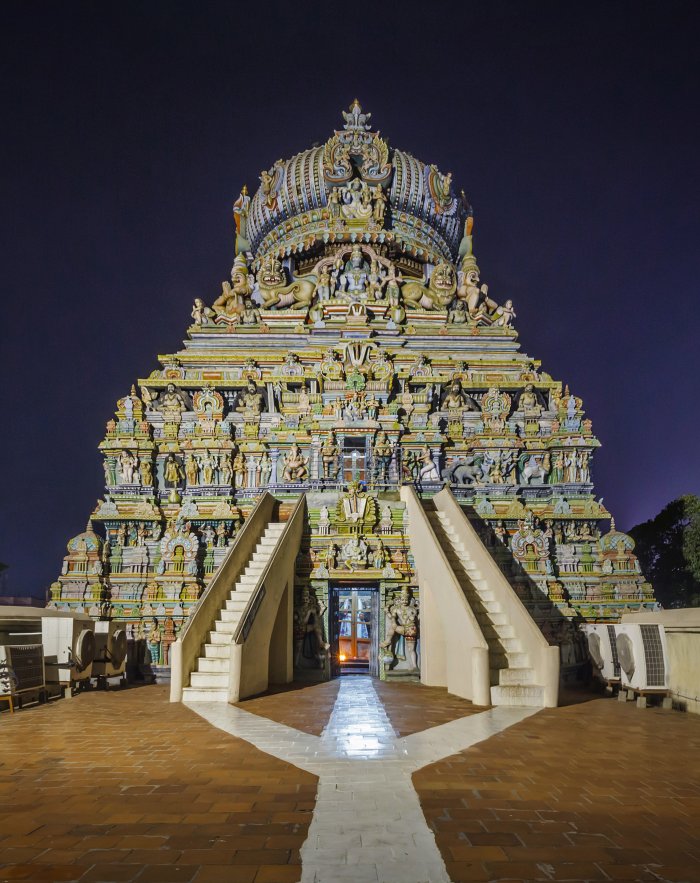
Koodal Azhagar Temple in Tamil Nadu dedicated to Lord Vishnu. Credit: Adobe Stock - Konstantin
His first avatar was the great horned fish Matsya who saved Manu, the first human, from the Great Flood. In his second avatar, he is Kurma (a tortoise) who helps the gods and demons to support the churning of the ocean and recover Amrita, the potion of immortality.
Then, in the third one, Vishnu acts like a wild boar Varaha to kill the demon Hiranyaksha ("Golden Eye"). As legend has it, Varaha is extremely dangerous with a cry louder than god Indra's thunder, and its eyes are brighter than lightning. Shining like the sun, Varaha swims deep down to the seabed to kill Hiranyaksha, and thus he rescues the Earth that once more can float on the surface.
As Narasimha (half-lion half-man) in the fourth incarnation, Vishnu has to destroy Hiranyakasipa, another demon and brother of Hiranyaksha, who also put the planet in danger. Hiranyakasipa knew he was immortal, and no god, animal, or human could kill him. In the fifth reincarnation, Vishnu is Vamana, the dwarf that must act quickly.
His enemy is king Bali, who has already overpowered the three worlds and banished the gods from heaven. Bali offers Vamana as much land as he could cross in three paces. Vamana changes his size and becomes the giant, Trivikrama, so gigantic that he takes Bali's entire kingdom and pushes it down into the underworld.
Vishnu also came as Parashurama (Ram with an ax), then Rama, the hero of the Hindu epic, the Ramayana, and as Krishna, known from the epic, the Mahabharata and other texts. At the same time, the second last Vishnu avatar is Buddha. His tenth incarnation is yet to come, and Vishnu will appear at the end of time in human form, riding on a white horse (in South India, Kalki is depicted as a horse). According to some, the world will be destroyed before a new creation. Others say this idea is based on the Maitreya Buddha doctrine.
In the Mahabharata, Kalki restores the moral order of people on Earth; he judges men and women, punishes evil, and rewards the good.
However, they will still appear on Earth in successive periods, as they are associated with different stages of human evolution on our planet.
Updated on August 4, 2022
Written by – A. Sutherland - AncientPages.com Senior Staff Writer
Copyright © AncientPages.com All rights reserved. This material may not be published, broadcast, rewritten or redistributed in whole or part without the express written permission of AncientPages.com
Expand for referencesReferences:
Jansen E.R. Book of Hindu Imagery
Swami Harshananda, Hindu Gods and Goddesses
More From Ancient Pages
-
 Arslantepe Mound – Home To The Oldest City-State Of Anatolia
-
 The Great Stupa At Sanchi – Oldest Stone Structure In India
-
 Ancient Grammatical Puzzle Solved After 2,500 Years
-
 Source Of Ancient Roman Silver Was The Iberian Peninsula
-
 First Roman Military Amphitheater Unearthed Near Megiddo
-
 Scotland’s Oldest Tartan On Display For The First Time!
-
 Unique Statue Of Roman Emperor Trajan Unearthed In Ancient City Of Laodicea,Turkey
-
 What Happened To Britain’s Economy After The Romans Left?
-
 Paleoindian Ochre Mine Found In Submerged Caves In Mexico’s Yucatan Peninsula
-
 Mysterious 11,000 – Year-Old Tower Of Jericho: Was World’s First Skycraper A Symbol Of Power Or An Ancient Time-Keeping Device?
-
 Viking Site L’Anse Aux Meadows Confirms Norse Vinland Sagas Were Based On Real Events
-
 Yayoi People (Korea) Interbred With Jomon People (Japan) Giving Birth To Ancestral Group Of Modern Japanese People
-
 X-Ray Of Skulls Reveals Vikings Suffered From Several Diseases
-
 Kukulkan (Quetzalcoatl): Feathered Serpent And Mighty Snake God
-
 Ancient Coffin Of Priest Psamtik, Son Of Osiris And Five Replicas Of Goddess Maat Sent On Upcoming Expo
-
 Native Americans’ Visions Of Distant Explorers May Unravel Some Ancient Mysteries Of North America – The Arrival – Part 1
-
 Nasca Lines: Researchers Identify 16 Bird Geoglyphs Drawn On Desert Plains Of Peru
-
 Mysterious Water Indians: Brotherhood Of Semi-Divine Beings Described As Half Men And Half Fish
-
 Small Figurine Reveals How A Viking’s Hair And Beard May Have Looked
-
 Prehistoric Dispilio: Accurately Dating Ancient Site To 5259 BC Using Cosmic Rays


