
Sacred Bird Garuda And Stealing Of Amrita Drink Of Immortality From The Gods
A. Sutherland - AncientPages.com - The holy bird Garuda is one of the most interesting figures in the Hindu pantheon. Garuda (not a god himself) is half-man, half-bird, and the enemy of the serpents (Nagas).
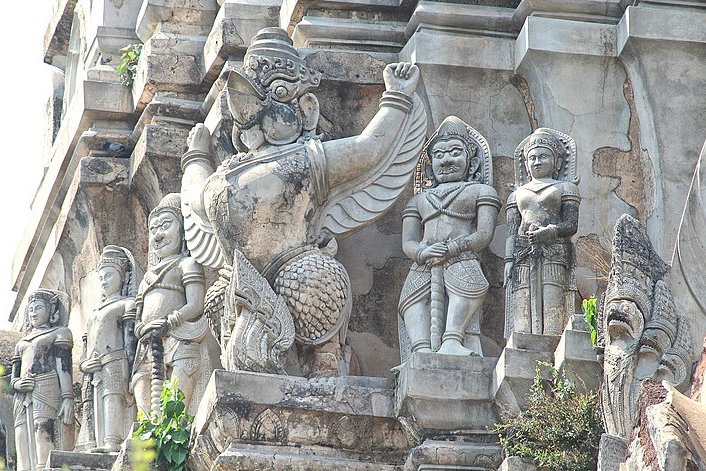
Garuda sculpture. Wat Ratchaburana, Ayutthaya, Kingdom of Thailand. Image source
He symbolizes courage and represents the utterances of the sacred teachings or Vedas, and those who read them are transported upon the wings of wisdom and with the power of lightning.
It is believed that Garuda's wings chant the Vedas as he flies around the heavens.
Similar mythological creatures can be found in the beliefs of other nations. A Babylonian/Sumerian myth says about this gigantic creature (the messenger of the gods), half man and half bird with a giant lion-head that could walk on two legs like a human and was known as Anzu/Zu (‘the wise one’).
According to Slavic folklore, the Firebird was a creature with eyes that sparkled like crystal and golden feathers that shone as bright as the sun. Roman, Greek or Egyptian mythologies speak about a mythical firebird, Phoenix, a symbol of Sun, immortality, rebirth, resurrection, and eternal life. This mythical creature has its counterpart in China, Japan.
Birth of Garuda And His Importance In Hinduism And Buddhism
According to the Mahabharata, India's great epic, Garuda was born from an egg and appeared as a powerful extremely brilliant light compared to the gigantic cosmic catastrophe that annihilates the entire world at the end of every age.
Frightened by Garuda's unlimited power, the Devas begged him to reduce himself in size and energy, and Garuda immediately complied with their request. Legend has it, Garuda was so huge that everyone mistook him for the god of fire, Agni.
Most frequently, Garuda is depicted as a humanoid creature with golden wings, clawed paws, and holding a snake in its beak. According to Hindu and Buddhist mythology, the movement of his wings gave rise to a storm; the brilliance of his feathers was so strong that it overshadowed even the glow of the sun. Garuda's wings were so huge that they could span several miles and the flapping of his wings was enough to create hurricane-like winds, which darkened the skies and destroyed houses.
He had the ability to increase his strength as much as he needed.

Garuda pillar, Nepal. Image credit: - CC BY-SA 4.0
Captivity Of Garuda’s Mother
Garuda was born to the sage Kashyapa and the mother of birds, Vinata. Kashyapa was also married to Vinata's sister Kadru, who gave birth to a thousand snakes (ancestors of all the snakes that live on earth today). One day, Vinata and Kadru, entered into a trivial bet regarding the color of the tail of Uchchaihshravas, the divine, seven-headed flying horse, who emerged during the Churning of the Ocean of Milk. Kadru claimed the horse's tail was black while Vinata was convinced it was white.
As a result of Kadru's cheating, Vinata lost the bet and became Kadru's slave, who was treated very badly by her and her serpent sons.
Stealing Of Amrita – Elixir Of Immortality
Trying to stop his mother's suffering in this humiliating captivity, Garuda approached the serpents and asked them what he would have to give them in order to purchase his mother's freedom.
In order to free his mother, the Nagas told that he would have to bring them the amrita - Nectar of Immortality, which the gods had bravely acquired from the depths of the ocean.
Garuda knew that this would be a very difficult task to accomplish, as the Devas fanatically guarded the elixir with a fire that covered the entire sky, sharp rotating blades, and two huge poisonous snakes that protectively stationed next to the elixir.
 Garuda carries Vishnu and Lakshmi. Image credit: - Public Domain
However, the powerful king of the birds was not afraid. He defeated them all and entered the area where the amrita was stored and protected. With the pot of amrita in his mouth, he immediately headed toward the Nagas who had kept his mother under their control.
And then, suddenly, he met on his way, Vishnu, a great Hindu god who preserves all things, one of the highest divinities, usually depicted with blue skin and four arms. They exchanged promises and Vishnu promised Garuda immortality without even drinking from the amrita's pot. Garuda, on his part, agreed to serve Vishnu as his private mount.
Further ahead, Garuda met Indra and promised him that once he had delivered the elixir to the Nagas, he would then ensure that Indra immediately regained possession of the divine amrita. Indra, in turn, promised to give Garuda the serpents as food.
Reaching the land of the Nagas, Garuda placed the pot containing the elixir on the grass and requested them to liberate his mother Vinata, immediately, and to perform some necessary religious rites before consuming the amrita. As the Nagas were busy with their rites, Indra hurried to the place and took away the pot with the amrita. When the serpents returned, they were shocked to see that the elixir vanished and only small droplets of it remained on the ground, which they tried to lick off. Legend says this made their tongues split in two.
When Garuda’s mission was fulfilled and the amrita returned to the gods, he had to fulfill his promise made to Vishnu. From then on, Garuda became closely associated with Vishnu, and even Vishnu's wife, Lakshmi, and they both used Garuda as their riding bird ('vahana').
He remained in conflict with the Nagas; he hated them taking every opportunity to destroy them.
Written by – A. Sutherland - AncientPages.com Senior Staff Writer
Copyright © AncientPages.com All rights reserved. This material may not be published, broadcast, rewritten or redistributed in whole or part without the express written permission of AncientPages.com
More From Ancient Pages
-
 Neolithic Watermelons Reveal Some Surprises About Our Ancestors
-
 Excavations In Ancient City Of Cremna – One Of The Five Colonial Cities In Pisidia
-
 Caligula’s Stunning 2,000-Year-Old Sapphire Ring Tells Of A Dramatic Love Story
-
 Is The Mystery Of Controversial Phaistos Disk Solved?
-
 On This Day In History: King Louis XVI Of France Was Formally Arrested And Declared An Enemy Of The People – On August 13, 1792
-
 Earliest Evidence Of Humans In The Americas – Confirmed
-
 Wasabi Plant Can Save Ancient Bio-Deteriorated Papyrus
-
 Dura-Europos Roman Shield Created With Ancient Painting Techniques On Wood
-
 Ji Gong: Legendary Ancient Monk Who Defended People Against Injustice
-
 4,500-Year-Old Lost ‘Sun Temple’ Dedicated To God Ra Unearthed In Abu Gorab Necropolis
-
 Ogdoad Of Hermopolis – Ancient Egyptian Concept Of Eternal And Primeval Forces
-
 Mystery Of Ancient Carved Shiva Lingas In India And Cambodia
-
 On This Day In History: The ‘Canterbury Tales’ Read For The First Time At Richard II’s Court – On Apr 17, 1397
-
 Tangaroa – Polynesian God Of Ocean And Fish In Constant Struggle With His Brother
-
 1,600-year-old Roman mosaics from ancient Serdica discovered in Sofia, Bulgaria
-
 2,000-Year-Old Rock Art Sites Discovered In Jalapão, Brazil
-
 Mummy Of Pharaoh Amenhotep I Digitally Unwrapped For The First Time In 3,000 Years
-
 Itiner-e: Digital Map That Increases Roman Empire Road Network By 100,000 Kilometers
-
 Qumran: The Dead Sea Scrolls And Their Connection To Enigmatic Essenes
-
 New Hope To Finally Find Tomb Of Alexander The Great


