
Izanagi and Izanami And World Creation In Shinto Cosmology
A. Sutherland - AncientPages.com - Shinto traditions are the cornerstones of Japanese mythology. The origin of the gods and the world dates back to a time before earth and heaven existed.
In Shinto theology, Izanagi and Izanami are considered the progenitors of the world and the Japanese archipelago.
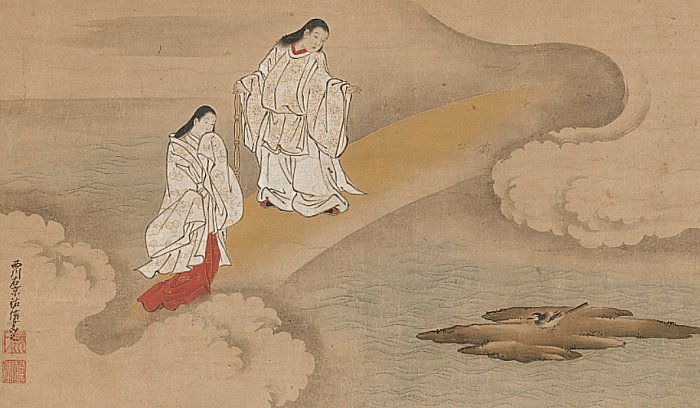
The God Izanagi and Goddess Izanami. Nishikawa Sukenobu Japanese,
At the beginning, there was only a formless mass of swirling gases, of which some slowly began to rise and form the heavens. The denser and darker material sank due to its weight and formed the earth. Then, three divinities created themselves and hid. After them, two other divinities were born, and they, too, hid. It was when the earth—still very young—was moving like a jellyfish.
In this way, seven more gods were born, the last two of which were Izanagi ('Male-who-invites') and Izanami ('Female-who-invites').
This divine pair (brother and sister) are the central deities and creator gods in early Shinto beliefs. They were born after heaven and earth separated out of the endless chaos. The heavenly divinities also commanded them “to complete and solidify the still drifting land."
While standing on the Floating Bridge of Heaven, the siblings looked down into the abyss and wondered if there was anything in the waters of the primeval ocean beneath them. Then, Izanagi plunged his heavenly jeweled spear into the ocean and lifted it. The drop that fell formed the first landmass—an island—Onogoro. The siblings descended on this island and got married there.

Izanagi-jingu Haiden - Shinto shrine located in Awaji, Hyogo Prefecture, Japan. Image credit: ChiefHira - CC BY-SA 3.0
Then, the couple began to procreate the world. First, Izanami released two creations, Hiruko ("floating in mourning") and Ahashima ("the island of foam"). Still, these two did not meet parents' expectations and were rejected for lack of solid consistency.
They learned the art of love-making by watching a pair of wagtails, and these water birds are still associated with the couple. The divine marriage (Izanagi and Izanami) slowly filled the world with mountains, rivers, forests, waterfalls, trees, herbs, and the wind.
Izanami gave birth to new deities successively, but the last one caused the divine pair many troubles. Izanami gave birth to the fire god, became very ill, and soon died.
Izanagi's Descent Into Hell And His Terrible Experience
Izanagi was heartbroken when his wife died and left for Yomi, the Land of Gloom, as the underworld is known in ancient Japanese beliefs.
He followed her to Yomi and met her there. She agreed to return with him to the world of the living on the condition that he would wait for her without entering the Land of the Dead. Izanagi did not keep his promise and followed his lovely wife. He found Izanami's body decomposing and full of worms, watched over by eight gods of thunder. Horrified, Izanagi managed to flee back to the world, but this terrible contact with the world of the dead made him feel very dirty.
He had to undergo ritual purification, and when he washed his left eye, he gave birth to the great goddess Amaterasu, goddess of the Sun. He then washed his right eye and brought into the world the god of the Moon, Tsukiyomi. Then, he washed his nose and gave birth to the god Susanoo, the third of his noble children. (In one version, all three deities were created from Izanagi's eyes.)
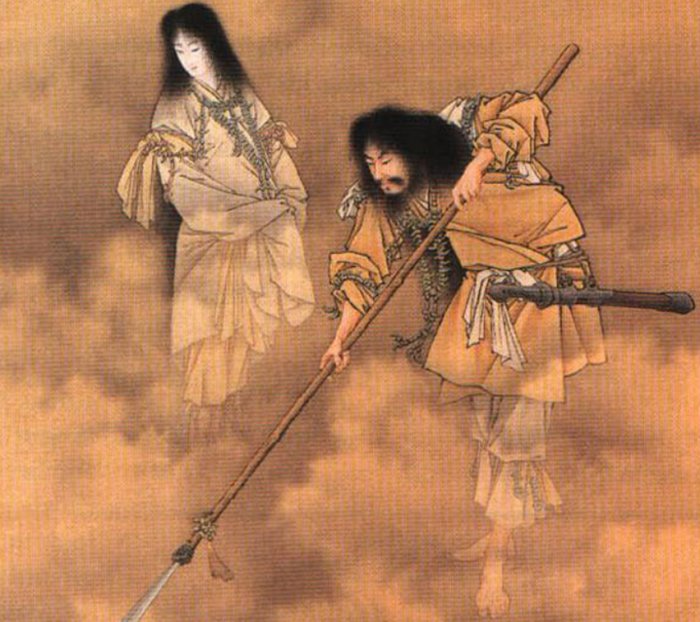
Kobayashi Eitaku, Izanagi and Izanami, c. 1885. Upploader: Lamré - Public Domain - source
He appointed Amaterasu, the goddess of the sun and ruler of the High Plain of Heaven. Her brother, Susanoo, became the ocean ruler and god of storms, while her second brother, Tsukuyomi, was appointed the god of the moon.
In this story, through their divine marriage and offspring, Izanagi and Izanami established the nature pattern for all time; however, through their divorce, they created mortal life and death.
The Land of the Living and the Land of the Dead have prohibitions. Izanagi broke some of these prohibitions. In the underworld, Yomi (or the Land of Gloom), there was no prohibition to look at Izanami, and in fact, her husband met her there, but he was not allowed to enter the “Palace” or the “House,” where the process of transition was taking place.
When Izanami was trying to come to life (or rejuvenate) in the “palace,” Izanagi broke the taboo and entered the place; he saw terrible things taking place and her wife’s body decomposing. He broke the laws of the underworld because he interrupted the processes involved in the transition between the worlds of the dead and the living. According to ancient Japanese beliefs, the rejuvenation process should not be disturbed and should be observed by outsiders.
The dead should not be observed during the process of transition.
Written by – A. Sutherland - AncientPages.com Senior Staff Writer
Updated on July 24, 2024
Copyright © AncientPages.com All rights reserved. This material may not be published, broadcast, rewritten or redistributed in whole or part without the express written permission of AncientPages.com
More From Ancient Pages
-
 Yokai Kijo (Kidjo): Demoness, Cannibal With Hideous Heart Is A Moral Reminder In Japanese Beliefs
-
 Where Does The Expression ‘Saved By A Bell’ Come From?
-
 Magnificent 2 Meters Tall Marble Apollo Statue And Other Artifacts Found In San Casciano dei Bagni, Italy
-
 Agora: An Ancient Meeting Place Visited By Many Famous Philosophers
-
 Famed Makishi Dancers And Likumbi Lya Mize Ceremony In Zambia – Much More Than Just A Festival
-
 Unearthing Anatolia’s Ancient City Of Lystra Where History And Faith Converge
-
 Huge Jars Unearthed In Kultepe, Turkey
-
 Why Do Native Americans Often Wear Long Hair?
-
 Ancient Jericho – City Of Giants And Home Of The Mighty Gibborim
-
 Eccentric Holy Roman Emperor Rudolf II Whose Occult Interest And Mistakes Led To The Thirty Years’ War
-
 Earliest Evidence Of Flip Flops In The Middle Stone Age
-
 Curious Encounter Between Inuit And Vikings Led To Something Surprising That Shaped History
-
 Strange Case Of 17th-Century Child Mummy Hidden From The Sun – What Does Virtual Autopsy Reveal?
-
 Forgotten Ancient Kingdom Of Tuwana Is Hidden Among Ruins In Cappadocia
-
 Monumental Fortification That Protected The Kings Of Jerusalem Unearthed In The City Of David
-
 Battle Of Assandun: The Great Battle In English History And A Brief Period Of Viking Dominion In England
-
 Tomte – A Beloved Scandinavian Christmas Gnome
-
 Societies In Iberian Peninsula Deployed “Escape Economics” 4,000-Year-Old
-
 Mythical Underground Labyrinth And Legendary Long-Lost Golden Tomb Found In Italy?
-
 Unique Historical Discovery – Wreck Of Vasa’s Sister Ship Äpplet Found Off Swedish Coast!

