
Ife Head: Significance Of The Head ‘Ori’ In Yoruba Ancient And Present Beliefs
A. Sutherland - AncientPages.com - The Yoruba peoples of South Western Africa are credited with one of Africa's oldest and finest art traditions. In the history of Ife art in Africa, there are many exquisite pieces of work, including the "Ife Head."
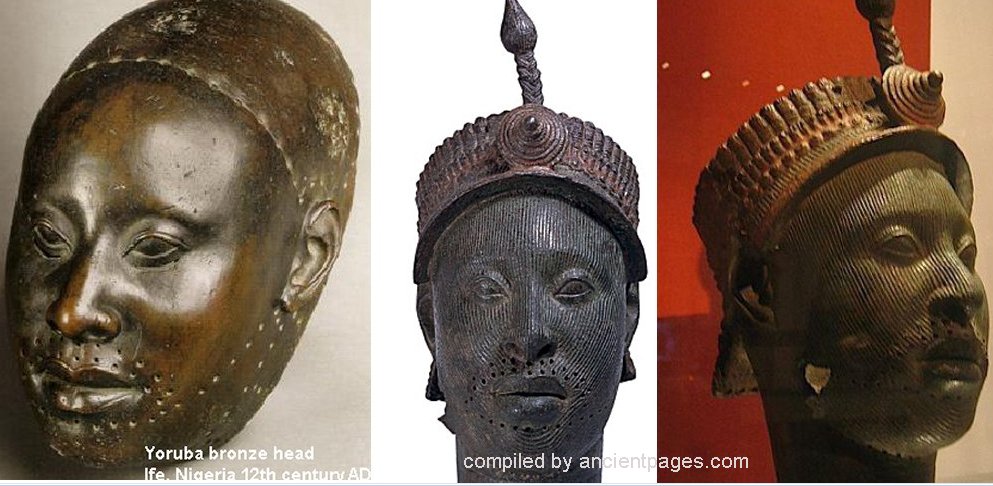
The artifact is undoubtedly a great work of art.
In 1938, at Wunmonije Compound in Ife, Nigeria, construction works on the grounds of a royal palace in Ife, Nigeria, accidentally revealed a beautiful, free-standing brass head cast.
The head, created using the lost wax technique, is one of thirteen brass heads, all discovered at the same site.
The Importance Of The Head In Yoruba Sculpture
Like many other African peoples, the Yoruba of western Nigeria, the Yoruba people regard the head ("ori") as the seat of the divine power of the Supreme Being. In the person's life, the head is the life source and a vital instrument controlling destiny and personality. The Yoruba people particularly highlighted the head as the body's crown and the place where the soul dwells.
A human head decides about one's identity, communication, and perception.
Therefore, in Yoruba's art, the head is the most elaborately formed part of Yoruba figure sculpture.
As it agrees with the tradition, it is perhaps not surprising that nearly all of the Ife metal sculptures that we know (only about thirty) depict heads. But when a full figure was finally discovered at Ife, the head was just about a quarter of the body, as it usually is with the typical proportion characterizing much of African art.
Use Of The Head Is Unknown
The identification of the Ife Head (a little smaller than life-size) remains uncertain, but it is dated to 1400– 1500 AD, and the head is African and a royal figure. Its elaborate beaded headdress may represent a crown associated with an Ooni, a ruler of Ife.
The head could not stand independently so that it might have been attached to a wooden body. The artifact may have been used in ceremonies and processions during the ruler's absence or because he was already dead.
The Ife Head Associated With Legendary Homeland Of The Yoruba
The oral traditions of the Yoruba people say that Ife was where civilization and its life began. Ife is the legendary homeland of the Yoruba people and its sacred ruler, the Ooni. This sacred figure is still worshiped among the Yoruba as the descendant of the original creator gods.
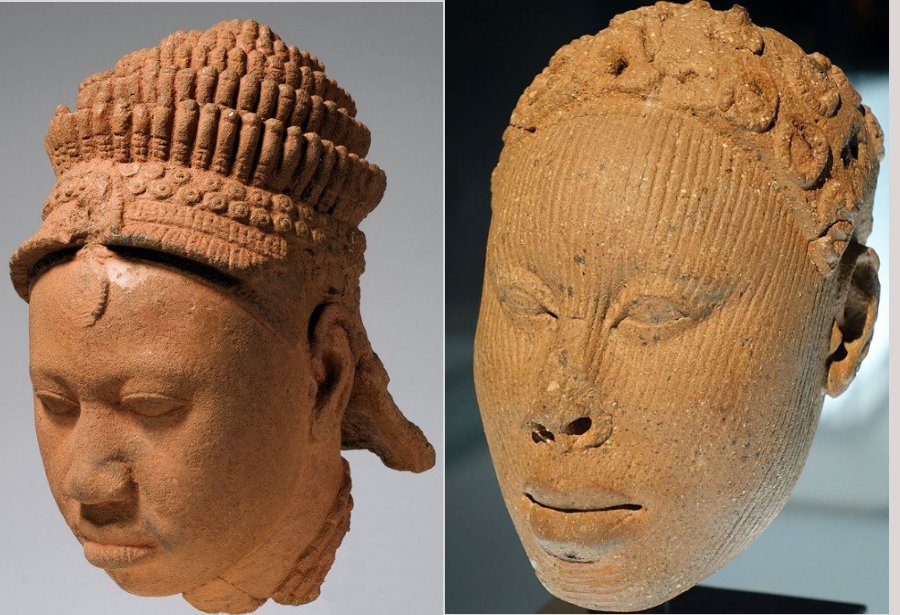
Left: Kingdom Of Ife: Sculptures From West Africa, London – Head with elaborate crown, Ife, Ita Yemoo. Terracotta, 12th-14th century. Copyright Karin L. Willis/Museum for African Art/Nigerian National Commission for Museums and Monuments; Right: Terracotta head from Ife, believed to be a king in 12th to 15th Century C.E., in the Ethnological Museum of Berlin (images source)
Ife is located in Osun State in modern southwestern Nigeria. It started as a city-state in the late first millennium, around 800 AD, and flourished as a leading political, economic, and spiritual center between 1100 and 1400.
The city of Ife, where the metalheads come from, was once called "Black Athens." Ife was and remains the main center of their traditional worship, which resulted from Yoruba mythology. It was also one of the major city-states of the former Yoruba state.
The art of Ife contains many sculptures in brass, copper, terracotta, and stone, all discovered at different sites in the city. When the Ife sculptures were first presented to the Western world, they were compared with the classical art traditions of ancient Rome and Greece.
It was even theorized that such Ife heads were evidence that Ife was once the site of the lost civilization of Atlantis.
Destiny Written In Inner Head Cannot Be Altered
The Yoruba believe that when the Supreme Being wants to create a human being, he asks one of his lesser deities to mold the physical body from divine clay. Once the molding is finished, the creator breathes life into it through the head.
Thus, he makes a living human being directed to another deity responsible for creating the inner heads.
Although all the inner heads look alike, each of them is basically different from the others. The inner head was chosen by a newly created human being, which automatically determines the person's destiny on earth.
The person who has chosen an excellent inner head will be lucky and prosperous; another person who is always unlucky in life is considered to possess a bad inner head.
But the problem is that the bad inner head can never be altered, which is confirmed by the Yoruba saying:
"A bad head cannot be washed clean
Human destiny cannot be altered with charms…"
Written by – A. Sutherland - AncientPages.com Senior Staff Writer
Updated on January 31, 2024
Copyright © AncientPages.com All rights reserved. This material may not be published, broadcast, rewritten or redistributed in whole or part without the express written permission of AncientPages.com
Expand for referencesMore From Ancient Pages
-
 White Temple Of God Anu In Sacred Precinct Of Kullaba At Uruk
-
 USC Archeologist Discovers Maya Royal Burial Site
-
 2,500-Year-Old ‘Dragon Bed’ Restored By Chinese Archaeologists
-
 Young Boy Finds Unique Micro-Mosaic Cross Medallion In Jerusalem
-
 On This Day In History: Battle of Salamis Was Fought – On Sep 22, 480 BC
-
 Puzzling Case Of An Ancient French Giant Whose Bones Caused Sensation And Controversy
-
 Mysterious Ancient Oil Lamps In Ohio And Wisconsin – Evidence Of Pre-Columbian Contact?
-
 Mysterious Ancient Structures Hidden Under The Sand In The Sahara Desert Could Re-Write History Of Ancient Egypt
-
 95% Of All Modern Europeans Descended From The Seven Daughters Of Eve
-
 Pazzi Conspiracy – Failed Murder Attempt On Lorenzo de’ Medici Made Him Even More Powerful And Threw Renaissance Florence Into Chaos
-
 Magnificent Chamber Graves Of Four Scandinavian Warriors Discovered In Poland – The Piast Dynasty In New Light
-
 3,800-Year-Old Wall Relief Created By Ancient Caral People Unearthed In Peru
-
 Fossilized Trilobite Amulet Found At The Roman Site In Spain Was Believed To Have Magical Or Protective Properties
-
 History Set In Stone – Maya Rulers Put Their Personal Stamp On Ancient Monuments
-
 New DNA Evidence Rewrites Ancient History Of Pompeii
-
 Who Were Persian ‘Sparabara’?
-
 Nude Athletes And Fights To The Death: What Really Happened At The Ancient Olympics
-
 How Gilgamesh Defeated Mighty King Agga Of Kish
-
 Artifacts From King Henry VIII’s Warship The Mary Rose – Analyzed
-
 Prophetic Dream Revealed Priceless Ancient Treasure That Was Later Stolen Or Destroyed – Was The Discovery Too Dangerous?

