
Why Didn’t Pythagoras And His Followers Eat Beans?
Conny Waters - AncientPages.com - Pythagoras of Samos, an ancient Greek philosopher who made great contributions to mathematics and founded the Pythagorean School of Mathematics in Cortona, a Greek seaport in Southern Italy, was a vegetarian.
But did you know that Pythagoras abstained from meat and beans? Most vegetarians consume beans, but Pythagoras told his followers they mustn’t eat or even touch beans! Was Pythagoras worried about gastric problems, or did he have a deeper reason for omitting beans from the diet?
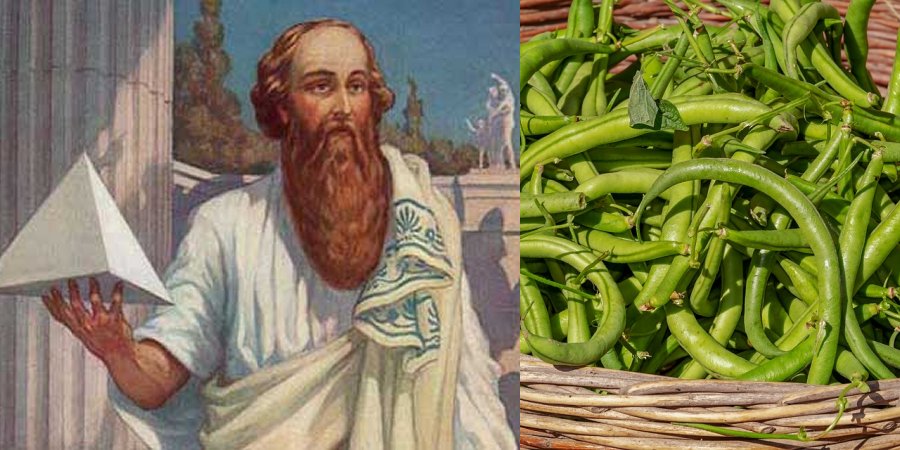
Left: Pythagoras. Credit: Famous Mathematicians. Right: Beans. Credit: Public Domain
The reason behind this is not entirely known, but there are certain theories that can provide some light on the great philosopher’s reluctance to beans.
Pythagoras believed that a person should strive for tranquility and peace. Beans were associated with metempsychosis, a philosophical term in the Greek language referring to the transmigration of the soul, especially its reincarnation after death. Pythagoreans believed that beans had the potential for life because they looked like human genitalia or fetuses.
Pythagoras conducted a scientific experiment demonstrating that humans and beans were spawned from the same source. He took some beans and buried them in the mud. They rested there for a few weeks before being removed and investigated by the great Greek philosopher. He concluded they looked like human fetuses.
Like ancient Egyptians, Greeks knew that fava beans could be deadly. Pliny wrote that followers of Pythagoras believed that fava beans were connected to Hades, the Greek God of the Dead, and the Underworld. The plants’ black-spotted flowers and hollow stems served as ladders for human souls and were associated with reincarnation.
Aristotle suggested that the bulbous shape of beans represented the entire universe, which was why beans shouldn’t be consumed.
Cicero proposed another explanation. In his book On Divination, he just wrote that he believed the Pythagoreans didn’t eat beans because they caused flatulence.
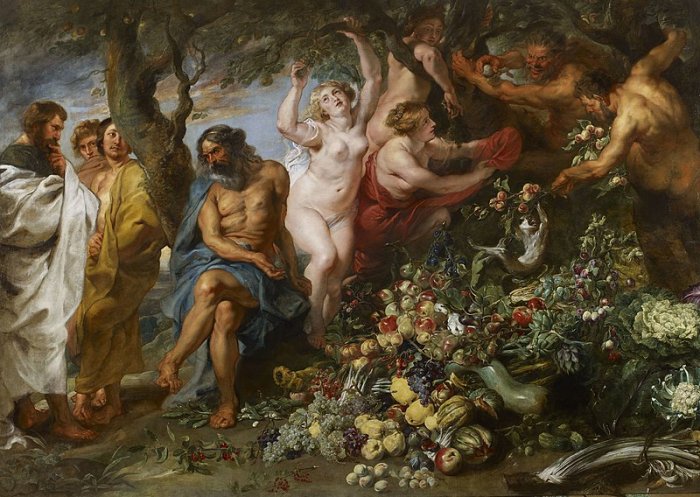
Pythagoras advocating vegetarianism. Painting made between 1618 and 1630. Credit: Public Domain
Another theory is that Pythagoras may not have had anything against beans at all. However, beans were used in ancient Greece as a ballot system. White beans represented a yes vote and black a no.
When Pythagoras said to his disciples, "Abstain from beans," he had no reference to them as an article of diet, for he ate them himself, but he advised his students not to get caught up in politics or government.
As H. L. Sumner points out, “what he did mean, and what his immediate followers already understood, was that they should abstain from the intrigues of politics as being antagonistic to a philosopher's pursuits.”
To put it in plain text – We do know that Pythagoras had disapproved of beans, but we simply don’t know what was behind his negative attitude.
Updated on November 24, 2023
Written by Conny Waters – AncientPages.com Staff Writer
Copyright © AncientPages.com All rights reserved. This material may not be published, broadcast, rewritten or redistributed in whole or part without the express written permission of AncientPages.com
Expand for referencesMore From Ancient Pages
-
 Shakespeare ‘Borrowed’ Phrases From Little-Known Manuscript – Study Reveals
-
 Medicine in Antiquity: From Ancient Temples To Roman Logistics
-
 800-Year-Old Shipwreck Discovered Off Salento Coast, Italy
-
 1,700-Year-Old Underground Temple Of Mithras Unearthed In East Anatolia, Turkey
-
 Cuneiform Tablet With New Indo-European Language Discovered In The Capital Of The Hittites
-
 Axum: Mysterious Megalithic Towering Obelisks In Ethiopia
-
 16 Meters Long Ancient Papyrus With Spells From The Book Of The Dead Found In Saqqara
-
 Ancient Wall Of Lolei Temple Built In 893 BC Unearthed In Siem Reap, Cambodia
-
 Nomadic People’s 1,500-Year-Old Imperial Worship Unearthed In Hohhot, Inner Mongolia
-
 10 Incredible And Bizarre Ancient Cases Of Mass Hysteria
-
 Controversial Hollow Earth Theory – Startling Discoveries And Different Conclusions – Part 2
-
 Human Ancestors Preferred Mosaic Landscapes And High Ecosystem Diversity – New Study
-
 Treasure Trove Of Assyrian Kings Found In Tunnels Excavated And Plundered By Terrorists
-
 How Ramesses II Became The Greatest Pharaoh In Egypt
-
 What Is The History Of Pancakes?
-
 Unusual Discovery Of A Viking Age Phallic Stone In Tystberga, Sweden
-
 Unique Viking Age Shipyard Discovered At Birka Challenges Maritime Activities Of The Viking Age
-
 3,400-Year-Old Cuneiform Tablet Excavated In Old City Of Alalah
-
 Neanderthal Extinction May Have Been Caused By Sex, Not Fighting – New Study Suggests
-
 On This Day In History: Viking Forces Laid Siege To Paris – On Nov 25, 885

