
Callanish Stone Complex: Sacred Place On The Isle Of Lewis In Scotland
A. Sutherland - AncientPages.com - The Callanish Stone Complex (Scottish Gaelic: Calanais) is located on the Isle of Lewis, the outer Hebridian island, west of Scotland. This megalithic landmark is very old and impressive; it originates in Neolithic Britain.
Situated on a prominent ridge overlooking Loch Roag, on Lewis (Western Isles), the Callanish stones are visible from a considerable distance.
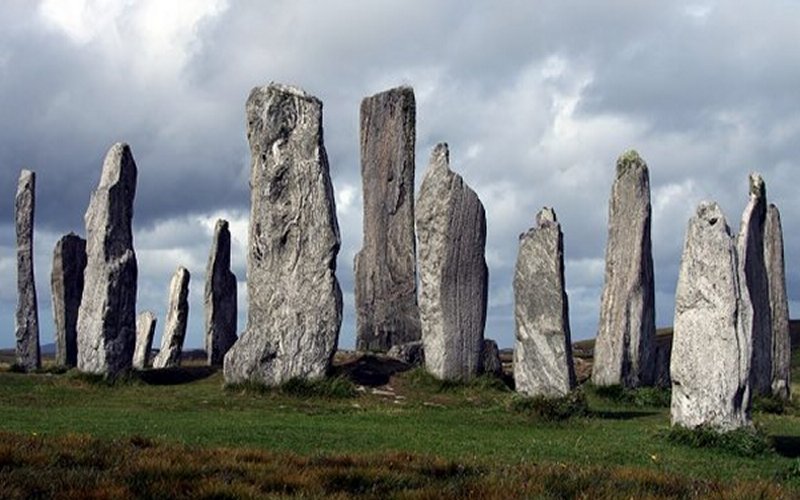
Callanish Stones is located near Callanish village, Isle of Lewis, Outher Hebrids, Scotland. Image credit: - CC BY-SA 3.0
A particular atmosphere of mystery dominates over the impressive physical presence of the stones and their total dominance in the landscape.
The main monument at Callanish dates back to approximately 3,000 BC. The Isle of Lewis at the time was inhabited by Stone Age farmers who occupied small villages around the Outer Hebrides.
At Callanish, the monoliths were quarried from one of the oldest rocks in Britain, the so-called Lewisian gneiss stone, deriving from the Isle of Lewis, and erected carefully in a circle. The monument's stability was essential, and low mounds of earth and rocks were added to the base of each upright because of the problems of digging sufficiently deep sockets.
The central stone was set in place at this time. The three rows running away to the south, east, and west were likely added soon after. Today, the avenue comprises twenty stones and runs to the north.
A cross-shaped setting of standing stones is centered on a circle of rocks, which contains a vast, 4.75m high and 30cm thick megalith at the center, and a small, chambered cairn, which is 7m in diameter and is probably, a later addition to the complex.
All this gives clues to how vital the area was to prehistoric peoples.

Engraving from a paper by Henry Callendar, 1854
The arrangement - with lines of stones radiating in four directions from the ring - is unique. However, its purpose is unclear and does not explain whether the stone alignments were constructed at the same time as the ring or later.
However, the majestic Callanish Stones are associated with astronomical events, especially concerning the Moon's movements.
Aubrey Burl, in his book "Circles of Stone The Prehistoric Rings of Britain and Ireland," mentions Diodorus Siculus, the famous Greek historian who died sometime after 21 BC, who first provided an astronomical explanation of the site:
"He wrote of a 'spherical temple' in Britain, and this was believed to have referred to Stonehenge. However, the statement that 'the moon as viewed from this island appears to be but a little distance from the earth' refers to something impossible at the latitude of Stonehenge. Instead, it exactly describes the southern moon 'behavior' at Callanish, where it seems "to roll along the top of the skyline."
Callanish was a sacred place to ancient people, and it remained an active focus for the prehistoric religious activity for at least 1500 years.
Like many other prehistoric stone circles, Callanish's use focused on various ceremonies and rituals for centuries.
Whether these activities involved the whole community, part of it, or specifically chosen individuals at different times of the year or various stages in life is unknown.
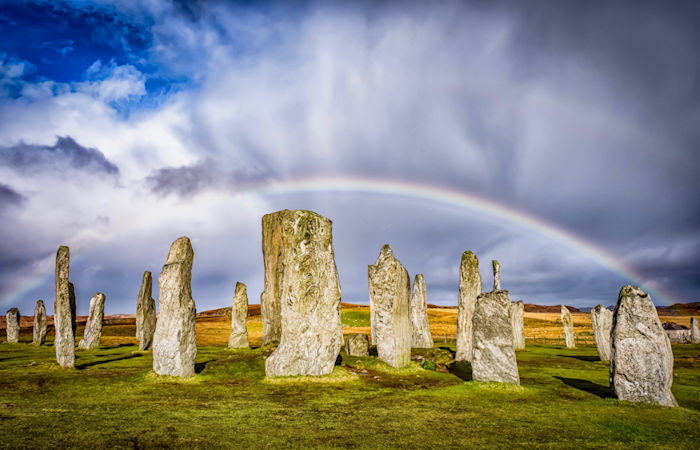
At Callanish, the monoliths were quarried from local gneiss stone and erected carefully in a circle. The monument's stability was clearly important, and low mounds of earth and stones were added to the base of each upright because of the problems of digging sufficiently deep sockets. Credit: Adobe Stock - rachel bibby/EyeEm
Excavations showed that the burial chamber, as mentioned earlier, was a later addition to the complex and had been modified several times.
The land had been cultivated before the circle was erected; a wooden structure may have preceded it. Archaeologists found some human bones and pottery that dates back to about 2200 BC.
There are many myths and legends related to Callanish. The stones were said to be a council of pagan giants, turned to stone by a Christian saint, St Kieran. In another version, the stone material to build Callanish was brought to the island in ships and erected by "black men" under the direction of priests who wore cloaks of colored feathers.
Yet another legend has it that early at Midsummer Sunrise at Callanish, an entity known as the "Shining One" walks up the avenue, heralded by the call of a cuckoo.
The Callanish Stones Site is in charge of Historic Scotland.
Updated on February 24, 2023
Written by – A. Sutherland - AncientPages.com Senior Staff Writer
Copyright © AncientPages.com All rights reserved. This material may not be published, broadcast, rewritten or redistributed in whole or part without the express written permission of AncientPages.com
Expand for referencesReferences:
M. Aubrey B. Milligan Circles of Stone: The Prehistoric Rings of Britain and Ireland
More From Ancient Pages
-
 Demon Oni: Cruel Harbinger Of Disease And Misfortune In Japanese Folklore
-
 Mysterious Books From The Unknown And ‘Impossible’ Coincidences
-
 Why Winter Solstice Matters Around The World
-
 Jiangshi – Terrifying Vicious Ancient Chinese Vampire In Disguise
-
 More Than 1, 300 Prehistoric Burial Mounds In Western Azerbaijan Have Been Systematically Surveyed For The First Time
-
 Extraordinary Find: The Oldest Neanderthal DNA Of Central-Eastern Europe
-
 Strange Prophecy Of Viking Ruler Oleg Of Novgorod’s Death And Mysterious Burial Place
-
 Huge Ring Of Ancient Shafts Discovered Near Stonehenge
-
 Third-Century Inscription Related To Dionysus Cult – Discovered
-
 Will Star Goddess Astraea Return To Earth With Second Golden Age Or Apocalypse?
-
 Immense Ancient Copper Mine Used By Romans Unearthed In Spain
-
 Your Destiny Is Engraved And Stored – Guardians Of The Great Mystery – Part 2
-
 Mysterious Ancient Oil Lamps In Ohio And Wisconsin – Evidence Of Pre-Columbian Contact?
-
 Decebalus – The Brave One’ – Last Mighty King Of Dacian People
-
 On This Day In History: Edict Of Longjumeau Was Signed And Ended Second War of Religion – On Mar 23, 1568
-
 Mysterious Scrolls And Artifacts Discovered Inside Ancient Buddha Statuette
-
 Giant Mimir And The Well Of Wisdom In Norse Beliefs
-
 ‘Impossible’ Ancient Knowledge Of The Gods’ Star – Mysterious Beings – Part 2
-
 Ancient City Of Urkesh – Home Of Kumarbi – The Foremost Son Of Anu
-
 Indian Black Earth And Biodiversity Of The Amazon – New Study

