
Mysterious Mount Roraima Surrounded By Myths And Clouds Of Dense Fog
A. Sutherland - AncientPages.com - Mount Roraima is located on a high plateau at the junction of Brazil, Venezuela, and Guyana.
It was carved from a single, monolithic, gigantic piece of rock with sides forming a straight vertical line.

Mount Roraima cliffs, Venezuela. Paulo Fassina. Credit: CC BY-SA 2.0
Some researchers say Mount Roraima is not a mountain but an artificially created formation. Some others say it is a rather unique work of nature. Some just say - it's a scary thing.
The top of the vertical walls is up to 400 meters. The corner-sloping ledge forms a relatively sharp upper and lower line around the perimeter. The height of the ridge reaches 170 meters! The total size of the structure reaches 1,150 meters from its base.
The Pemon (Pemón or Pemong), who are indigenous people living in areas of Venezuela, Brazil, and Guyana, this fascinating formation must have played an essential role in their rich mythology. The Pemon's mythic tradition merged into their present Catholic and Christian faiths. In their beliefs, gods reside in the grassland area's table-top mountains called tepui.
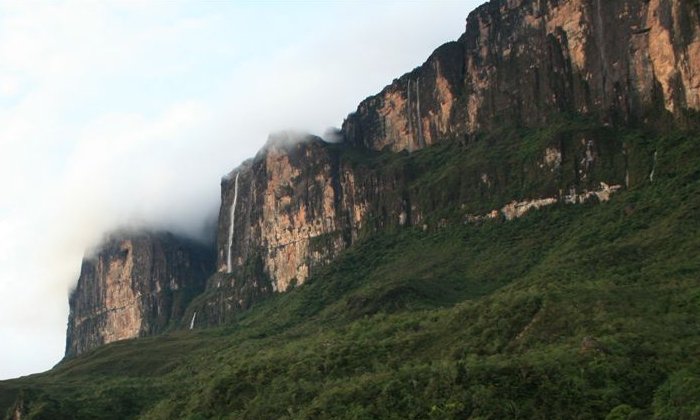
Mount Roraima. Image source
The Pemon people believe the mountains are off-limits to the living, as they are also home to ancestor spirits called mawari.
The word tepui in the local Pemon people means' House of the gods,' For centuries, people avoided climbing Mount Roraima for fear of the gods' punishment. In addition, rumors went about strange creatures that lived on top of it.
In 1912, the first non-native person who visited Roraima to study Pemon myths and language seriously was the German ethnologist Theodor Koch-Grunberg.
Important myths describe the origins of the sun and moon, the creation of the tepui mountains that
spectacularly rise from the savannahs of the Gran Sabana and the activities of the creator hero Makunaima and his brothers.
In the language of Pemon Indians, 'roroi' means "blue-green," and 'ma' - "great." Thus, the name "Roraima" is translated from the local dialect and means "big blue-green mountain."
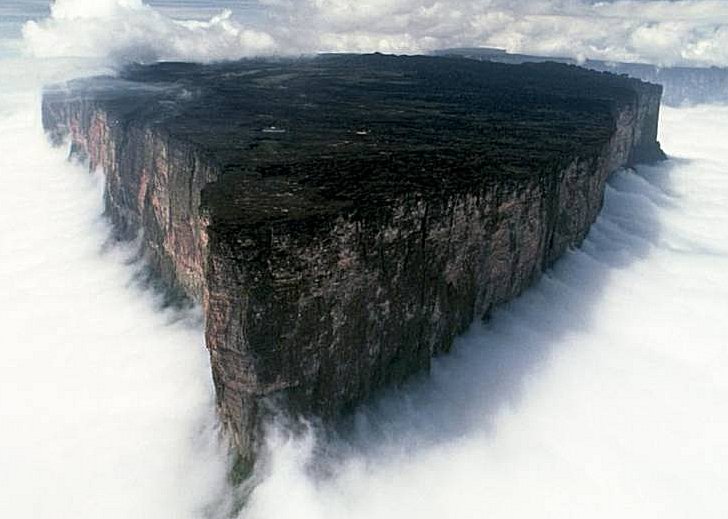
Mount Roraima. Image credit: Wikimedia Commons
According to the beliefs of Aboriginal peoples, a stump was left from the mighty tree. This stump was a source of all the fruits and vegetables in the world. Legendary hero Makunayma - literally means "He Works By Night" - also known as "God" ("Great Spirit") cut down the tree, and the barrel fell to the ground and caused a terrible flood.
Makunaima is the great Creator god of the Akawaio (indigenous people in Roraima (Brazil), Guyana, Venezuela, and neighboring Caribean tribes.
Traditional Cariban cosmology has been mixed to some degree with Christian elements after the arrival of Christian missionaries.
Older myths from this region of the world feature Makunaima as a legendary cultural hero who slays monsters. In more recent sources, these heroic deeds are usually ascribed to the benevolent demigod Sigu (or Sigoo) instead of Makunaima.
In the Caribs' beliefs, the great god, Makunaima, is never personified, and mortal man has never seen him.
Roraima's cliffs can be climbed to the top, which takes approximately two days. However, in the course of lifting, the traveler risks falling into a cloud of dense fog, so you must be especially careful.
It is worth noting that Roraima Mountain's most unusual form is not particularly unique because there are similar rock formations around the world.
Written by – A. Sutherland - AncientPages.com Senior Staff Writer
Updated on January 10, 2022
Copyright © AncientPages.com All rights reserved. This material may not be published, broadcast, rewritten or redistributed in whole or part without the express written permission of AncientPages.com
Expand for referencesMore From Ancient Pages
-
 How Strong Is The Link Between Sanskrit And European Languages?
-
 Mystery Of Ancient Carved Shiva Lingas In India And Cambodia
-
 Shrine Discovered In Egyptian Temple And Evidence Of Previously Unknown Rituals
-
 Spectacular Fengdu Ghost City Devoted To Afterlife
-
 Hieroglyphs Discovered In Sudan’s Old Dongola – Once Important City Of Nubia
-
 An Intact 4,000-Year-Old Burial Chamber Found In Aswan
-
 Mysterious Stone Age Cemetery Found Near The Arctic – Why Are The Graves Empty?
-
 Intriguing Ancient ‘Horoscope’ Scroll Found In The Judean Desert
-
 Climate In The Andes Has Driven 7,000 Years Of Dietary Changes – New Study Reveals
-
 17 Mysterious Miniature Coffins In Scotland Remain An Unsolved Enigma
-
 Lilith – Beautiful Demonic And Brave Symbol Of Equality And Adam’s First Wife Who Refused Subordination
-
 How Norwegians Expressed Resistance Against Nazi Occupation Using Christmas Cards
-
 Has Yorkshire’s Lost Underwater Town Ravenser Odd Finally Been Found?
-
 Controversial Atacama Skeleton Is Not An Alien – DNA Study Reveals
-
 Traces Of An Unknown Ancient Race Of Winged Beings And Other Mysterious Creatures Discovered In Japan
-
 Ancient Egyptian Copper Smelting Workshop Discovered At Wadi El-Nasab In South Sinai
-
 Burnt Food Remains In Neolithic Cooking Pot Sheds Light On 5,000-Year-Old Food Preparation
-
 Horses In Florida Did Not Travel Far Distances – New Study Suggests
-
 Will-o’-the-wisp: Eerie Lights Over Swamps And Marshes That Frightened And Led People Astray
-
 1500-Year-Old Mystery Of The Sandby Borg – Excavation Of Ringfort On Öland, Sweden

