AncientPages.com - On December 18, 1941, it was forbidden to use the Norwegian flag and its colours in a way that offended national sentiment. The ban was issued by Vidkun Quisling's fascist party, National Gathering.
Using the flag in that manner was considered a demonstration against the German occupation.
This was followed by a series of Christmas cards that could hardly be misunderstood.
Santa hat meant resistance
The text God norsk jul (Good Norwegian Christmas) adorned the cards, and they were filled with Norwegian symbols. Flags, ski jumping, rose-painting, and notably: Christmas gnomes with red hats.
“It’s perhaps not so surprising that they were confiscated,” Anja Hysvær Langgåt says.
She is a conservator at the Norwegian Museum of Cultural History, which has many Christmas cards from World War II.
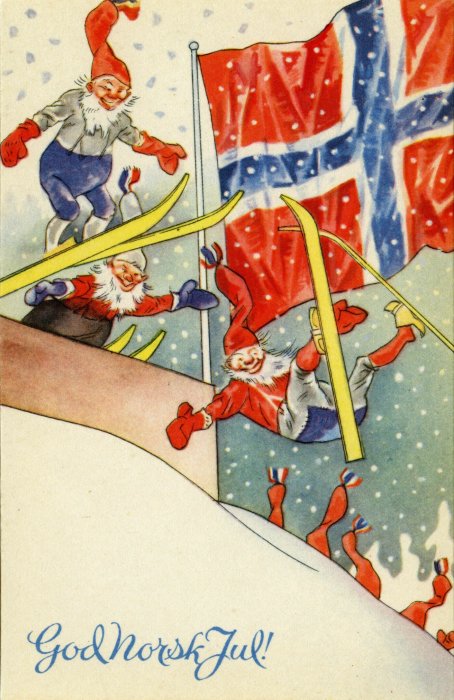
Ski jumping was the Norwegian national sport during World War II. This Christmas card was part of a series of ten Christmas cards illustrated by Frank Wathne in 1941. They were immediately banned. (Image: ©Frank Wathne / BONO 2023)
Four girls with red hats
Wearing red hats was a way to show resistance during the World War II, similar to the practice of attaching paperclips to lapels.
National Gathering and the police therefore cracked down on its use around Norway.
Local newspaper Porsgrunn's Dagblad wrote on April 2, 1942, that the police took action against 'four girls' who were wearing red and blue hats.
But despite the ban, several creative Christmas cards appeared.

On February 23, 1942, police in Trondheim announced that people caught with red hats would be punished. (Photo from exhibition, Norwegian Home Front Museum: Wolfmann / Wikimedia Commons / CC BY-SA 4.0)
A huge protest
Sigrid Torjusson, who lived during the World War II and works as a volunteer at the Norwegian Museum of Cultural History, knows these Christmas cards better than most.
Her favourite is the Chistmas gnomes with yellow, blue, and green hats.
“I think it’s a very strong symbol. It's really a huge protest,” Torjusson tells sciencenorway.no.
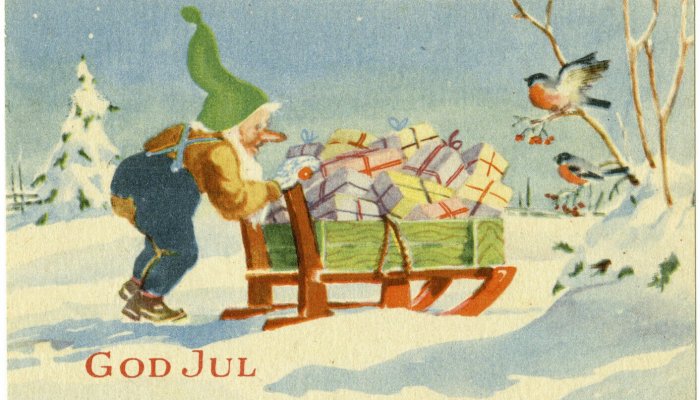
Paul Lillo-Stenberg, who was incidentally the grandfather of Lars Lillo-Stenberg from the band DeLillos, created several Christmas cards with Christmas gnomes wearing hats of various colours. (Image: Paul Lillo-Stenberg / Norwegian Museum of Cultural History)
Many creative solutions
Many different solutions appeared on Christmas cards after the ban on red hats.
“Some chose to make Santa hats in other colours, while others chose to challenge and defy the ban by including red hats,” Langgåt says.
One of those who defied the ban was the illustrator Vigdis Rojahn.
“It’s perhaps my favourite. There the German crow and snatches the red hat from the Christmas gnome,” the conservator says.
Not only were these cards banned, but Rojahn had to be interrogated.
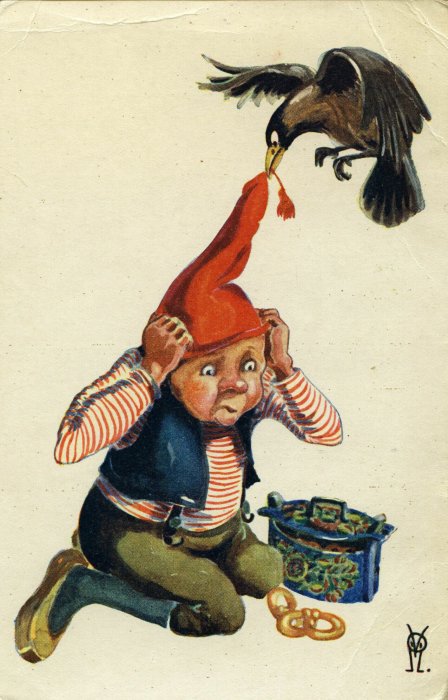
The crow on the Christmas card may remind one of the eagle on the Third Reich's coat of arms. (Image: Vigdis Rojahn / Norwegian Museum of Cultural History)
Thorbjørn Egner's bareheaded Santa
“And then there are the more ingenious solutions where they comment on the ban in other ways,” says Langgåt.
The Christmas gnomes could, for example, wear a sixpence or be missing a hat, as on one of Thorbjørn Egner's Christmas cards from 1942.
Here stands a bareheaded Santa scratching his head.
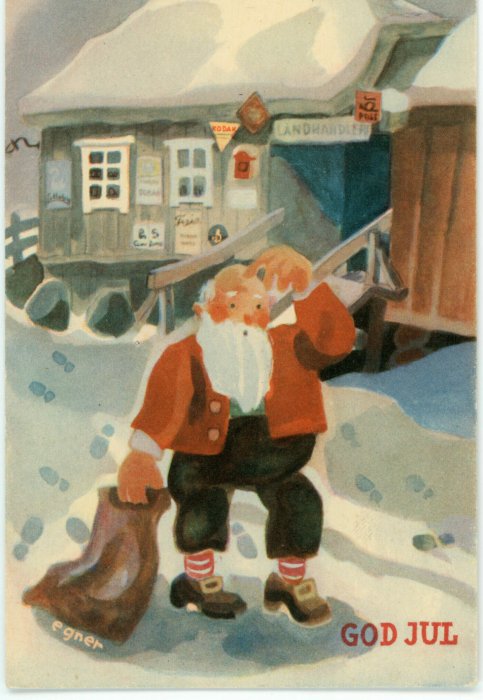
Thorbjørn Egner also illustrated several cards during the war with Christmas gnomes wearing the red hat, but this card may have an equally clear message. (Image: Thorbjørn Egner / Norwegian Museum of Cultural History)
Roots back to the French Revolution
The red Santa hat was already popular in Norway before the World War II, according to Ingun Grimstad Klepp. The textile researcher at OsloMet is one of the authors behind the book Norsk strikkehistorie (Norwegian knitting history).
People knitted the red hats themselves. The hats often had tassels.
“It is also a garment with long historical roots as a symbol of freedom and political unity,” Klepp writes to sciencenorway.no.

When red tuques were banned, Paul Lillo-Stenberg drew Norwegian Christmas gnomes with yellow, blue, and green hats on his Christmas cards. (Image: Paul Lillo-Stenberg / Norwegian Museum of Cultural History)
At the end of the 18th century, during the French Revolution, the red Santa hat became popular as a symbol of freedom throughout Europe.
And in Norway, the hat continued to be a protest against the union with Sweden and a symbol of Norwegian identity.
"We are healthy and doing well despite everything”
It was therefore quite bold both to make and send these Christmas cards, Torjusson points out.
But how common was it for Norwegians to send these protest cards to each other during the war?
Langgåt and Torjusson at the Norwegian Museum of Cultural History are unsure how many of the cards were actually sent.
In the museum's collection, several of the cards are blank on the back. Of those sent by mail, several are postmarked in 1945, after the end of the war.
But Torjusson has Christmas cards in her private collection that were sent during the war.
"Hope you are healthy and doing well. We are healthy and doing well despite everything," it says on the back of one of the cards.
The article was originally published on Science in Norway.
The Norwegian version can be found here
AncientPages.com