
Does Yarmouth Runic Stone Describe A Trans-Atlantic Viking Voyage?
Ellen Lloyd - AncientPages.com - In 1812, a Yarmouth doctor, Richard Fletcher stumbled upon a mysterious 400-pound boulder in a salt marsh in the Nova Scotia area, in Canada. The mysterious stone is covered with an inscription consisting of only fourteen characters, but the question remains - who wrote it?

Can the Yarmouth Runic Stone offer evidence Vikings made a Trans-Atlantic journey? Credit: Adobe Stock - Nejron Photo
This particular inscription has puzzled researchers for decades and some believe the characters are Norse runes. Thousands of Norse inscriptions made in stone, wood, and metal have been unearthed, and each item gives us a glimpse into a culture that believed in the power and protection of the gods, telling fortunes and casting spells, and the glory of war.
Readers of Ancient Pages will know that runes, God Odin's secret language played an important role in the lives of the Vikings.

'Calling of Vikings,' by Viktor Vasnetsov Viktor Vasnetsov (1848-1926) - Credit: WikiPaintings - Public Domain
Whether the inscription on the Yarmouth stone, also known as the Fletcher Stone is genuine or not has never been determined. Some think it is nothing but a hoax, while others say it’s just a work of Mother Nature. However, there are also other interpretations that could shed more light on this puzzling inscription.
The Yarmouth Runic Stone is very interesting in the history of Yarmouth. Most people think that it was left by the Vikings — that’s the general theory — but there are lots of other theories. Basically, it was found towards the end of Yarmouth harbor in 1812 by Doctor Fletcher. Some people, notably the descendants of Dr. Fletcher, always felt that he did the carving because he was apparently a practical joker: and his family always felt that he did it. Lots of others have felt that the Vikings left the stone, and it’s been translated a couple of times by various people from the Runes.
One translation was made by Henry Phillips Junior around about 1875, and he felt that the Runes read either ‘Hako spoke to his men’ or ‘Hako’s son spoke to his men,” said Curator, Eric J. Ruff of the Yarmouth County Museum where the stone is preserved and displayed.
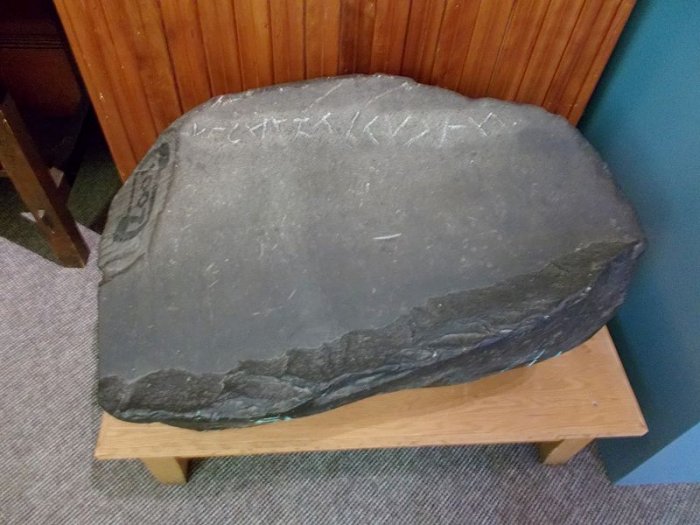
The Yarmouth Runic Stone as currently displayed at the Yarmouth County Museum. Credit: Public Domain
Dr. Barry Fell suggested that the Yarmouth inscription could be written in early Basque, reading "Basque people have subdued this land". His theory was based on the possibility that such stones were deliberately set up along the coast to inform other travelers that territory had already been claimed.
Another possibility, as proposed by Elbert E. Esmiol is that we are seeing a precious artifact left by visitors from the Mycenaean civilization, one of the greatest civilizations of Greek prehistory famous for its majestic architecture and imposing monuments.
The Mycenaean civilization which, according to legend, had been ruled by King Agamemnon, the conqueror of Troy, sprang to life suddenly in southern and central Greece in about 1600 BC.

Closeup of the apparent inscription. Credit: Wreck Smurfy/Public Domain
Developing from seemingly nothing, this civilization would grow to prominence and become one of the most dominant civilizations of the Aegean for hundreds of years.
Esmiol proposed that the inscription is in one of the royal Mycenaean alphabets, and reads as follows:
"Exalted Throne: The pure Lions of the royal household sent into the sunset to protect, to seize, and to make a hole in the mighty waters at the summit have been sacrificed - the whole corporate body".
Yet another theory, proposed by John Campbell is that the inscription is in Old Japanese and reads "wabi deka Kuturade bushi goku" - "Katurade, the eminent warrior, has died in peace". According to the Yarmouth County Museum, the Yarmouth stone is real, but the origin of the inscription remains unknown.
Updated on June 23, 2021
Written by - Ellen Lloyd – AncientPages.com
Copyright © AncientPages.com All rights reserved. This material may not be published, broadcast, rewritten or redistributed in whole or part without the express written permission of AncientPages.com
Expand for referencesMore From Ancient Pages
-
 Ancient Irish Practiced Special Burial Rituals Such As Dismemberment Of Bodies
-
 Re-Writing History Of England’s Domesday Book Of William I The Conqueror
-
 8-Year-Old Boy Finds Unusual Viking Age Artifact On Gotland Island, Sweden
-
 They Spoke The Language Of The Gods – Keepers Of Sacred Ancient Knowledge – Part 1
-
 Historic Event – Exeter Museum Returns Ceremonial Dress Of Famous Chief Crowfoot To Canada’s Siksika People
-
 Unique Medieval Spindle Whorl With Cyrillic Inscription Discovered In Poland
-
 Ethical Ancient DNA Research Must Involve Descendant Communities – Researchers Say
-
 1,700-Year-Old Moche Culture Ceremonial Banquet Hall Discovered In Peru
-
 On This Day In History: American General Benedict Arnold Commits Treason – On Sep 21, 1780
-
 Astonishing Lunar And Solar Calendars Created 30,000 B.C.
-
 Advanced Flying Machines And Interplanetary Travel Described 7000 Years Ago In India
-
 2,500-Year-Old ‘Dragon Bed’ Restored By Chinese Archaeologists
-
 Clapping To Show Appreciation Is An Ancient And Widespread Behavior
-
 Cats Were Rare And Expensive During The Viking Age – Spectacular Discovery Reveals Why
-
 Magnificent Alsengem Among 30,000 Archaeological Objects Discovered In Kalmar, Sweden
-
 Jars With 2,600-Year-Old Vanilla Remnants Discovered In The City Of David
-
 Ancient Mystery Of The Massive, Astronomically Oriented Buildings Worldwide
-
 Giant Solar Mirrors And Sophisticated Lenses – Advanced Ancient Technology Used By Our Ancestors
-
 When Did Humans First Start To Speak?
-
 1,000-Year-Old Viking Weaver’s Sword Reveals Its Secrets

