
Mystery Of 3,000-Year-Old Conical Hats – Was It A Highly Advanced Device?
A. Sutherland - AncientPages.com - They are considered to be "hats of ancient wizards" but their original purpose has baffled scientists for many decades.
Did wizards wear conical hats? Similar hats were worn by many gods. Quetzalcoatl wore his conical cap as Ehecatl, the snake-bird deity, and god of wind feared by the Aztecs, the Sumerian gods were often depicted in similar cone-shaped hats.
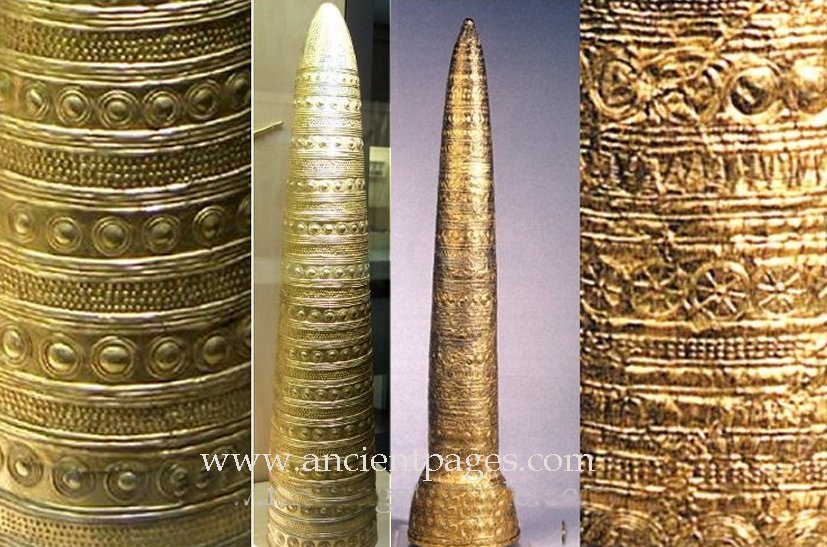
Are the circular symbols on the golden hats a proof of a highly advanced astronomical knowledge of the Bronze Age or perhaps the hats were used as cult objects in ceremonies and rituals?
If so, who was the subject of this worship?
Could the Bronze Age people possess such sophisticated astronomical skills as those presented on conical hats? Where did their advanced knowledge come from?
At first, there was only "a piece of sheet metal 8 cm below the surface of the earth. Since this disturbed the work, it was chopped up and thrown away carelessly. It was only when the sheet metal pieces were washed away by the rain that they were recognized as gold and collected by a worker's wife. Georg Raschke, then head of the prehistoric and early history collection of the Germanisches Nationalmuseum, was able to correctly classify the fragments based on the circular ornaments on them. He managed to buy the gold sheets (280 g) and when the site was examined, he found further fragments (30 g) and fragments of two bronze tires. Subsequently, it turned out that these could have been part of a hat brim reinforcement." 1
Four of the elaborately decorated cones have been uncovered at sites in Switzerland, Germany, and France over the past 170 years.
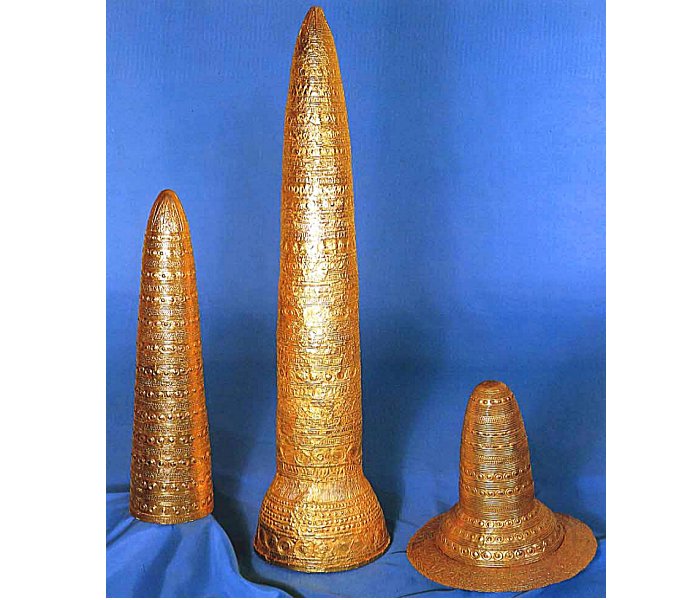
The first of them is 'Golden Hat of Schifferstadt', discovered in 1835 at Schifferstadt near Speyer, c. 1400–1300 BC; the second is the so-called 'Avanton Gold Cone' (incomplete), found at Avanton near Poitiers in 1844, and dated to c. 1000–900 BC.
The third one of these artifacts known as 'Golden Cone of Ezelsdorf-Buch', also dates back to c. 1000–900 BC and was discovered near Ezelsdorf near Nuremberg in 1953. It is the tallest known 'hat' measuring about 90 cm. The fourth is 'Berlin Gold Hat', probably originates from Swabia or Switzerland, and is dated to c. 1000–800 BC.
The gold hats are 3,000 years old and are very similar to each other regarding their form and symbolism and decoration like disks, circles, and wheel symbols.
All four hats were hammered up whole from a single piece of gold.
One of the theories proposes that mysterious conical hats were worn by "king-priests" (Lords of Time) possessing supernatural powers because of their ability to predict the correct time to sow, plant and harvest.
The tallest of them, measuring 90 cm, is that found in Ezelsdorf near Nürnberg. Germany in 1953.
According to scientists who analyzed strange artifacts, these were used to calculate the movements of the sun and the moon in advance.
Another opinion is that the cone-shaped ceremonial hats represent the conical crown of the gods from the region of the Near East, which should serve 'the cultic 'exaggeration' of a person through a high head covering.' The mysterious conical hats have been also related to the so-called 'priest-kings' (Lords of Time) who possessed supernatural powers because of their ability to predict the correct time to sow, plant, and harvest.

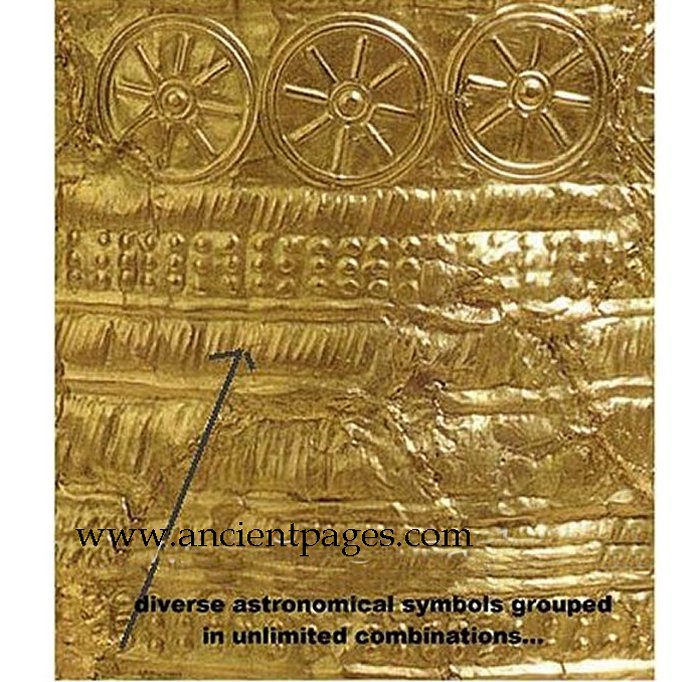
However, there are other interpretations of numerous combinations of both astronomical and calendrical symbols that cover four conical hats.
Mysterious hats are composed of 10 to 20 zones filled with a different number of symbols. The number of circles of each symbol and the number of symbols from one or more zones is multiplied in a first step, the total amount means a number of days.
Then the number of days is compared to astronomical cycles like the synodic month or the tropical year.
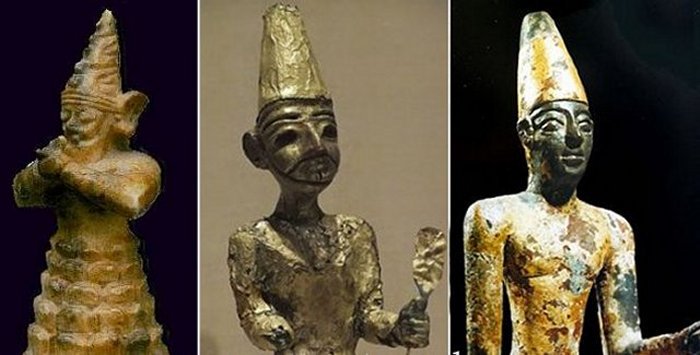
Left: Hittite figure of Baal: Canaanite God El - Megiddo, Modern Israel, c.1400 BC; Right: Phoenician deity Reshep, Byblos, 19th-18 century B
Other explanations suggest hats, quivers, calendars of a different kind, containers, crowns, and much more.
According to scientific studies, the 1,739 sun and half-moon symbols decorating the hat's surface make up a scientific, still undeciphered code which resembles 18.67-year cycle called the "Metonic Cycle" probably identified by Meton of Athens (born circa 460 B.C.; date of death unknown), a Greek mathematician, astronomer, geometer, and engineer.
But the problem is that the Meton's "discovery" took place 500 years after the mysterious conical hats were made.
Similar five golden cones were also unearthed in Ireland during the 17th and 18th centuries and even in many other places of prehistoric Europe, according to Prof Sabine Gerloff, a German archaeologist from Erlangen University, Germany and other researchers.
Written by – A. Sutherland AncientPages.com Staff Writer
Copyright © AncientPages.com All rights reserved. This material may not be published, broadcast, rewritten or redistributed in whole or part without the express written permission of AncientPages.com
Expand for referencesReferences:
D. Price, Europe Before Rome: A Site-by-Site Tour of the Stone, Bronze, and Iron Ages
More From Ancient Pages
-
 Mountain Meadows Massacre: Real Burial Sites Are Far From The LDS Monument’s Location
-
 Horses Skinfaxi And Hrimfaxi – Bringers Of Light And Darkness To Earth In Norse Mythology
-
 Can This Ancient Underwater Graveyard Solve The Mystery Of The Great Flood And Noah’s Ark?
-
 Story Of Atahualpa: The Last Emperor Of The Inca Empire
-
 Historian Discovers Artifacts And Skeletons Of An Ancient Unknown Race In The North American Desert
-
 Mysterious Watson Brake: Old Mound Complex In North America With Earthworks Raised For Unknown Purpose
-
 Extraterrestrial Visit Recorded On Stone: They Came From The Stars
-
 Bizarre Towering Pillars Of Externsteine: Myths, Legends And Sacred Rituals From Times Long Gone
-
 Long-Lost Paleontological Site With More Than 100 Unique Fossils Re-Discovered In Brazil
-
 Two-Story Houses With Balconies Unearthed In Ancient City Of Pompeii, Italy
-
 Oldest Cyrillic Inscriptions Dated To The Time Of King Simeon the Great – Discovered
-
 Amazing Victorian Time Capsule – 135-Year-Old Message In A Bottle Found In Edinburgh
-
 Enigma Of The Chime Hours And People Who Can See Beyond The Visible Realm
-
 Sinister Manchac Swamp And The Chilling Curse Of Julia Brown
-
 Why Did Vikings Burn And Bury Their Longhouses?
-
 New Dating Of Intriguing Cave Art Reveals History Of Puerto Rican People
-
 Amazing Time Capsule – La Roche-Cotard Cave Sealed For 50,000-Years Offers Evidence Neanderthals Were The World’s First Artists
-
 Fragment Of A Fine Marble Statuette Of Heracles Found In Jezreel Valley, Israel
-
 Setne Khamwas And The Book Of Magic Written By Thoth
-
 What Happened To The Staircase In The Temple Of The Goddess Hathor?

