
Puzzling Palpa Lines In Peru Made By The Paracas Culture Are Even Older Than The Nazca Lines
Ellen Lloyd - AncientPage.com - The enigmatic Palpa lines in Peru are not as famous as the Nazca Lines, but these puzzling lines and geoglyphs that can only be properly viewed from the air are equally fascinating.
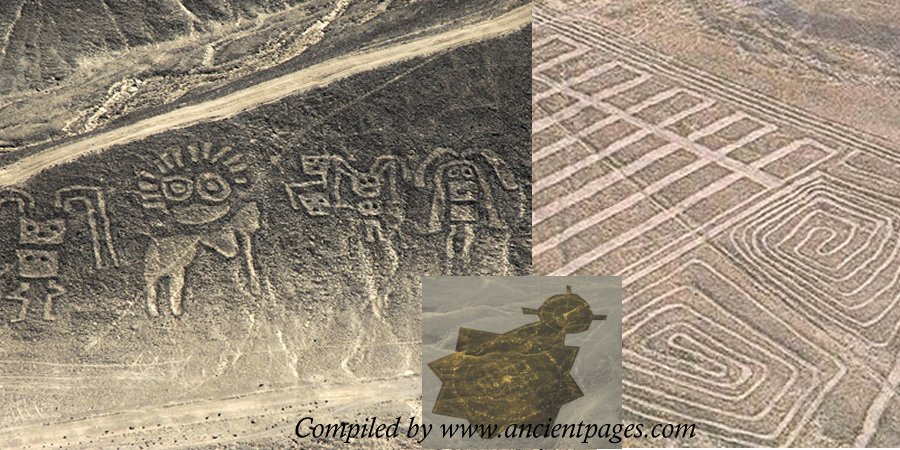
Archaeological examinations reveal the Palpa lines are older than the Nazca lines and were most likely created by the Paracas culture. This Andean society existed between about 800 BCE and 100 BCE in what today is the Ica Region of Peru.
The Palpa lines are located between Sacramento, Pinchango, and Llipata. The purpose of the lines and geoglyphs is unknown. There are as many as 600 geoglyphs of giant size. They represent a series of human and animal zoomorphic figures, including the Familia Real (Royal Family), a group of eight figures on a hillside.
Like the Nazca lines, these ancient carvings are regarded as one of archaeology's greatest enigmas because of their quantity, nature, size, and continuity. Scientists suggest the geoglyphs had ritual astronomical functions.

Palpa Lines and Geoglyphs, Peru. Credit: Adobe Stock - javarman
These giant geoglyphs and lines must have been important to our ancestors, and they were undoubtedly not easy to create. Many consider the figures an extraordinary example of the traditional and millenary magical-religious world of the ancient pre-Hispanic societies that flourished in Peru.
The mysterious Candelabrum located about 130 miles from the Nazca Plain, is one of the most enigmatic ancient giant ground drawings in the world.

Paracas Candelabra. Image credit: Alex Zanuccoli - flickr.com
The Candelabra is 595 feet long and resembles a candlestick, seen from as far as 12 miles to sea. Its creators believed it was important that the ground drawing must be visible from the air. Who made it and why? It is a question no one has been able to answer so far.
It’s important to note that similar geoglyphs have been found in North America as well. We wrote on Ancient Pages that over 300 remarkable intaglios exist in the American Southwest and adjacent Mexico.
The most famous are the Blythe Intaglios, located west of the Colorado River about 15 miles north of Blythe, California.

Blythe Intaglios. Image credit: - CC BY-SA 4.0
Here, we come across gigantic human and animal figures carved on the ground. Just like Peru's wonderful and intriguing Nazca lines, these figures can only be adequately seen from the air, which is why white men didn't discover them until the 20th century.
According to the stories told by modern-day Mohave and Quechan Indians, the human figures represent Mastamho, the Creator of Earth and all Life, while the animal figures represent Hatakulya, one of two mountain lions who helped in the Creation.
" In the Mohave myth, there are two totemic lion figures, helpers to Mustamho (the creator), who are known as Numeta and Hatakulya. Those lion figures are present in numerous petroglyph locations. Numeta is normally depicted with his tail up in the air while Hatakulya has his tail down.." (Johnson, 1986)
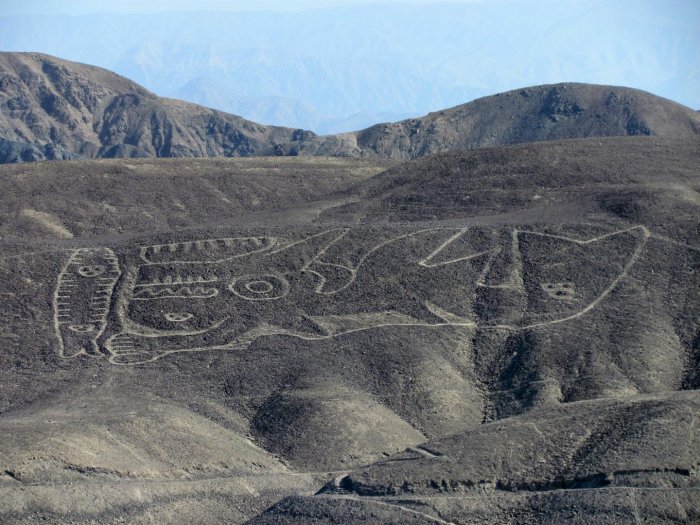
The orca geoglyph in southern Peru. Image credit: German Archaeological Institute
Recently, researchers found a new giant geoglyph of orca with mysterious symbols and a ‘trophy head’ in the Nazca Desert.
The figures are difficult to discover because they can only be properly from the air. We can only wonder how many more giant geoglyphs are hiding in front of our eyes.
Updated on October 29, 2023
Written by Ellen Lloyd – AncientPages.com
Copyright © AncientPages.com All rights reserved. This material may not be published, broadcast, rewritten or redistributed in whole or part without the express written permission of AncientPages.com
Expand for referencesAlex Patterson, A Field Guide to Rock Art Symbols of the Greater Southwest
More From Ancient Pages
-
 Agathocles Of Syracuse: Sicilian Ruler Who Committed Numerous Crimes Saved And Extended Sovereignty Of Sicily
-
 Ancient Mystery Of A Lost Polar Civilization That Vanished Without A Trace
-
 Rare 2,300-Year-Old Tomb Of Greek Courtesan Found In Jerusalem Burial Cave
-
 Horrible Ancient Massacre On The Island Of Chios Led To Greek Independence
-
 Czech Neolithic Well Is Oldest Wooden Structure In The World
-
 Athena – Goddess Of Wisdom Delivered Punishments And Gifts
-
 North America Is Named After An Italian Explorer
-
 Ancient DNA Reveals Easter Island’s Population Collapse Never Occurred
-
 Another 2,000-Year-Old ‘Snack Bar’ Discovered In Pompeii
-
 Monster Water God Gong Gong Blamed For Cosmic Catastrophes In Chinese Myths
-
 Migrants From Turkey And Greece Arrived In Britain Some 6,000 Years Ago
-
 Ancient Maya Reservoirs Can Solve Today’s Water Crises – Scientists Say
-
 Ancient Secrets Of John Dee And The Enochian Apocalypse Examined
-
 Survivors Of The Latest Ice Age Thrived Near The Sea Of Galilee 23,000 Years Ago
-
 Viking’s Symbols Of Travels Prestige And Adventure Were Imported From Abroad
-
 Rare 1,850-Year-Old Bronze Zodiac Coin Discovered During Underwater Survey Off Israel’s Coast
-
 Unusual Underwater Archaeological Discovery In California May Confirm Thousand-Year-Old Legend And Re-Write Ancient History
-
 First Discovery Of 60,000-Year-Old Quina Technology In East Asia Challenges Understanding Of Ancient Human Evolution
-
 Axum: Mysterious Megalithic Towering Obelisks In Ethiopia
-
 Previously Assumed Turkic Origin Of The European Huns – Refuted; They Had Ancient Siberian Roots

