
Ancient Egyptian Women Had Equal Rights As Men – Egyptian Cosmology And Goddess Maat Reveal Why
Ellen Lloyd - AncientPages.com - When ancient Greek historian Herodotus (484–c. 425 BC) visited Egypt, he was shocked to see how women behaved. Unlike women in ancient Greece, Egyptian females had the same rights as men. They worked, received the same pay rations as men, got drunk, and could become powerful rulers.
Such behavior was completely unacceptable in ancient Greece where women had no rights at all and had to obey the man, who was master of the house.
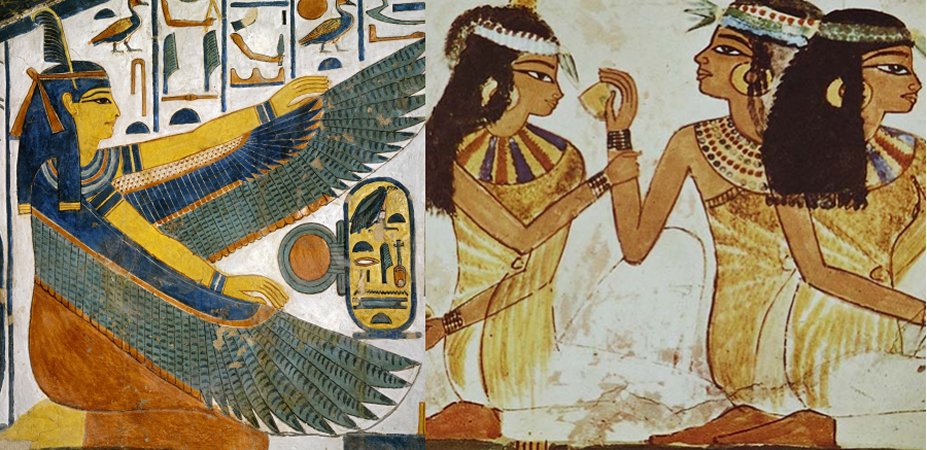
Ancient Greek women had to receive permission from the man to leave the house’s female quarters. The situation for females in ancient Egypt was much different. In the land of the pyramids, it was not unusual that women spend their days visiting markets and shopping, while their husbands stayed at home doing ordinary housework.
Ancient Egyptian Cosmology And Goddess Maat
Women in ancient Egypt had equal rights as men for thousands of years, but why did their living conditions differ so much from women who lived in neighboring countries?
The answer to this question can be found in Egyptian mythology and ancient Egyptians’ cosmological beliefs.
In ancient Egypt, people worshipped Maat (Ma’at), goddess of truth, balance, and order. Her name, literally, meant ‘truth’ in Egyptian and she was a symbol of harmony. Egyptians believed that without her existence, the universe would become chaos, once again.
As previously mentioned in Ancient Pages, there is a striking similarity between the Ten Commandments and the 42 Principles of Ma’at that appeared at least 2,000 earlier.
The 42 Principles of Ma’at were created so that ancient Egyptians could follow vital rules and act with honor and truth in manners that involve family, the community, the nation, the environment, and the gods.

Goddess Maat. Image credit: blackawakeningmovement.com
Ancient Egyptians viewed the universe as a complete duality of male and female
When the Universe was born there existed a mutual relationship between gods and goddesses. Female gods were just as important as male gods. It was, therefore, necessary to preserve a balance between the gods and people and between the two sexes. Goddess Maat was responsible that this balance was kept.
See also:
Maat – Ancient Egypt’s Most Important Religious Concept
10 Fascinating Facts About Pharaohs
Herodotus believed the Egyptians 'have reversed the ordinary practices of mankind’ and the treatment of women in ancient Egypt caused controversy among other ancient cultures, but the Egyptians kept their laws based on their beliefs.
Divorce, Education, Wills, Inheritance And Same Punishment For Crimes
Egyptian women were allowed to divorce if they were no longer happy with their husbands. Rich Egyptian women could study and get a proper education. This was not possible for women who came from poor families due to financial matters.
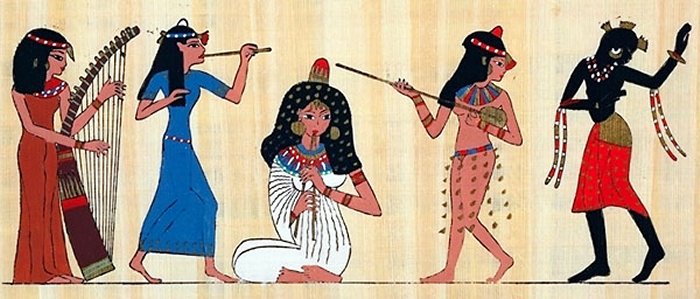
Women in ancient Egypt had plenty of rights.
Women and men received the same punishment for the same crime. The property was inherited through the woman's family, and women were able to manage their land, their animals, and their homes themselves. Egyptian females were allowed to make wills and even choose which of their children would inherit.
In another article on Ancient Pages, we discussed the importance of Egyptian makeup. Frescoes discovered in ancient Egyptian temples illustrating daily life reveal men often wore makeup. In fact, it’s almost impossible to find a portrait of an ancient Egyptian whose eyes are not decorated.
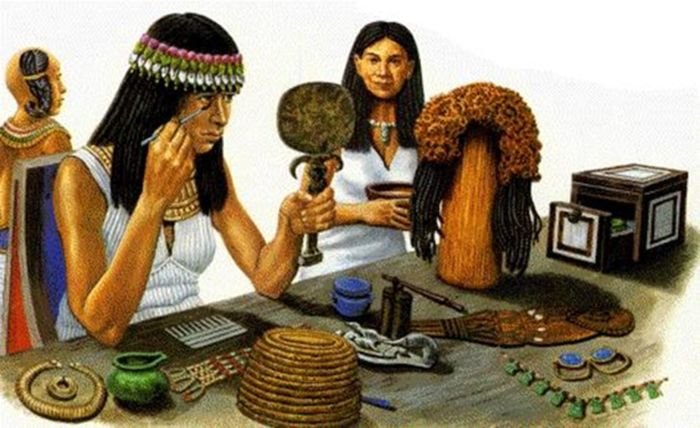
The use of cosmetics was vital to men and women in ancient Egypt. Makeup was once an important part of everyday life in Egypt and it was not only used to look better. There was a much more important purpose behind the use of cosmetics in ancient Egypt. Cosmetics was sacred to ancient Egyptians and used not only for aesthetic purposes but rather for magical and religious purposes.
There were no differences between how men and women used makeup.

Pharaoh Hatshepsut and Queen Nefertiti were two famous female rulers in ancient Egypt.
Egyptian women could become powerful pharaohs, but they were naturally challenged by their male rivals. Once a female had become a pharaoh, her duties did not differ from male pharaohs.
A good example of a skillful and efficient female ruler is Pharaoh Hatshepsut, who brought prosperity to ancient Egypt. Another important female ruler was Queen Nefertiti. Why she suddenly disappeared after being elevated to near-equal status by King Akhenaten remains a mystery.
Written by - Ellen Lloyd – AncientPages.com
Copyright © AncientPages.com All rights reserved. This material may not be published, broadcast, rewritten or redistributed in whole or part without the express written permission of AncientPages.com
Expand for referencesMore From Ancient Pages
-
 Underwater Ancient Cypress Forest Offers Clues To The Past
-
 Dionysus – Greek God Of Wine, Music, Ritual Madness And Ecstasy Was Born Twice
-
 Battle Of Visby – Death Came With King Atterdag’s Ships
-
 Chaco Canyon Mystery Solved By Scientists Hauling Logs On Their Heads
-
 Maya Site With At Least 300 Buildings Some Of Which Are Over 8 Meters High – Discovered
-
 Egyptian Blue: World’s Oldest Artificial Pigment
-
 Ancient Greek Seven-Room Building And Treasures Found Underwater Off The Coast Of Salamis
-
 Traces Of Early Humans Discovered In Southern Iran
-
 Tree Rings On the Oregon Coast Show Evidence A Tsunami That Struck The Pacific Northwest In 1700
-
 ‘Sesselfelsgrotte Cave’ – Innovative Neanderthals Adjusted To Climate Change By Creating More Complex Tools
-
 Non-Royal Elite Burial And Deciphered Hieroglyph Reveal Privileged And Hard Life Of Maya Ambassador
-
 Archaeological Discovery Of “Once-In-A-Lifetime” Medieval Gold Necklace In Britain
-
 Mysterious Fossilized Antarctic Forest May Offer Evidence Of The Great Flood – But Some Facts Speak Against This Theory
-
 ‘Impossible’ Ancient Egyptian Visit Troubles Historians
-
 Unsolved Old Cherokee Mystery In The Great Smoky Mountains
-
 World’s Oldest Moon Map Carved Into Ireland’s 5,000 Year-Old Tomb At Knowth
-
 Human Activities In The Year 1300 Impacted Earth’s Atmosphere More Than Previously Known
-
 The Chinese Nostradamus And His Striking Predictions
-
 Crosby-Schøyen Codex: Ancient Coptic Manuscript Reveals Sermon That Spurred Violence Against Jews
-
 Archaeologists Dug For Evidence Of The Rosetta Stone’s Ancient Egyptian Rebellion – Here’s What They Found

