
Is Biblical Mount Sinai Located In Har Karkom Where Mesopotamian Moon God Sin Was Worshipped?
Ellen Lloyd - AncientPages.com - The quest for the Biblical Mount Sinai is not over. It has previously been suggested that Mount Sinai, also known as Mount Horeb or Gabal Musa, is located in the Sinai Peninsula of Egypt, where we also find Saint Catherine's Monastery, the oldest working Christian monastery in the world.
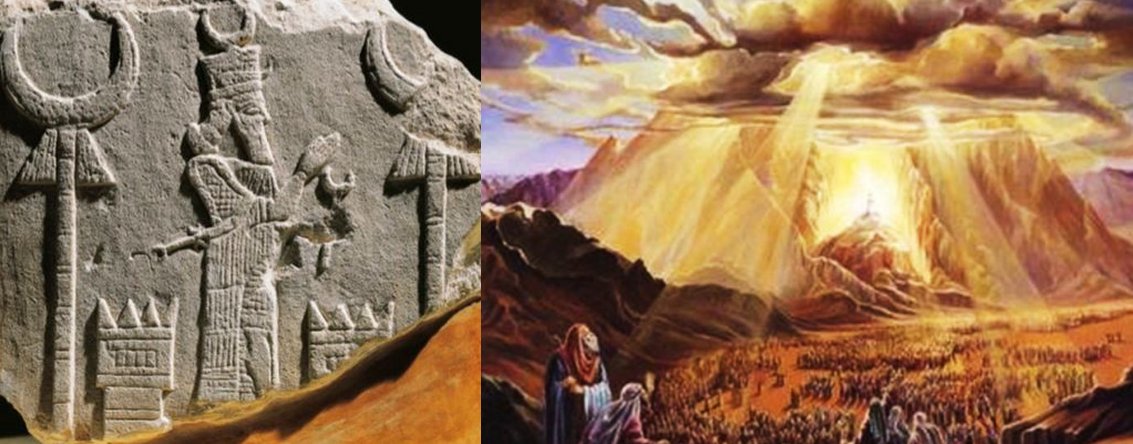
Nevertheless, there are Biblical scholars and archaeologists who questions this particular location and maintain this place should by no means be associated with Biblical Mount Sinai.
There are no archaeological nor historical reasons to claim that the Biblical Mount Sinai is in Egypt, scientists say.
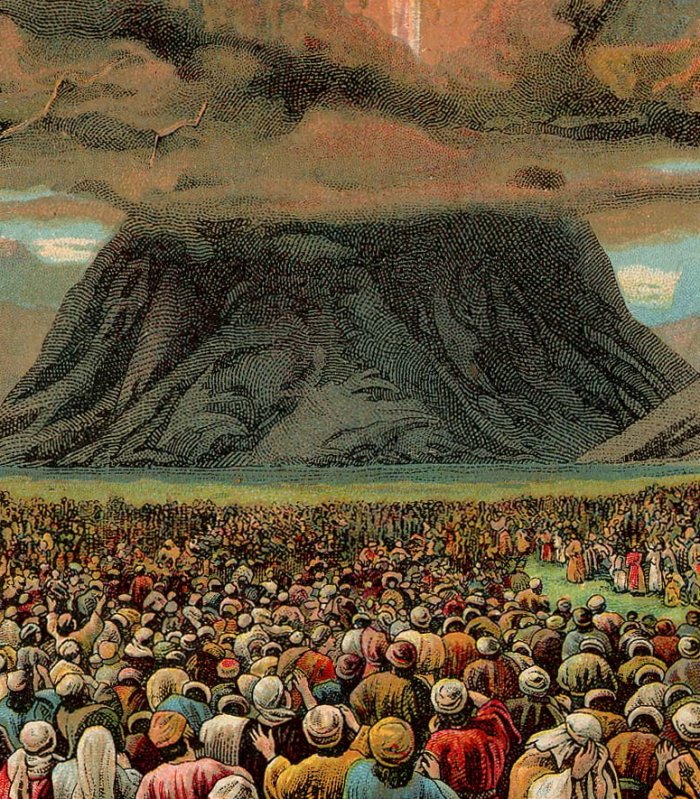
Mass-revelation at the Mount Horeb in an illustration from a Bible card published by the Providence Lithograph Company, 1907. Image credit: Wikipedia
According to Jewish, Christian, and Islamic tradition, the biblical Mount Sinai was the place where Moses received the Ten Commandments. It is one of four sacred mountains in Judeo-Christian traditions.
The other mountains are Mount Ararat in eastern Turkey, named as the place where the Ark of Noah came to rest when the waters of the flood receded, Mount Moriah or Mount Zion in Israel, where lies the city of Jerusalem and the Temple of Solomon, and Mount. Tabor in Israel that is regarded as the site of the transfiguration of Jesus.
See also:
Has World’s Oldest Image Of Virgin Mary Been Discovered In Dura-Europos Church?
Search For Noah’s Ark Continues – The ‘Inside Mount Ararat’ Research Project
Mystery of The Tower of Babel – The Mountain Of God Or A Symbol Of Chaos And Ignorance?
Biblical Events Confirmed: The Jerusalem’s Wall That Nehemiah Built
In an article called “ Where Is Mount Sinai? The Case for Har Karkom and the Case for Saudi Arabia” in the March/April 2014 issue of Biblical Archaeology Review, Italian archaeologist Emmanuel Anati reveals that he has found evidence indicating Biblical Mount Sinai was on a site known as Har Karkom in the Negev of Israel.
Sin – The Moon God And His Connection To Biblical Mount Sinai
According to Anati, who has been investigating the site for more than 30 years there are 40,000 rock engravings and more than 120 rock cult sites at the base of Har Karkom.
It is Anati’s opinion that people who lived in Har Karkom during the Early Bronze Age worshipped the Moon God Sin. Many temples were raised in his honor.
In Mesopotamian mythology, Shamash was the God of Sun and Sin was the God of the Moon.
In the Early Dynastic god lists, the Moon god appears immediately after the four leading gods An, Enlil, Inana and Enki.
One study suggests that name Sinai derives from the name of the moon God Sin.
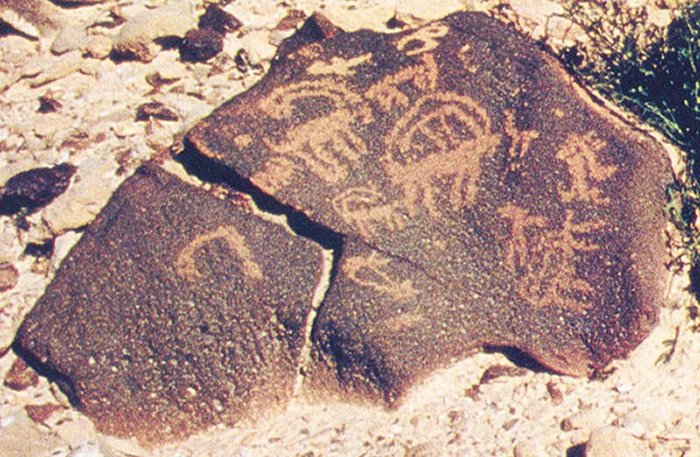
Italian archaeologist Emmanuel Anati has discovered many rock carvings that depict ibexes, with their crescent-shaped horns, and may have symbolized the Moon. Image credit: Emmanuel Anati
In Har Karkom there are many petroglyphs of cult scenes contain ibexes with their crescent-shaped horns, symbolizing the Moon. Similar discoveries have never been made in the Sinai Peninsula.
“How could it be that such an outstanding Bronze Age holy mountain would not be mentioned in the Pentateuch?” Anati asks. Surely, it must be referred to, but the name in the Bible is Mount Sinai.
Anati thinks that those who refuse to accept Har Karkom as the site where Biblical Mount Sinai was located are simply not sufficiently acquainted with the discoveries.
Written by Ellen Lloyd – AncientPages.com
Copyright © AncientPages.com & Ellen Lloyd All rights reserved. This material may not be published, broadcast, rewritten or redistributed in whole or part without the express written permission of AncientPages.com and Ellen Lloyd
About the author:
Ellen Lloyd – is the owner of AncientPages.com and an author who has spent decades researching ancient mysteries, myths, legends and sacred texts, but she is also very interested in astronomy, astrobiology and science in general.
More From Ancient Pages
-
 Why Was The Moretta Mask So Popular?
-
 Mystery Of The Headless Skeletons From Vráble
-
 Somalia’s Legacy: Laas Geel Caves Covered With At Least 5,000-Year-Old Paintings
-
 2,000-Years-Old Warrior Graves With Iron Swords, Mysterious Square Structures, Unearthed In Bejsce, Poland
-
 Mystery Why Vikings Left Greenland Has Been Solved By Scientists
-
 Ice Age People Returned To Central Europe Much Earlier Than Previously Thought
-
 Sun God Ra Was Venerated In Every Age Of Ancient Egypt’s Long Dynastic History
-
 Mysterious Sherbrooke Stones – Did Africans Visit North America 2,500 Years Ago?
-
 What Was Inti Raymi And Why Was It Celebrated By Inca?
-
 On This Day In History: Mathematician And Astronomer Christiaan Huygens Born – On Apr 14, 1629
-
 Ancient Greco-Roman Amphora Workshop Discovered In Alexandria, Egypt
-
 Long-Lost Legendary Ancient Temple Discovered On San Miguel Hill In Mexico
-
 Brief History Of Abortion – From Ancient Egyptian Herbs To Fighting Stigma Today
-
 Unraveling The Mystery Of Ancient ‘False Doorways’
-
 Mysterious Figurine Of Seated Olmec Woman With Polished Hematite Disk
-
 Legendary And Mysterious Stone Of Brutus – The London Stone Refuses To Give Up Its Secrets
-
 Depictions Of Two Biblical Heroines Unearthed In Ancient Synagogue, Huqoq In Galilee, Israel
-
 Cache Of 13,000 Ostraca Unearthed In Upper Egypt’s Sohag
-
 On This Day In History: Samuel Morey Patents The Internal Combustion Engine – On April 1, 1826
-
 Priceless 800-Year-Old Treasure Featuring Three Golden Lions Unearthed

