
Ganesha: Elephant-Headed God Of Knowledge, Learning, Literature And Scribe Of The Mahabharata
A. Sutherland - AncientPages.com - It is commonly believed that the Elephant God, Ganesha (Ganesh, in Hindi word) means success and wealth; therefore people place a statue or a figurine of the Ganesha, in his store, or another place of their business.
Ganesha is one of the best-known and loved deities in the Hindu pantheon of gods and indeed is the most recognized of the Hindu gods outside of India.

Lord Ganesha. Image credit: Jayananda sagar - CC BY-SA 3.0
He is the Lord of Good Fortune, the Lord of Beginnings, and the Remover of Obstacles and evils people meet in their lives, but he can also place obstacles in the path of those who need to be checked. He is also considered the destroyer of pride, selfishness, vanity.
Ganesha protects homes and cars. People often place a Ganesha statue or medallion on the front dash of their cars. Ganesha is also associated with learning and study, scribes, schools, and wisdom.
It is he who transcribed the Mahabharata while the poet Vyasa recited it. The elephant-headed son of Parvati and Shiva, Ganesha (Ganapati) with a bulky belly and four hands, is the subject of many myths.
One myth in the Shiva Purana explains his elephant-head, it is said that he was created by his mother Parvati ( daughter of the mountain) using earth, which she molded into the shape of a boy.
One day, while Shiva was away, Parvati wanted to take a bath but there was no one to guard the door. So she formed a little boy from clay and breathed life into him. She instructed him to guard the entrance to her bathroom, while she bathed.
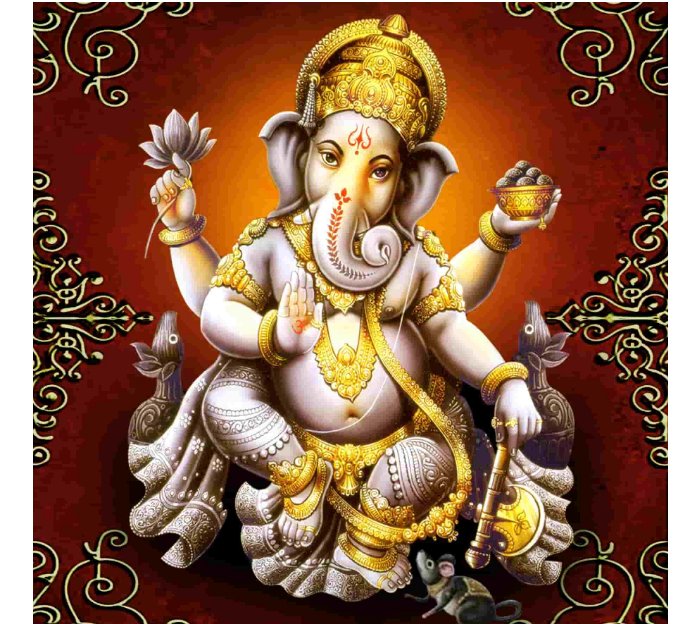
Ganesha - the God of Powers, Abilities, wisdom, knowledge, intelligence, arts, and Skill Ganesha possesses the traditional bodily attributes of the Hindu gods, which includes superhuman strength, superhuman stamina, endurance, resistance to harm, and enchanted longevity. Image credit: Pradeep Kumar Sharma - CC BY-SA 4.0
Unexpectedly Shiva returned and was furious that the boy at the door would not let him in to see his wife. In his rage, he cut off the boy’s head. Parvati came rushing out and was horrified by what Shiva had done. She told him that this was their son. Shiva ordered a new head to be found for the boy and, as the first animal available was an elephant, so Ganesha gained a new head and became the most unique of the Hindu gods.
The boy was short and fat with a red face, but in some deeper sense, he was very beautiful. He was named Ganesh, “Lord of his father’s ganas” (“hosts”) and a small mouse often showed on his depictions, became his vahana (vehicle) to ride on.
Ganesha is portrayed as standing, sitting, dancing, or crawling as a child, or even sitting on his mother's knee.
His image is found everywhere, in many different forms. Ganesh is widely worshiped in all parts of India, regardless of people’s spiritual affiliations and his characteristics and the attributes that have evolved over the centuries of Indian history.
Written by – A. Sutherland AncientPages.com Staff Writer
Copyright © AncientPages.com All rights reserved. This material may not be published, broadcast, rewritten or redistributed in whole or part without the express written permission of AncientPages.com
Expand for referencesMore From Ancient Pages
-
 Colossus of Ramesess II At Karnak Temples Is Undergoing Restoration
-
 1.5-Million-Year-Old Hand Axes And Hundreds Of Ancient Artifacts Found In The Iraqi Desert
-
 Anglo-Saxon Previously Unknown Monastic Or Trading Center – Discovered
-
 Where Is The 12,000-Year-Old Map That Could Change All We Know About Ancient Egypt Hidden?
-
 Human And Neanderthal Brains Have A Surprising ‘Youthful’ Quality In Common – New Study
-
 Antediluvian Time-Capsule Hidden In Forbidden Ancient Egyptian Crypts?
-
 The Use Of Surnames Started During The Middle Ages In England
-
 Still Intact Renaissance Shipwreck Discovered On The Baltic Seabed
-
 Extremely Rare English Medieval Shipwreck With Fascinating Cargo Discovered In Poole Bay, Dorset
-
 Ancient Artifacts With Foreign Inscriptions And Unknown Signs Discovered In The American Southwest Reveal An Epic Story
-
 On This Day In History: Walpurgis Night Celebration In Northern Europe – On Apr 30
-
 Remote North Atlantic Islands Were Settled By An Unknown Group Of Humans Centuries Earlier Than Thought
-
 On This Day In History: Mesoamerican Long Count Calendar Begins – On August 11, 3114 B.C
-
 Archaeologists Make An Unusual Find In A 2,000-Year-Old Romanian Burial Mound
-
 Ancient Roman Wooden Sewn Boat Unearthed In Croatia
-
 Gog And Magog Prophecy In The Book Of Revelation
-
 America’s Mysterious Pedro Mountain Mummy And The Hidden Race Of Little People
-
 Mysterious Viking Gerdrup Grave – Burial Place Of Sorceress Katla And Her Son Odd Mentioned In The Eyrbyggja Saga?
-
 Remains Of A 2,300-Year-Old Sunken Ship Discovered At Alamein Shore
-
 On This Day In History: Pakal Ascends The Throne Of Palenque At Age Of 12 – On July 29, 615

