
Gigantic Neolithic Newgrange Monument: A Temple, Astronomical Observatory Or Ancient Tomb?
A. Sutherland - AncientPages.com - In Ireland, the chambered round cairn of Newgrange, with its quartz walls and a passage aligned towards the midwinter sunrise, was placed inside a circle of over thirty massive blocks of stone. It is a fascinating ancient construction located about 26 miles north of Dublin, Ireland.
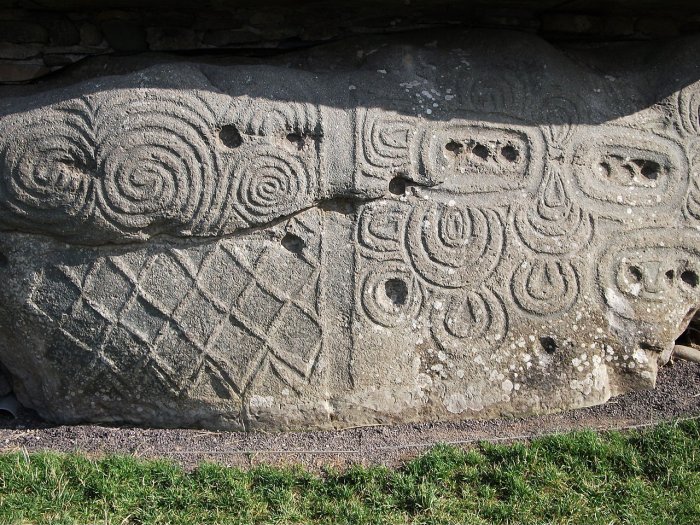
Stone at Newgrange - Megalithic art on one of the kerbstones - Image credit: - - CC BY-SA 3.0
The gigantic Neolithic tomb of Newgrange (in Irish: Si An Bhru) is one of the world's most impressive prehistoric monuments, probably constructed about 5,100 years ago. The structure is older than the Great Pyramid of Giza and the Stonehenge enormous trilithons.
First written references to Newgrange appear as early as 656 AD in medieval Irish annals, and during the Roman times, Newgrange was already a ruin.
It is believed that the ancient Celts considered the place as an abode of spirits and a former home of their mythological ancestors, "the peoples of the goddess Danu" (Tuatha Dé Danann). Danu was a mother goddess associated with Anu, another Celtic mother goddess who sponsored fertility and prosperity in the land. Some Celtic traditions say that Newgrange belonged to the Daghda ("the good god").
The Celts believed the abandoned prehistoric tombs, such as Newgrange, were portals ('sidh') to the mysterious and dangerous Otherworld, with its subterranean realms and hidden places within the hills.

View of Newgrange, archaeological site of Brú na Bóinne. Image credit: Jean Housen - CC BY-SA 3.0
Professor Michael J. O'Kelly excavated and restored the megalithic passage tomb at Newgrange from 1962 to 1975. He discovered that the builders of Newgrange deliberately oriented the passage so that each year around the winter solstice, the rising Sun's rays would shine through a unique aperture he called a roof box to illuminate the chamber.
Newgrange has a diameter of about 264 ft and is almost circular. Stones layered with turf form the Newgrange's mound, surrounded by 97 large stones, the so-called 'kerbstones' (curbstones), some of which are richly decorated.
Surrounding the Newgrange mound is a ring of 12 standing stones, up to 8 feet in height. There were probably approximately 35 upright stones, but they were destroyed or removed over time.
Newgrange is famous for a spectacular phenomenon occurring at the site every year for a few days around the 21st or 22nd of December. The entrance to the Newgrange passage tomb contains a doorway with two standing stones and a horizontal lintel.

A section of the passage leading towards the chamber of the Newgrange passage tomb in Ireland. Image credit: O'Dea - CC BY-SA 4.0
Above this doorway is the 'roof box' or 'lightbox.' Every year after 9 am (on the early morning of the winter solstice – the shortest day of the year) – the newly risen Sun sends a shaft of sunlight through the Newgrange' light box', creating a narrow beam of light illuminating the central chamber located at the back of the tomb.
The phenomenon lasts 17 minutes, the beam of light slowly disappears, and the chamber is dark again.
It is commonly agreed that the Iron Age Celts did not build Newgrange, but it was unclear how old it really was.
Finally, Professor O'Kelly excavated and restored Newgrange from 1962 to 1975. He discovered that those who built the Newgrange deliberately oriented the passage so that each year around midwinter, the rising Sun's rays would shine through a unique aperture to illuminate the chamber.

Sketch of a cross section of the Newgrange passage grave made by William Frederick Wakeman (d. 1900). Screen capture of PDF version of the 1903 edition converted into black and white and adjusted for contrast and brightness. - Wakeman's handbook of Irish antiquities (1903). p. 85. - Public Domain
The stone chamber and mound at Newgrange in Ireland has a 'lightbox' allowing the sunrise to be glimpsed briefly on a midwinter day.
According to radiocarbon dating conducted by O'Kelly, Newgrange was constructed in the last centuries of the fourth millennium BC, probably around 3200 BC.
The Newgrange monument's primary functions as a tomb, an astronomical observatory, or an ancient temple celebrating the Sun's union with Mother Earth are often disputed.
Written by – A. Sutherland AncientPages.com Staff Writer
Updated on December 19, 2022
Copyright © AncientPages.com All rights reserved. This material may not be published, broadcast, rewritten or redistributed in whole or part without the express written permission of AncientPages.com
Expand for referencesMore From Ancient Pages
-
 On This Day In History: William I ‘The Lion’ Was Crowned At Scone – On Dec 24, 1165
-
 Was Napoleon Bonaparte Defeated At Waterloo Because Of Volcanic Eruption?
-
 1,200-Year-Old Viking Sword Found By Hiker In Norway
-
 Ceibal Is The Oldest Known Ceremonial Site Of The Maya Civilization
-
 Strange Case Of The Italian Doppelganger – A Tragedy – Part 1
-
 Are Relics In Santi Apostoli Church Really The Remains Of St. James And St. Philip?
-
 Raven Mocker And Cannibal Body Snatchers In Cherokee Mythology
-
 Mystery Of Queen Semiramis: Famous And Powerful Ancient Ruler And Warrior Queen
-
 Ancient Statue Of Makara, Legendary Sea-Creature Found In Cambodia
-
 Chinese Writing System – Increasingly Complex Over The Course Of Its 3000-Year History
-
 On This Day In History: Martin Luther Was Excommunicated From The Catholic Church – On Jan 3, 1521
-
 Michabo (Michabou) – Algonquins’ Great Spirit With Power Over The Earth
-
 Ancient Temple Complex Dated To Nanzhao Kingdom Unearthed In Southwest China
-
 Secrets Of Viking Age Shields Finally Revealed
-
 Mysterious Havering Hoard – Largest Ever Bronze Age Hoard Discovered In London
-
 Pyramid-Builders’ Cemetery With Coffins Discovered Near Giza, Egypt
-
 Pilot Mountain Is Home To A Mysterious Underground Civilization – Cherokee Legend Tells
-
 Geri And Freki: Two Wolves ‘Greedy’ And ‘Ravenous’ Were Loyal Companions Of Odin In Norse Beliefs
-
 Ekambareswarar Temple In Tamil Nadu, India Dedicated To Lord Shiva
-
 First Near-Complete Sauropod Dinosaur Skull Found In Australia Hints At Ancient Links Between Continents

