
Abydos: One Of The Most Important Cities Of Ancient Egypt
A. Sutherland - AncientPages.com - Once, it was the site of many temples, especially the temple of Seti I, and first of all, this very ancient city is strongly associated with the "Lord of Abydos" - Osiris, god of the dead and its cult.
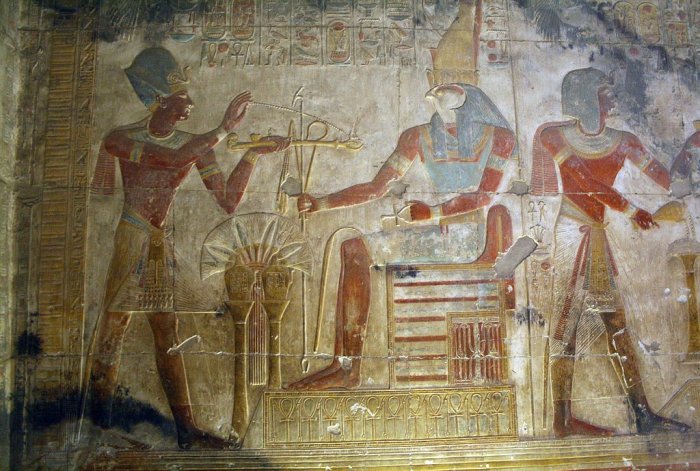
Temple of Osiris at Abydos. God Horus presents royal regalia to a worshipping pharaoh. Credit: Steve F-E-Cameron - CC BY-SA 3.0
Today, it's considered one of ancient Egypt's most important archaeological sites. It is a place with a famous royal necropolis where early pharaohs were entombed and other tombs and mortuary cult enclosures of the rulers of the First Dynasty.
According to some ancient mortuary texts, beyond a gap in the mountains to the west of Abydos lay the afterlife, a fantastic realm depicted as a long mountainous valley with a river running through it, the banks lined with wheat fields, fruit orchards, and gardens of flowers.
Many of these tombs are still buried under the desert sands. They keep millennia-old secrets of the sacred ground of Abydos, which flourished and was already surrounded with an aura of sanctity.
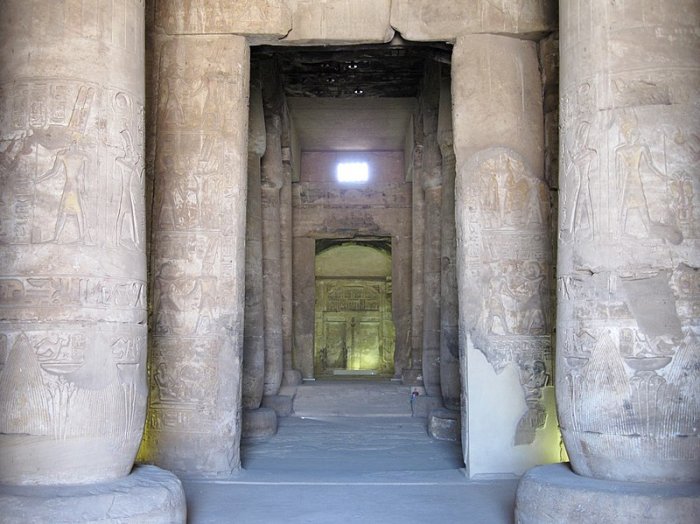
Abydos Temple. Credit: Olaf Tausch - CC BY 3.0
Otherwise, these archaeological treasures could cast light on the origins of the Egyptian civilization, still a controversial subject among many scholars.
Abydos rose to its peak as a holy city during the New Kingdom (1567- 1080). Still, the rising local cult of the "Lord of Abydos" lasted at least from the Middle Kingdom (around 1800 BC) until late Antiquity and the tomb of Osiris was the main focus of worship.
Today, the Abydos Temple is notable for the memorial temple of Seti I, which contains an inscription from the nineteenth Dynasty known to the modern world as the Abydos King List.
It is a chronological list showing cartouches of most dynastic pharaohs of Egypt from Menes until Ramesses I, Seti's father.
Abydos is the source of many of Egypt's most ancient artifacts. Unfortunately, the Great Temple of Abydos and most ancient towns are buried under the modern buildings to the north of the Seti temple.
Many of the original ancient structures and artifacts are considered irretrievable and lost.
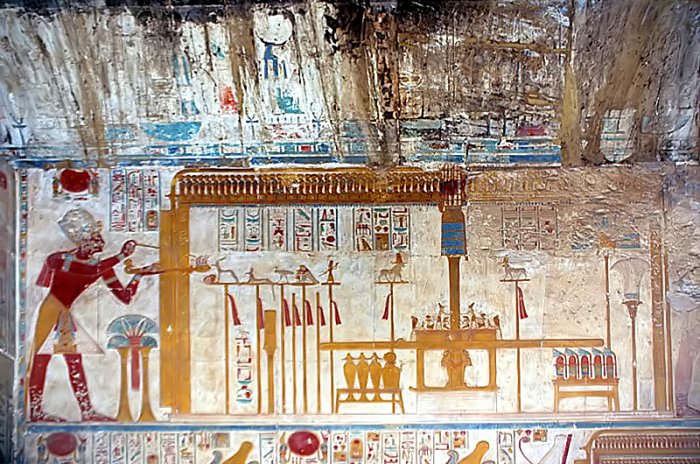
Chapel of Osiris, King censing before shrine containing Osiris emblem, Temple of Seti I, Abydos, Egypt. Credit: Roland Unger - CC BY 3.0:
In archaeology, many extraordinary finds still make headlines either because of their prehistoric significance - many priceless artifacts witnessed the glory of Abydos - or even because of the sensational circumstances surrounding them.
In 1988 Günter Dreyer, a German archaeologist, unearthed small bone and ivory tags intricately inscribed with one of the world's earliest forms of writing, namely, crude hieroglyphs developed at about the same time as Mesopotamian cuneiform.
"Each discovery raises new questions and issues and indicates that further mysteries remain to be explored and resolved," said David O'Connor, an internationally recognized Egyptologist with 40 years experience of excavation and research at Abydos and author of "Abydos: Egypt's First Pharaohs and the Cult of Osiris."
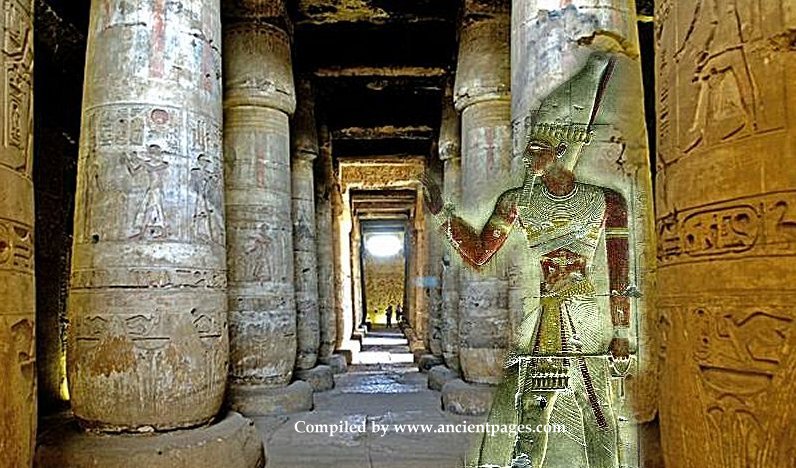
In 1991, O'Connor uncovered an eerie fleet of wooden boats buried in enormous brick-lined graves: how many more priceless artifacts are hidden under the desert sand?
Abydos and its sacred ground are famous for its two fine temples, one built by Seti I, who encouraged artistic and architectural ideas in his reign. The other was by Ramses II, although by no means his most extensive and well-preserved.
Once upon a time, this structure must have been among the most beautiful in the Nile Valley, but there is much more to find in the most sacred cities - Abydos.
Many secrets of Abydos are still waiting to be discovered.
In the 19th Dynasty, the site and its chief deity were honored by Seti I, who ruled Egypt from 1313 to 1292 B.C. The three gods of the Osirian Triad (Osiris, his wife Isis, and son Horus) were raised to an even higher level than the greatest gods of the Land of the Pharaohs - Ptah of Memphis, Re-Harakhte of Heliopolis, and Amun-Re of Thebes.
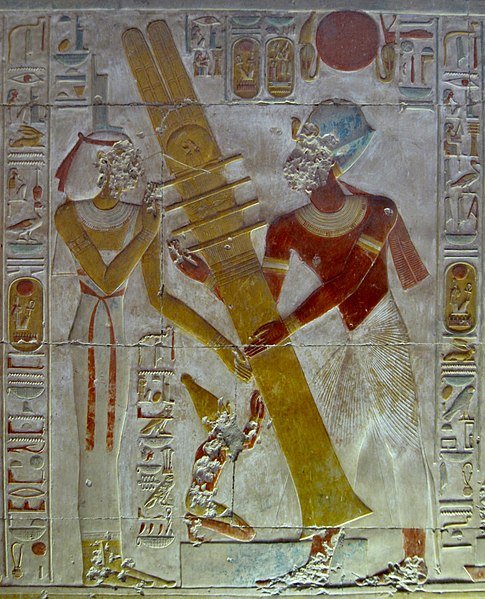
A scene from the Hall of Osiris at Abydos shows the raising of a djed pillars, a symbol of stability. Credit: Olaf Tausch - CC BY 3.0
An impressive temple of Kom Al-Sultan was constructed, with separate sanctuaries for each deity and the seventh chamber of equal size to himself as a god. Why?
For example, what happened to the earliest shrine at Abydos, dedicated to the Jackal God of Abydos - Wepwawat ("the opener of the ways (or Roads)" - the wolf-jackal of the graveyard?
"Abydos will continue to intrigue archaeologists, Egyptologists, and lay enthusiasts for many generations to come," said O'Connor.
Written by – A. Sutherland AncientPages.com Staff Writer
Updated on October 23, 2022
Copyright © AncientPages.com All rights reserved. This material may not be published, broadcast, rewritten or redistributed in whole or part without the express written permission of AncientPages.com
More From Ancient Pages
-
 Amulets, Figurines Discovered In Recently Unearthed Limestone Sarcophagus In Minya, Egypt
-
 Gothic Warrior With Rare Sword Unearthed In Thessaloniki, Greece
-
 Dramatic Life Story Of Queen Marie Antoinette Executed By Guillotine During The French Revolution
-
 Hunter-Gatherers Used Open Habitats Millennia Before Stonehenge Monuments Were Built
-
 Mysterious Philistines: They Migrated Across Mediterranean – DNA Testing Shows
-
 Unsolved Archaeological Mystery Of Ta Prohm Temple, Cambodia
-
 Ancient Bizarre Experiments Conducted In Mysterious Underground Temple
-
 Groundbreaking Discovery Reveals High Cognitive Abilities In Humans Who Lived 170,000 Years Ago
-
 170-Million-Year-Old Sea Monster Identified As The Oldest Mega-Predatory Pliosaur
-
 Human Footprints Of People Who Used Caves Of Ojo Guareña, Burgos 4600 Years Ago
-
 Ancient Venetian Merchants Were Always Prepared For The Worst
-
 Oldest Lunar Calendar Engraved On A Pebble Dated To 10,000 Years Ago
-
 Secrets Of The Ancient Temple Of Dimitra At The Acropolis Of Falasarna Revealed By Archaeologists
-
 Decoding The Mysterious Medieval Pearl Manuscript
-
 Pre-Clovis, Paisley Caves: Archaeologists Identified The Earliest Population Of North America
-
 On This Day In History: Ensisheim Meteorite Fell To Earth – On Nov 7, 1492
-
 Mystery Of The Ancient Bear Bones In The Aleutian Islands, Alaska
-
 Inventory Stela And Its Message: Controversy About This Artifact Still Remains
-
 Eduba: Scribal School In Ancient Mesopotamia
-
 Ancient Stone Tools Found In India Suggest Humans Ancestors May Have Left Africa Much Earlier Than Previously Thought

