
How Did Vikings Worship Their Gods?
Ellen Lloyd - AncientPages.com - The Pagan Vikings worshipped several gods and goddesses. However, unlike other ancient civilizations, the Vikings had neither an organized priesthood nor a hierarchy of religious leaders. Temples or other religious buildings were also never used when the Pagan Vikings paid tribute to the Norse gods.
So, how did the ancient Vikings worship their gods?

Nature played an important religious role in the lives of Vikings and Norse people. credit: Adobe stock - Nejron Photo
During the Pagan Viking age, it was a common practice in express ones’ respect to the Norse gods according to local customs. This was, in most cases, done on farms. The farmer and his wife led many everyday rituals.
It was always important for the Vikings to be on good terms with the gods. To ensure this, they made “blót” sacrifices. The blot was an important social and religious event, and the Chief was the master of the ceremony. It was an exchange in which people sacrificed to the gods in order to get something back in return. For example, this might be the gods’ goodwill regarding weather, fertility, or luck in battle.
The Vikings gathered for a feast. Sacrifices were made, and the sacred mead flowed freely.
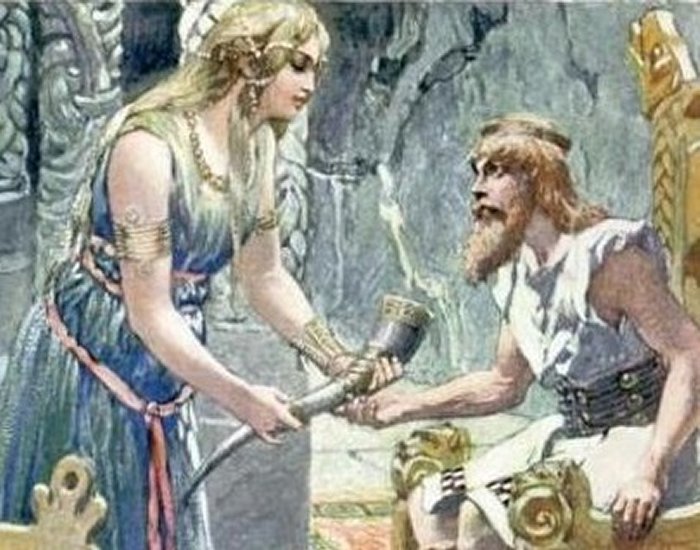
Odin captures Mead of Poetry by Emil Doepler (1900).
All drank in honor of the dead and held a memorial "for the good year and peace". Singing songs and reading poems honoring the gods and ancient heroes was also an important part of the ceremony.
One of the most comprehensive descriptions of a blot sacrifice in the North can be found in Hakon the Good’s Saga, which was written by the Icelander Snorri Sturluson in the 1200s. In his saga, Snorri writes that Sigurd Håkonsson was a very generous man and supplied the whole feast, which he was long remembered for.
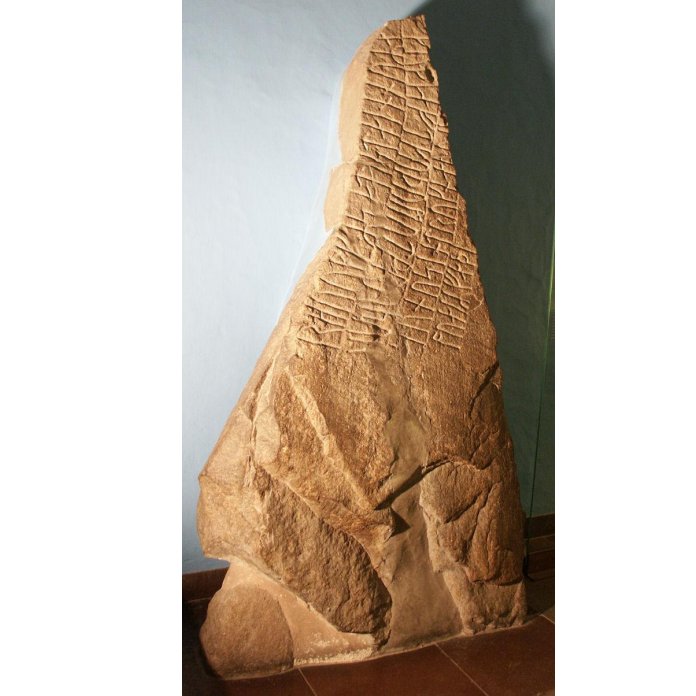
Rune stone from Helnæs on Funen. Many rune stones were erected in memory of powerful men. Credit: National Museum of Denmark
It is believed that there were four fixed blot sacrifices a year at the following times: the winter solstice, the spring equinox, the summer solstice, and the autumn equinox. The Vikings also held additional blot sacrifices, for example, if a crisis arose that required help from the gods.
Farms were not the only places used to honor the Norse gods. The Vikings also used certain sacrificial sites because they believed that there was particularly strong contact with the gods at these locations. In Denmark, archaeologists have discovered places such as Tissø in West Zealand and Tyrseng at Viby in Jutland. These were named after Thor, the Norse God of war.
There are also places in Denmark that are named after the great Norse god Odin. However, the Vikings did not use Odin’s name indiscriminately. It was reserved for places of special significance. Onsholt in Aarhus is one such place. Onsholt is a shortening of Odin’s Holt, which means ”Odin’s Wood”
Updated on March 13, 2024
Written by - Ellen Lloyd – AncientPages.com
Copyright © AncientPages.com All rights reserved. This material may not be published, broadcast, rewritten or redistributed in whole or part without the express written permission of AncientPages.com
More From Ancient Pages
-
 An Ancient Woman’s DNA From A 20,000-Year-Old Pendant – Recovered By Researchers
-
 Mazu: Chinese Goddess Of The Sea – Protector Of Fishermen
-
 Mahabalipuram: Ancient Ruined City And Its Marvellous Rock-Cut Architecture In South India
-
 Hulagu Khan Destroyed Thousands Of Priceless Ancient Books Kept In The House Of Wisdom In Baghdad
-
 Controversial Artifact: What Kind Of Message Does The Phaistos Disk Contain?
-
 Archaeologists unearthed artifacts in a 3,700 year-old mine factory
-
 Humans Used Northern Migration Routes To Reach Eastern Asia
-
 Ancient Mayan City Filled With Palaces, Pyramids And Plazas Discovered On Construction Site In Mexico
-
 Dorset Culture: Mysterious Rock Carvings Of Qajartalik – Faces Of Unknown Beings
-
 Egypt’s Oldest Tomb Oriented To Winter Solstice Discovered In Aswan
-
 Ancient Pottery Reveal How Peru’s First Great Empire Wari Functioned
-
 Mystery Of The Sphinx – A Guardian Of Knowledge And Symbol Of Riddles And Intrigue
-
 New Insight Into Genetic History And Social Structures In Neolithic And Bronze Age Croatia
-
 Early Neolithic High Mountain Settlers Were Busy With Complex Livestock And Farming Activities – New Study
-
 DNA Of 10,000-Year-Old Luzio Solves The Mysterious Disappearance Of The Sambaqui Builders
-
 7,000-Year-Old Ibex Remains Found Under The Ice In Italy Are 1,700 Years Older Than Ötzi!
-
 Rare Medieval Hall Found Near Norman Castle At Skipsea, UK
-
 Olive Trees Were First Domesticated 7,000 Years Ago In The Jordan Valley
-
 Unexpected discovery of hidden color in ancient mummy portraits
-
 Qanat Firaun -‘Canal Of The Pharaohs’ Is The Ancient World’s Longest Underground Tunnel

