
Codes Of Ur Nammu: World’s Oldest Known Law Code
A. Sutherland - AncientPages.com - The Codes of Ur Nammu, written on a Sumerian clay tablet are the world’s oldest laws known to exist. The codes were composed by the Sumerian King Ur-Nammu and date back to around 2100-2050 BC.
The period when the laws were written was called, “Year Ur-Nammu Made Justice In The Land.”
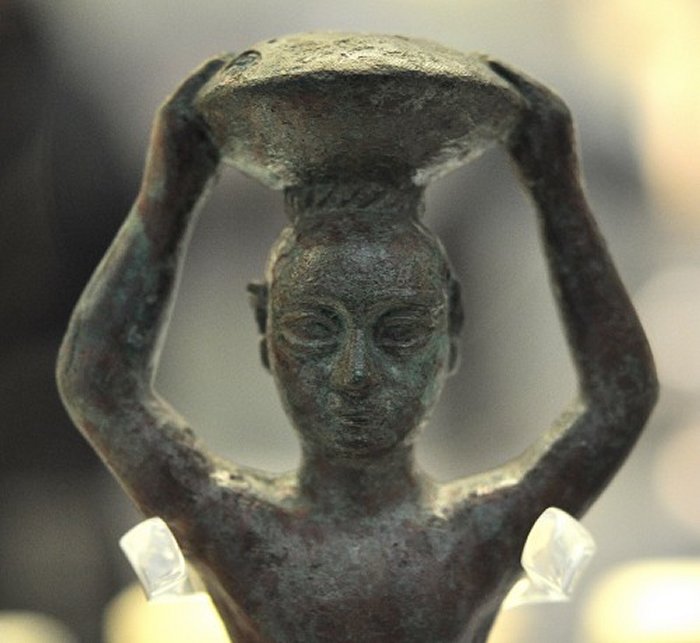
A close-up image of the upper part of a copper figurine of Ur-Nammu, king of Ur. Image credit: Ancient Encyclopedia
Ur-Nammu was the founder of the Ur III dynasty and his son Shulgi was the greatest of all neo-Sumerian monarchs. Ur-Nammu's Code contained the laws covered both civil and criminal matters. Among criminal provisions, it specifies which should be capital offenses: murder, robbery, deflowering another man’s virgin wife, and adultery when committed by a woman.
The first copy of the code, in two fragments found at Nippur, was translated by Samuel Kramer in 1952; owing to its partial preservation, only the prologue and 5 of the laws were discernible. Further tablets were found in Ur and translated in 1965, allowing some 40 of the 57 laws to be reconstructed.
Another copy found in Sippar contains slight variants.

Codes Of Ur Nammu: World’s Oldest Known Law Code
Although it is known that earlier law-codes existed, such as the Code of Urukagina, this represents the earliest legal text that is extant. It predated the Code of Hammurabi by some three centuries.
The laws cover a wide array of crimes and punishments that were less severe than we might expect. The reason was because the Code of Ur-Nammu assumed a universal understanding on the part of the people that law descended from the gods and the king was simply the administrator of those laws.
Harsh penalties were considered unnecessary for the majority of crimes as, since people were assumed to know how they should behave toward each other, a monetary fine as a reminder of how to behave was sufficient.
The Code is comprised of 40 paragraphs that state the crime and the punishment that would be administered by the state through the will of the gods.
- 1. If a man commits a murder, that man must be killed.
- 2. If a man commits a robbery, he will be killed.
- 3. If a man commits a kidnapping, he is to be imprisoned and pay 15 shekels of silver.
- 4. If a slave marries a slave, and that slave is set free, he does not leave the household.
- 5. If a slave marries a native (i.e. free) person, he/she is to hand the firstborn son over to his owner.
- 6. If a man violates the right of another and deflowers the virgin wife of a young man, they shall kill that male.
- 7. If the wife of a man followed after another man and he slept with her, they shall slay that woman, but that male shall be set free.
- 8. If a man proceeded by force, and deflowered the virgin female slave of another man, that man must pay five shekels of silver.
- 9. If a man divorces his first-time wife, he shall pay (her) one mina of silver. (6)
- 10. If it is a (former) widow whom he divorces, he shall pay (her) half a mina of silver. (7)
- 11. If the man had slept with the widow without there having been any marriage contract, he need not pay any silver. (8)
- 13. If a man is accused of sorcery he must undergo ordeal by water; if he is proven innocent, his accuser must pay 3 shekels.
- 14. If a man accused the wife of a man of adultery, and the river ordeal proved her innocent, then the man who had accused her must pay one-third of a mina of silver. (11)
- 15. If a prospective son-in-law enters the house of his prospective father-in-law, but his father-in-law later gives his daughter to another man, the father-in-law shall return to the rejected son-in-law twofold the amount of bridal presents he had brought. (12)
- 16. If [text destroyed...], he shall weigh and deliver to him 2 shekels of silver.
- 17. If a slave escapes from the city limits, and someone returns him, the owner shall pay two shekels to the one who returned him. (14)
- 18. If a man knocks out the eye of another man, he shall weigh out ½ a mina of silver. (15)
- 19. If a man has cut off another man’s foot, he is to pay ten shekels. (16)
- 20. If a man, in the course of a scuffle, smashed the limb of another man with a club, he shall pay one mina of silver. (17)
- 21. If someone severed the nose of another man with a copper knife, he must pay two-thirds of a mina of silver. (18)
- 22. If a man knocks out a tooth of another man, he shall pay two shekels of silver. (19)
- 24. [text destroyed...] If he does not have a slave, he is to pay 10 shekels of silver. If he does not have silver, he is to give another thing that belongs to him. (21)^
- 25. If a man’s slave-woman, comparing herself to her mistress, speaks insolently to her, her mouth shall be scoured with 1 quart of salt. (22)
- 26. If a slave woman strikes someone acting with the authority of her mistress, [text destroyed...]
- 28. If a man appeared as a witness, and was shown to be a perjurer, he must pay fifteen shekels of silver. (25)
- 29. If a man appears as a witness, but withdraws his oath, he must make payment, to the extent of the value in litigation of the case. (26)
- 30. If a man stealthily cultivates the field of another man and he raises a complaint, this is however to be rejected, and this man will lose his expenses. (27)
- 31. If a man flooded the field of a man with water, he shall measure out three kur of barley per iku of field. (28)
- 32. If a man had let an arable field to a(nother) man for cultivation, but he did not cultivate it, turning it into wasteland, he shall measure out three kur of barley per iku of field. (29)
Written by - A. Sutherland - AncientPages.com Senior Staff Writer
Copyright © AncientPages.com All rights reserved. This material may not be published, broadcast, rewritten or redistributed in whole or part without the express written permission of AncientPages.com
Expand for referencesMore From Ancient Pages
-
 Something Unexplained Is Happening In Ancient English Caves – Reports From Numerous People
-
 Strange History Of Stele Of Ankh-ef-en-Khonsu – ‘Stele Of Revealing’ Gave Birth To Thelema, A New Religion
-
 Gilded Coffin Of Nedjemankh, Priest Of Ram-God Heryshef Recovered By Egyptian Authorities
-
 Travel Back To Ancient Greece In Virtual Reality
-
 Your Destiny Is Engraved And Stored – Guardians Of The Great Mystery – Part 2
-
 Has World’s Oldest Image Of Virgin Mary Been Discovered In Dura-Europos Church?
-
 Vast Paleogenetic Study Reveals Insights On Migration, Farming And Language Development Across The Southern Arc
-
 Geronimo: Story About This Western Indian Chief Will Never Die
-
 Mystery Of The Mandala: The Circle Of Life
-
 El Argar Civilization: Bronze Age Palace And Grave Goods Unearthed In Spain’s La Almoloya
-
 Unique Ancient Figurine Puzzles Scientists – Was She An Unknown Pre-Historic Water Goddess?
-
 A Pioneering Study Provides New Insights Into Pregnancy During The Viking Age
-
 Scientists Argue Over The Mysterious Void Discovered Inside The Great Pyramid Of Giza
-
 Medicine in Antiquity: From Ancient Temples To Roman Logistics
-
 Beautiful Mosaics In Ancient City Of Germanicia
-
 Lady Cao – Moche Queen Who Re-Wrote Ancient History
-
 Ground-Breaking Discovery: A 3,300-Year-Old Deep-Sea Canaanite Shipwreck Found
-
 On This Day In History: Shakespeare’s King Lear Performed Before The Court Of King James I – On Dec 26, 1606
-
 Striking Ancient Stone Idols: The Forgotten Polovtsian Statues Of Eastern Europe
-
 Incredible Cave With Secret ‘Door’ Discovered In The American West – Fascinating Underground Mystery

