
Mysterious History Of Qin Shi Huang – First Emperor Of China
Ellen Lloyd - AncientPages.com - Emperor Qin Shi Huang's past is still surrounded by a number of unsolved mysteries and controversies. His birth and death remain a great puzzle until this day.
According to legend, a rich merchant named Lu Buwei befriended a prince of the Qin State during the latter years of the Eastern Zhou Dynasty (770-256 BCE).
The merchant's lovely wife Zhao Ji had just gotten pregnant, so he arranged for the prince to meet and fall in love with her. She became the prince's concubine, and then gave birth to Lu Buwei's child in 259 BCE.
The baby, born in Hanan, was named Ying Zheng. The prince believed the baby was his own.
Ying Zheng became king of the Qin state in 246 BCE, upon the death of his supposed father. He ruled as Qin Shi Huang, and unified China for the first time. The young king was only 13 years old when he took the throne.
First Emperor Of A Unified China
Qin Shi Huang (or Shi Huangdi) was the First Emperor of a unified China, who ruled from 246 BCE to 210 BCE. In his 35-year reign, he managed to create magnificent and enormous construction projects. He also caused both incredible cultural and intellectual growth and much destruction within China.
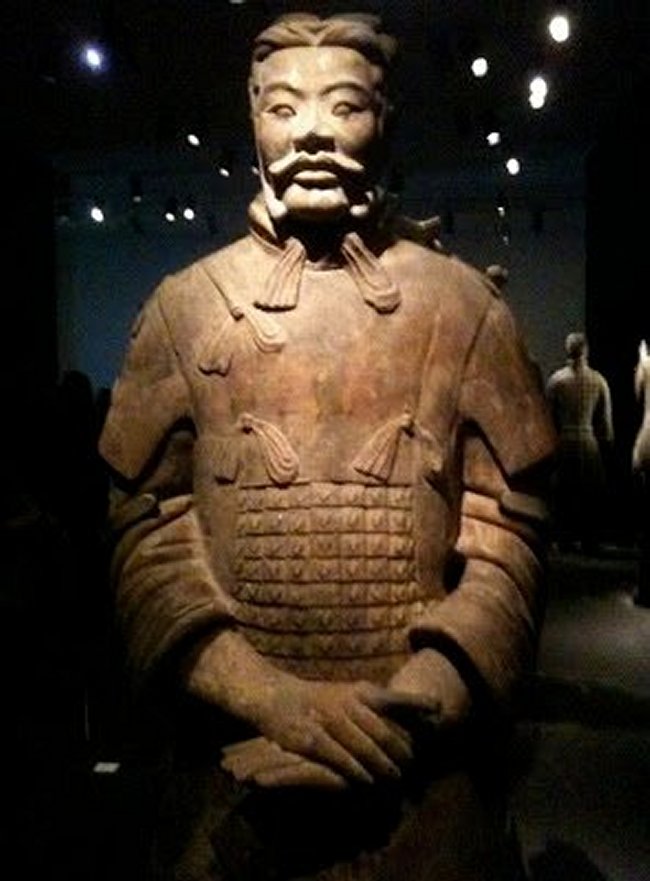
Emperor Qin Shi Huang
Whether he should be remembered more for his creations or his tyranny is a matter of dispute, but everyone agrees that Qin Shi Huang, the first emperor of the Qin Dynasty, was one of the most important rulers in Chinese history.
Was Qin Shi Huang Handsome Or Disfigured?
Qin Shi Huang true appearance remains a subject of debate. Was Qin Shi Huang a handsome or disfigured man? According to some sources he was tall and handsome while others hold that he was short and disfigured. The description of his features can be found in the Book of History.
But since the book was written in classical languages during the Western Han Dynasty (206 BC-24 AD), there are disagreements based on the difference of interpretation of modern people.
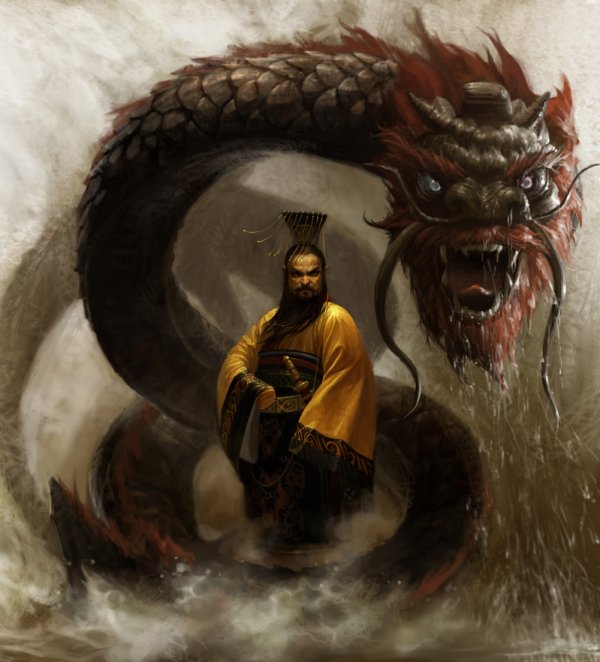
The Qin empire was founded at end of a war between a few powers that had lasted for more than two centuries.
One group thinks the emperor had big eyes, a high nose, a loud voice and a spirited quality in action.
Walking erect and confident, he was a real Apollo. While in the opinion of others, represented by Guo Moruo, a Chinese author, historian, and archaeologist, Qin Shi Huang had a saddle nose, protruding eyeballs and the howl of a jackal. He was pigeon-breasted and suffered from tracheitis and rickets.
Qin Shi Huang's Quest For Immortality
As he entered middle age, the First Emperor grew more and more afraid of death. He became obsessed with finding the elixir of life, which would allow him to live forever.
The court doctors and alchemists concocted a number of potions, many of them containing "quicksilver" (mercury), which probably had the ironic effect of hastening the emperor's death rather than preventing it.
Just in case the elixirs did not work, in 215 BCE the Emperor also ordered the construction of a gargantuan tomb for himself. Plans for the tomb included flowing rivers of mercury, cross-bow booby traps to thwart would-be plunderers, and replicas of the Emperor's earthly palaces.
Qin Shi Huang's Terracotta Army
To guard Qin Shi Huang in the afterworld, and perhaps allow him to conquer heaven as he had the earth, the emperor had a terracotta army of at least 8,000 clay soldiers placed in the tomb. The army also included terracotta horses, along with real chariots and weapons.
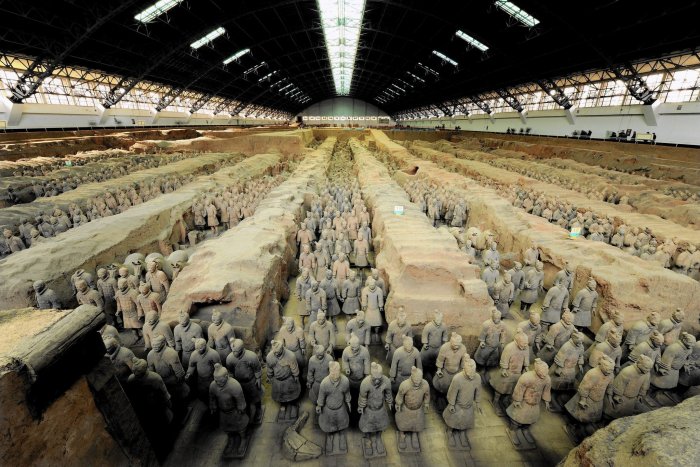
The "China's First Emperor and His Terracotta Warriors". Image credit: Chicago Tribune
The underground terracotta army found in Qin Shi Huang, the First Emperor’s burial complex is undoubtedly one of the most remarkable and mysterious discoveries from the ancient world.
When the burial complex was first discovered by farmers in 1974, archaeologists set to work on one of the most astonishing ancient sites on record. The excavation uncovered a sprawling citadel with thousands of warriors, each designed with a unique face and clothing (although the bodies and limbs were mass-produced from molds).
The Death Of Qin Shi Huang
A large meteor fell in Dongjun in 211 BCE - an ominous sign for the Emperor. To make matters worse, someone etched the words "The First Emperor will die and his land will be divided" onto the stone. Some saw this as a sign that the Emperor had lost the Mandate of Heaven.
Since nobody would fess up to this crime, the Emperor had everyone in the vicinity executed. The meteor itself was burned and then pounded into powder.
See also:
Controversy Of Cao Cao’s Tomb Continues – Did Archaeologists Unearth A Fake Tomb?
Controversial Story And Secret Knowledge Of Li Ching-Yuen Who Lived For 256 Years!
2,000 Year-Old Books Written By Bian Que The Divine Healer Unearthed
Nevertheless, the Emperor died less than a year later, while touring eastern China in 210 BCE. The cause of death most likely was mercury poisoning, due to his immortality treatments.
Were the remains of Qin Shi Huang preserved intact? Some experts have proposed that the remains of Qin Shi Huang are intact while others disagree on this issue.
Like his birth, the death of Qin Shi Huang is also a mystery. His sudden death gave people a lot of space to imagine. Some say he died of poisoning from the elixirs. Some believe that he died from overwork. According to other researchers, he was murdered. Who is correct? There is no final conclusion and much of Qin Shi Huang’s life and death still remains shrouded in mystery.
Written by Ellen Lloyd – AncientPages.com
Copyright © AncientPages.com This material may not be published, broadcast, rewritten or redistributed in whole or part without the express written permission of AncientPages.com
More From Ancient Pages
-
 Ptolemaic Granite Sarcophagus Found In Alexandria, Egypt
-
 Incredible Find – 3,000-Year-Old Canoe Found In Wisconsin’s Lake Mendota
-
 3D-printed replica of an artefact revives music of Iron-Age Ireland
-
 Large Roman Public Latrine With 60 Wooden Seats Discovered In Bet Shean, Israel
-
 Kali – Hindu Goddess Of Death, Fear And Horror Who Destroys Ignorance, Evil And Establishes World Order
-
 Huge Maya Civilization With Pyramids, Settlements, Ball Courts, Roads And More Discovered By LIDAR In Guatemala
-
 Amazing ‘Guennol Lioness’ – One Of The Greatest Ancient Works Of Art Of All Time
-
 Prehistoric Puzzle: Three Gigantic Stone Heads Of Unknown Origin
-
 Impressive Study Highlights Female-Led Migration Into Bronze Age Orkney And Wins Prestigious Award For 2023
-
 Swords And Spears Of The Yotvingians – A Long-Forgotten Ancient Warrior Culture Discovered In Poland
-
 Roman Treasure Hoard Found In Thetford Forest, East Anglia – Was Pagan Until 5th Century
-
 What Is The Link Between Drought And The ‘Barbarian Conspiracy’ In Roman Britain?
-
 Are The Baffling La Marche Cave Paintings Authentic Or Cunning Forgeries?
-
 Arizona’s Enigmatic Beehive-Shaped Stone Coke Ovens
-
 Ancus Marcius: Semi-Legendary Fourth King Of Rome Obliged To Make War To Defend And Expend Territories
-
 3D Scans Used To Study Mysterious Roman Burial Practice
-
 Ancient People In Tasmania Witnessed Stunning Auroras When The Earth’s Magnetic Field Flipped
-
 Oldest case of leukemia found on 7,000-Year-old skeleton
-
 Asgard Walls Built By Giant Master Mason And Birth Of Magical Horse Sleipnir
-
 Leonardo da Vinci’s 280-Meter Long Bridge Design – Tested

