
Karnak: One Of Largest Temple Complexes In The World And Its Spectacular View
A. Sutherland - AncientPages.com - Karnak is one of the largest temple complexes in the world. This magnificent place has a rich architectural, ritual, religious, economic, social, and political history.
The Karnak Temple complex is located in southern Egypt in and around the modern city of Luxor, which has a wealth of ancient Egyptian ruins.

Karnak. Image credit: Simon - Pixabay
The outstanding construction and historical place of ancient Egypt stands at Karnak.
"On the east bank of the river, about a mile to the north of modern Luxor, there lies a group of temples known at the present day as Karnak. The name was given to the village which grew up over the ruins of the ancient city and temple.
"The debris of succeeding generations of villages buried the whole temple, leaving only the highest portion of the nave of the hypostyle hall above the ground, the clerestory alone remaining visible; hence the name given to the village, “the Town of the Windows”, writes Margaret Alice Murray in her book "Egyptian Temples"
"Now that the site has been extensively excavated it will be seen that there are at least twenty temples in the group; the greater number being dedicated to Amon, but there are also temples to Mut, Khonsu, Ptah, Sekhmet, and others, besides chapels to minor deities which occur in several places within the walls of the main buildings. .." 1
This colossal temple complex covers hundreds of acres in the area of modern-day Luxor. Once Karnak was surrounded by the thriving city of Thebes.
The Theban king Kamose erected a memorial in the temple of Karnak to record his victories in battle. The most spectacular renovation was at Karnak, where the temple to the god Amun was lavishly updated.
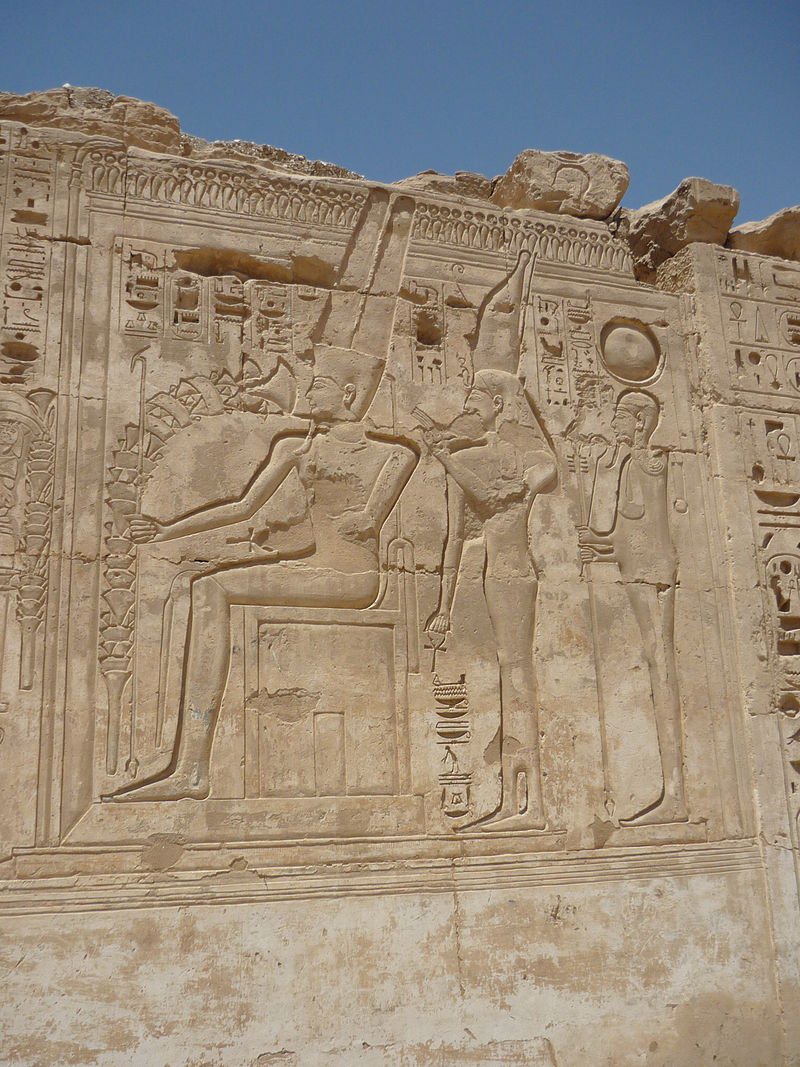
The Theban Triad at Medinet Habu. From left to right: Amun, Mut and Khonsu. Image credit: Rémih - CC BY-SA 3.0
Also, Thutmose III's most famous victory is recorded on an inscription at the Temple at Karnak.
It describes a surprise attack on Megiddo, Israel, where his army of 10,000 soldiers captured the city.
The temple of Karnak was known as Ipet-isu-or "most select of places"-by the ancient Egyptians. It is a city of temples built over 2,000 years and dedicated to the Theban triad of Amun-Ra, Mut, and Khonsu. This derelict place can still overshadow many wonders of the modern world and, in its day, must have been awe-inspiring.
For the largely uneducated ancient Egyptian population, this could only have been the place of the gods. According to some sources, this was the most significant religious building ever made. It covered about 200 acres (1.5 km by 0.8 km) and was a place of pilgrimage for nearly 2,000 years. The area of the sacred enclosure of Amun alone is sixty-one acres and could hold ten average European cathedrals.
The sacred barges of the Theban Triad once floated on the lake during the annual Opet festival. Storerooms, living quarters for the priests, and an aviary for aquatic birds surrounded the lake.
The Egyptians believed that towards the end of the annual agricultural cycle, the gods and the earth became exhausted and required a fresh input of energy from the chaotic energy of the cosmos.

Hypostyle hall of the Precinct of Amun-Re, as it appeared in 1838 in The Holy Land, Syria, Idumea, Arabia, Egypt, and Nubia. Image credit: Public Domain
The Opet festival was held yearly at Karnak and Luxor to accomplish this magical regeneration. It lasted for twenty-seven days and was also a celebration of the link between the pharaoh and the god Amun. The procession began at Karnak and ended at Luxor Temple, one and a half miles (2.4 kilometers) to the south.
The statue of the god Amun was bathed with holy water, dressed in fine linen, and adorned in gold and silver jewelry. The priests then placed the god in a shrine and onto the ceremonial barque supported by poles for carrying.
Pharaoh emerged from the temple, his priests carrying the barque on their shoulders, and together they moved into the crowded streets. A troop of Nubian soldiers serving as guards beats their drums, and musicians accompanied the priests in song as incense filled the air.
Written by – A. Sutherland - AncientPages.com Senior Staff Writer
Updated on January 7, 2024
Copyright © AncientPages.com All rights reserved. This material may not be published, broadcast, rewritten or redistributed in whole or part without the express written permission of AncientPages.com
Expand for referencesReferences:
- Margaret Alice Murray, Egyptian Temples"
Kelly, Miles. 1000 Facts Ancient Egypt
More From Ancient Pages
-
 Puzzling Palpa Lines In Peru Made By The Paracas Culture Are Even Older Than The Nazca Lines
-
 Why Did Ancient Egyptians Fear The Vizier?
-
 Nobel Prize: Svante Pääbo’s Ancient DNA Discoveries Offer Clues As To What Makes Us Human
-
 Oshun Goddess Of Yoruba People Who Brings All Things That Make Life Worth Living
-
 Feud Between The Medici And The Borgia Families – What Caused The Renaissance Clash?
-
 Scotland’s Mysterious Ballachulish Figure Could Be Cailleach Bheithir – Ancient Hag Goddess Of Winds And Storms
-
 Ancient Napata And Meroe Kingdoms Reveal Secrets Of Queen Tiye And Goddess Maat
-
 Who Were Persian ‘Sparabara’?
-
 Secret Underground Ancient Teotihuacan Tunnel May Solve A Long-Standing Mystery And Reveal Royal Tombs
-
 Ancient Indian Sages Had Highly Advanced Scientific Knowledge Thousands Of Years Ago
-
 Code Of Chivalry: ‘Knightly’ Behavior, Courageous Medieval Knights, Warriors And Superior Men
-
 Why Did First Printed Books Scare Ancient Scholars In Europe?
-
 Battle Of Assandun: The Great Battle In English History And A Brief Period Of Viking Dominion In England
-
 Londinium: Ancient Roman Outpost That Became Powerful City Of London
-
 Mystery Of Panxian Cave: How Could Gigantic Animals Reach A Mountain Cave Located Over 1600m Above Sea Level?
-
 Drone Reveals 3,000-Year-Old ‘Mega Fortress’ Dmanisis Gora In The Caucasus Mountains Is Much Larger Than Previously Thought
-
 Mazu: Chinese Goddess Of The Sea – Protector Of Fishermen
-
 Mythical Submerged City Of Ys – Europe’s Own Sodom And Gomorrah
-
 Sumerian City Of Girsu: Political, Religious Center With Large Archive Of Thousands Of Cuneiform Tablets
-
 Incredible Technology In Mysterious Huashan Caves, China


