
Remarkable South-Pointing Chariot – Ancient Cybernetic Machine Invented 1,700 Years Ago Is An Engineering Masterpiece
A. Sutherland - AncientPages.com - It is almost wrong to refer to this engineering masterpiece as ancient or primitive. The first known cybernetic machine was invented already 1,700 years ago.
The device comes from the land of many remarkable inventions, namely ancient China. Although the object was called "south-pointing carriage", it had no connection with a magnetic compass.
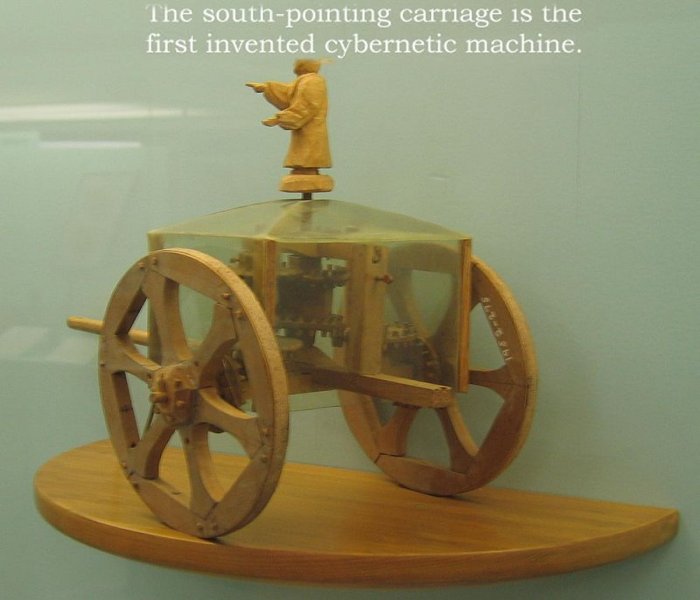
Exhibit in the Science Museum in London, England. This conjectural model chariot incorporates a differential gear. Image via wikipedia
In the very interesting book The Genius of China: 3,000 Years of Science, Discovery, and Invention, author and researcher Robert Temple describes the device as a "large carriage, 3.3 metres long, 3.3 metres deep, and 2.75 metres wide, surmounted by a jade statue of an "immortal" a sage who had achieved immortality.
The figure's arm was raised, pointing ahead, and it always faced towards the south, no matter which way the carriage turned. Even if the road were circular, the jade figure would rotate, keeping the finger-pointing in the same direction."
It is unclear when exactly the device was created. We know with certainty the object existed in the third century AD. This machine may have been invented even earlier, indeed, as much as 1,200 years earlier.
An official history for 500 AD describes how: "The south-pointing carriage was first constructed by the Duke of Zhou [beginning of the first millennium BC] as a means of conducting home wards certain envoys who had arrived from a great distance beyond the frontiers. The country was a boundless plain in which people ¡ost their bearings as to east and west, so the Duke caused this vehicle to be made in order that the ambassadors should be able to distinguish north and south."
If this information is correct, the invention would date from about 1030 BC. But Needham suspects that the word "carriage" was inserted in this account by scribes and that what is being described is a "southpointer", that is, a compass.
The Chinese scholar Zhang Heng (A.D. 78 - 139) who was one of the world's first scientists to propose that the universe is infinite in both space and time and also the creator of the first seismograph has sometimes been credited with building the south-pointing carriage.
However, according to Joseph Needham, a British historian of Chinese science and technology, is director of the Needham Research Institute in Cambridge, England it is unlikely Zhang Heng constructed the first cybernetic machine.

A model reconstruction of a "south-pointing carriage" based on a description dating from the 3rd century AD.
This is the engineering work of an unknown ancient person whose identity remains a secret. Who was he or she? Perhaps there is a clue to solving this mystery.
Needhman suggests that the famous mechanical engineer Ma Jun who lived during the Three Kingdoms era of China was the inventor and builder of the south-pointing carriage. Among many things, Ma Jun invented an intricate hydraulic-powered, mechanical-operated puppet theatre, improved silk loom and constructed square-pallet chain pumps meant for irrigation.
Joseph Needham describes Ma Jun's mechanical theatre in a passage taken from the Sanguo Zhi, Records of the Three Kingdoms:
Certain persons offered to the emperor a theatre of puppets, which could be set up in various scenes, but all motionless.
The emperor asked whether they could be made to move, and Ma Jun said that they could. The emperor asked whether it could be possible to make the whole thing more ingenious, and again Ma Jun said yes, and accepted the command to do it.
See also:
Zhang Heng Seismograph Could Record Earth’s Dangerous Movements
Magnetic Compass Was Invented In Ancient China
Highly Advanced Robots In Ancient China
He took a large piece of wood and fashioned it into the shape of a wheel which rotated in a horizontal position by the power of unseen water. Then, he arranged images of singing-girls which played music and danced, and when (a particular) puppet came upon the scene, other wooden men beat drums and blew upon flutes. Ma Jun also made a mountain with wooden images dancing on balls, throwing swords about, hanging upside down on rope ladders, and generally behaving in an assured and easy manner. Government officials were in their offices, pounding and grinding was going on, cocks were fighting, and all were continually changing and moving ingeniously with a hundred variations.
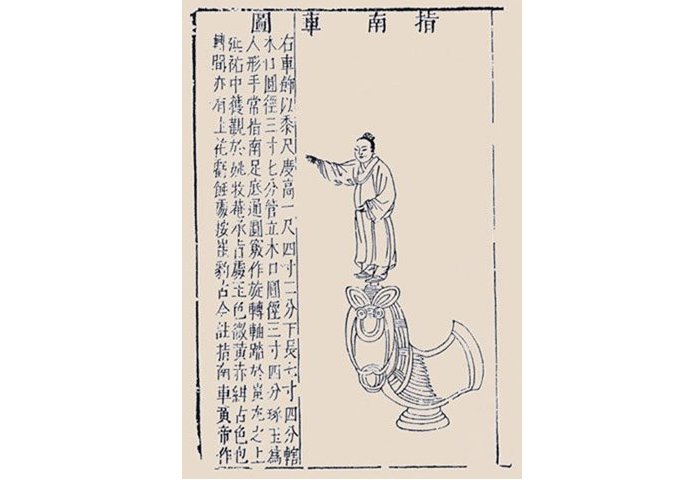
Image of South-pointing chariot from Sancai Tuhui (first published 1609).
Now let's return back to the subject of the remarkable south-pointing carriage. If the machine did not use a magnetic compass, how did it work?
According to Temple, the device "had a train of differential gears, similar to those in a modern automobile.
Perhaps the function of a differential gear should be explained as follows.
When a wheeled vehicle is turning a corner the wheels on opposite sides of the vehicle are clearly going to need to turn at different rates since the near side is traveling a shorter distance than the far side.
With a hand-cart or horse-drawn carriage, this may not pose such problems. But when a vehicle has power being applied to the axle to make the wheels turn, how is it possible for one wheel to be permitted to speed up a little, and the other slow down a little, on the same axle?
This is made possible only by an ingenious combination of gear wheels and flywheels: the differential gear."
The precision needed in the construction of the south-pointing carriage almost defies belief. For the outside road wheels alone, Needham points out, J. Coales, in The Historical and Scientific Background of Automation, "has calculated that a difference of only one percent between the wheel circumferences would lead to a change of direction of the pointing figure of as much as 90 percent in a distance only fifty times that between the two wheels."
This was because the carriage would veer more and more to one side if one wheel were smaller (relative slip). So that for this south-pointing carriage, the size of the road wheels had to be accurate to a margin of error far less than one percent, and a commensurate accuracy in size of gear wheels would have been necessary.
This points to the engineering of such a high order that we must admit it is a genuine ancient masterpiece!
Written by A. Sutherland - AncientPages.com Senior Staff Writer
Copyright © AncientPages.com All rights reserved. This material may not be published, broadcast, rewritten or redistributed in whole or part without the express written permission of AncientPages.com
More From Ancient Pages
-
 Unexplained Disappearance Of East Balkan Civilizations – Discovery Of Unusual Mini Artifacts – Part 1
-
 They Spoke The Language Of The Gods – Secret Symbols, Unknown Books And Manuscripts – Part 2
-
 Unexpected And Surprising Results Of Ancient DNA Study – Who Were The First People In South America?
-
 Island Archaeology Could Be A Model For Space Exploration
-
 Cacao Was Cultivated By Cultures Along The Pacific Coast Around 5,000 Years Ago – New Study
-
 Forgotten Ancient Wisdom: People Have Two Souls – Native American And Pre-Christian Beliefs Reveal
-
 Anglo-Saxon Previously Unknown Monastic Or Trading Center – Discovered
-
 Ancient Treasure Hidden In Perplexing Secret Underground Labyrinth In France – Dangerous Search – Part 1
-
 Human Skeleton Dated To Parthian Era Unearthed At Tepe Ashraf In Iran’s City Of Isfahan
-
 Why Was An Ancient High-Ranking Woman Buried Within The Abandoned Khar Nuur Fortress, Mongolia?
-
 On This Day In History: Battle Of Lugdunum Was Fought – On Feb 19, 197
-
 Pax Romana: 200-Year-Long Period Of Stability Within The Roman Empire
-
 Mysterious Disappearance Of Explorer Peng Jiamu In Lop Nur – The Wandering Lake
-
 Impressive Study Highlights Female-Led Migration Into Bronze Age Orkney And Wins Prestigious Award For 2023
-
 Female Pharaoh Twosret Was Exploited, Used And Almost Erased From History
-
 Canopic Jars: Funerary Tradition Of Ancient Egyptians And Their Beliefs In Afterlife
-
 Man In Sweden Finds Viking Age Skeleton In His Garden
-
 Is A Viking Settlement And Even Older Church Hidden Under St. Clement’s Church In Norway?
-
 Milk Enabled Massive Steppe Migration
-
 Mystery Of The Delphi Oracle Prophecies: Was Pythia On Drugs While Guiding Ancient Greek Civilization For Thousands Of Years?

