
Unique Balchiria Stelae Engraved With A Goat-Like Figure Found On Corsica Is A Puzzle
Jan Bartek – AncientPages.com - About 6,000 years ago, someone carved a mysterious goat-like figure on the Balchiria Stelae in Corsica.
It's a design unlike anything seen in the Western Mediterranean at this time. What were ancient people trying to tell us when they made this puzzling engraving? Who does it depict?
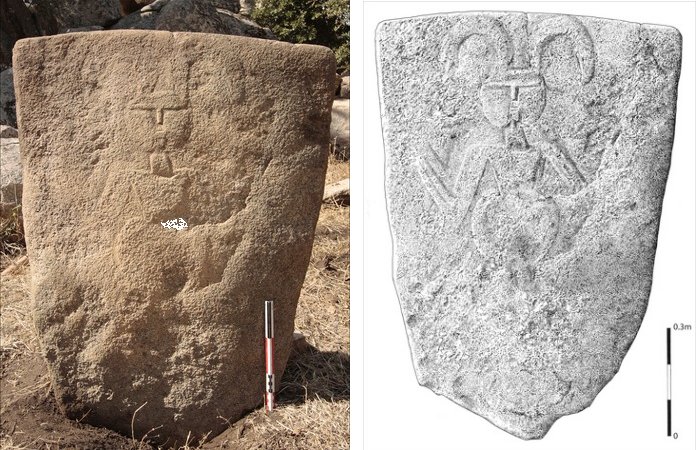
Left: Engraved Balchiria stela. Credit: F. Leandri - Right: Engraved stela drawing. Credit: R. Picavet
Corsica is an ethnically Italian island that has belonged to France since 1768, but there is archaeological evidence this beautiful place has been occupied for thousands of years.
Many ancient structures found on Corsica are mysterious, and so is even the island's name. It's unknown why the island is called Corsica. Perhaps the name comes from ancient Greece, where the island was known as Kalliste, Corsis, Cyrnos, Cernealis, or Cirné.
Corsica Was Occupied By Many Ancient Civilizations
During its long prehistory, Corsica has experienced many invasions and all ancient civilizations have left a legacy on the island. Phoenicians established numerous colonial cities along the coasts of the Mediterranean, and Carthaginians occupied Corsica for a short period. Later, Etruscans made claims on the land, and in 238 B.C. Corsica became a province of the Roman Republic.
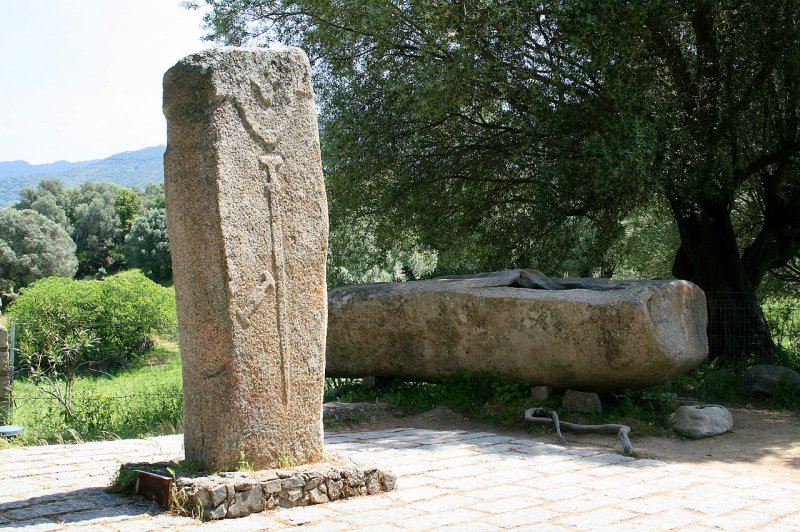
Filitosa (Corse-du-Sud), France, the menhir Filitosa V. Image credit: Jean-Pol GRANDMONT - CC BY 3.0
During the Middle Ages, Corsica was invaded by the Vandals and the Ostrogoths, but the Byzantine Empire recovered the island and it became part of the Kingdom of the Lombards.
Struggles to claim Corsica as its own continued for many years, and so did attempts to gain independence. Finally, Corsica fell into the hands of the French.
Mysterious Ancient Structures On Corsica
There are many interesting ancient structures on Corsica that have intrigued archaeologists and historians. The most famous ones are known as the torri, "towers" named after their builders the Torrean civilization of the Corsican Bronze Age. These towers were raised in various parts of the island.
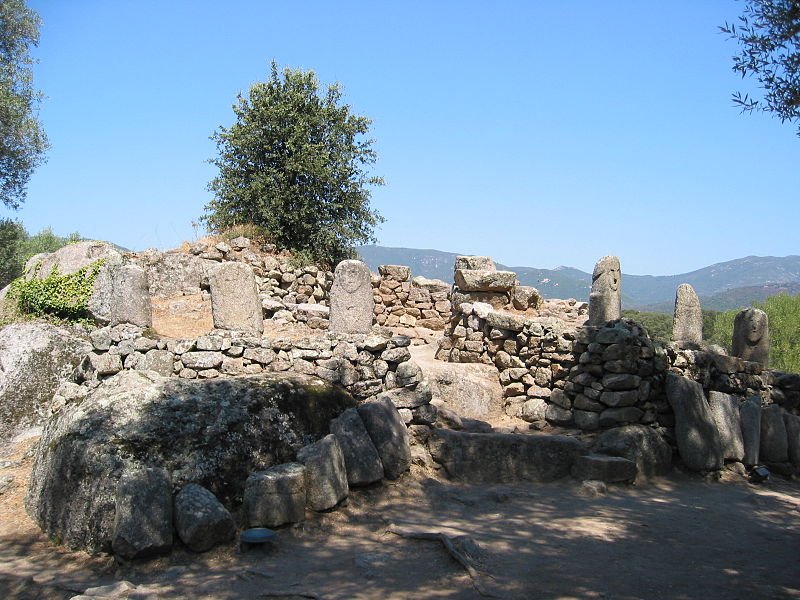
Prehistoric structures at Filitosa. Credit: xtra, CC BY-SA 2.0
The Torreans were stone warriors, who, according to researchers "were the same people as the seagoing Shardana who were known to have attacked Egypt in the late second millennium BC, and the bronze weapons with which they subdued the islanders were the weapons depicted on the sword-bearing menhirs of Filitosa." 1
The Torréens conquered Filitosa around 1300 BC and destroyed most of the menhirs, incorporating the broken stones into the area of dry-stone walling surrounding the site's tree torri (towers). Conical structures such as these were built by the Torréens all over the south of Corsica.
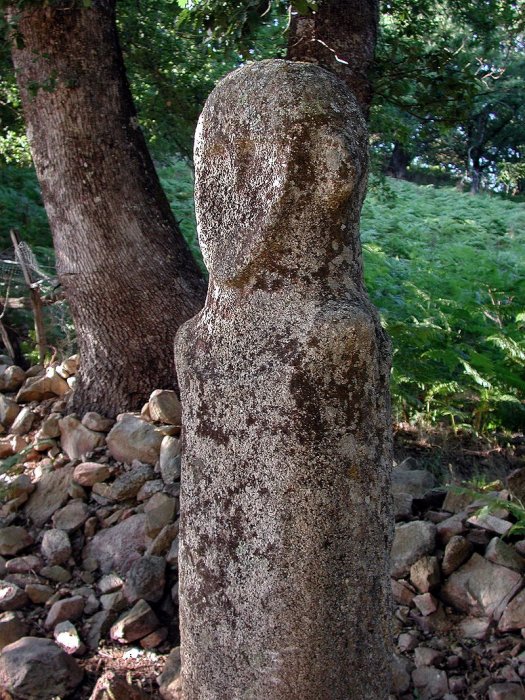
Anthropomorphic menhir in Tavera, Corsica. Credit: Filitosa Anthropomorphel, CC BY-SA 3.0
Again, no one is absolutely certain of their function; it's generally agreed that the smaller specimens are likely to have been used as places of worship to some divinity, though traces of ashes and bones found in some suggest they could have been where the Torréens burned of buried their dead. Corsica's larger torri are thought to have served as stores for weapons or food, or perhaps refuges or lookout towers." 2
The torris are similar to the Nuraghi which are beehive-like towers found on Sardinia.
Mystery Of The Balchiria Stelae
The two stone stelae, known as the Balchiria stelae were accidentally discovered in 2017. Scientists think it was once part of a now ruined prehistoric monument. The engraved anthropomorphic image of a goat-like figure has intrigued researchers.
"The head of the figure, which features a T-shaped block forming eyebrows and a nose, is capped by two curved appendages that resemble horns (Figure 1). The torso rests above a large circle, which features no explicit representation of lower limbs. The upper limbs are clearly depicted except at their extremities: the right limb is folded into a prayer position, while the left has been depicted only above the elbow." 3
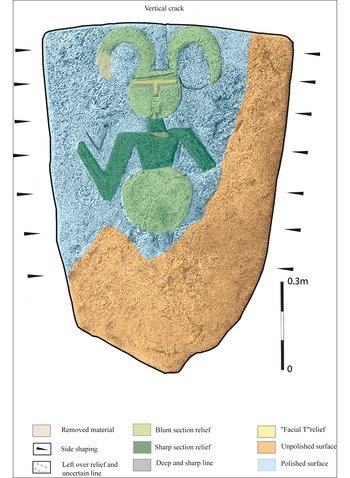
Engraved stela morpho-technological study Credit:E. Mens
Ancient depictions of beings with horns have been found on many occasions in Europe. Archaeologists have uncovered more than one hundred rock-cut tombs in Sardinia that had walls covered with bucrania (schematic depictions of cattle head and horns). Several such engravings have been discovered in the hypogea of the Ozieri Culture (c. 4200–3500 BC) who also produced ceramics with outstretched arms. These ancient images have been interpreted as representations of a bull-like divinity.
However, the figure engraved on the does not resemble a bull, but rather a goat.
The presence of Ozieri influences in southern Corsica has been confirmed and it's possible the engraved stela at Balchiria could be the work of this ancient culture. However, the identity and purpose of the engraved goat-like figure are still open for debate.
The stela is unique in the Western Mediterranean context both in terms of its motif and morphology. Unraveling the mystery of Balchiria horned figure can tell us more about Sardinia's prehistory including peoples' ancient beliefs and traditions.
Updated on October 21, 2023
Written by Jan Bartek - AncientPages.com Staff Writer
Copyright © AncientPages.com All rights reserved. This material may not be published, broadcast, rewritten or redistributed in whole or part without the express written permission of AncientPages.com
Expand for references- Edward Gibbon - The History of the Decline and Fall of the Roman Empire
- Rough Guidesi - The Rough Guide to Corsica
- Guilaine, J., Leandri, F., Mens, E., & Picavet, R. (n.d.). The Balchiria stelae. Antiquity, 1-9. doi:10.15184/aqy.2019.228
- Palmer, Robert R. "The Kingdom of Corsica and the Science of History." Proceedings of the American Philosophical Society105, no. 4 (1961): 354-60. Accessed February 2, 2020.
- Robin, G. (2017). What Are Bucrania Doing in Tombs? Art and Agency in Neolithic Sardinia and Traditional South-East Asia. European Journal of Archaeology, 20(4), 603-635. doi:10.1017/eaa.2017.12
More From Ancient Pages
-
 Champa’s Megalithic City My Son And The Nagas Inscription That Could Re-Write History
-
 Unexpected Archaeological Discovery May Re-Write English Civil War History
-
 Hot-Tempered Shield Maiden Freydis Eiriksdottir’s Unusual Adventures In Vinland And Greenland – Trouble Followed in Her Footsteps
-
 Stone Tools Reflect Three Waves Of Migration Of The Earliest Homo Sapiens Into Europe
-
 On This Day In History: Irish Rebellion Led By The United Irishmen Against British Rule Begins – On May 24, 1798
-
 Hidden Ancient Citadel In The Mayan City Of Tikal Discovered By LIDAR
-
 Artifacts Discovered At Yirra Confirm Aboriginal People Lived In Pilbara During The Last Ice Age
-
 Baffling Unexplained ‘Alien’ Condition – Evidence Of Unknown DNA?
-
 Philippine Ayta People Have The Highest Level Of Denisovan DNA – New Study
-
 New Study Reveals Rare Mortuary Treatment Of Egyptian Mummy
-
 Underwater Stone Age Village Habonim North Found Off Israel’s Carmel Coast Thrived During Climate Change
-
 Excavations Of 2,500-Year-Old Water Cistern In Croatian Village Lumbarda – Completed
-
 Surprising DNA Study Links Present-Day Native American Tribe To Ancestors In San Francisco Bay Area
-
 Evidence From Ancient Egypt Shows Smallpox Stretches Back At Least 3,000 Years
-
 Curious Giant Shaped Rock In China – An Ancient Man-Made Construction Or Natural Formation?
-
 Large Fresco Depicting The Procession Of The Wine God Dionysus Found In Pompeii
-
 Violent Steppe Invasion In Iberia Peninsula Theory Challenged By Archaeologists
-
 Ancient Glass Workshop Unearthed At Iron Age Of Němčice
-
 Vikings May Have Made Imitation Gold Dinar Found In Morston, Norfolk – Expert Says
-
 Ancient Knowledge Of Levitation And Antigravity

