
Demon Oni: Cruel Harbinger Of Disease And Misfortune In Japanese Folklore
A. Sutherland - AncientPages.com - In Japanese folklore, religion, and popular culture, there are many evil demonic entities, ghosts, and monsters that are often difficult to recognize from people.
 A Japanese print showing two 'oni', one with one eye and one with three eyes. Katsushika Hokusai (1760–1849). Public Domain
Legends about yōkai, ghosts, and all kinds of wraiths have been popular among the Japanese for a long time, but it was not until the Edo period of Japanese history (1603-1868), along with the growing popularity of books, that they began to come out in a printed form.
One group of them is known as the Oni. They are cunning and cruel creatures, which are present everywhere.
This kind of yokai is identified with misfortune, illness, and disasters. There are two known groups of the Oni demons. Many of them originate from hell, many others second are busy with haunting lands.
The Oni are documented in innumerable legends and folktales that date back to the eighth century. They are believed to have originated in China and to have come to Japan with the Buddhist faith.
Countless Frightening Depictions Of 'Oni'
There is a large variety of 'Oni' depictions. The earliest images of Oni (or similar figures associated with them) originate from Buddhist depictions of hell. However, in contemporary Japanese culture, these creatures are usually portrayed as strong, frightening, and large human-like male figures. Their bodies are pink or blue and their faces typically human-like, but strangely flat, with a mouth that runs from one ear to another.
Their heads have one, two or even more horns, and a third eye; the hands, carrying a club or an iron staff, are clawed with protruding fangs.
 The Oni are constant companions of disaster, diseases or other misfortunes.
A garment of the Oni is made of tiger skin.
One legend tells that terrifying Oni can fly, and by swooping down can easily capture the souls of evil people whose days are already very limited, and deliver them to eternal torture.
Nurikabe: Trickster That Manifests Itself As Invisible, Impassable Wall In Japanese Old Beliefs
Is The Legendary Tsuchinoko Real?
Yuki-Onna ‘Lady Of The Snow’: A Female Demon And Symbol Of Death In Japanese Mythology
The demons Oni significantly vary in size though most of them maintain the same characteristic features. However, it happens sometimes that the Oni are stupid, very naive, benevolent, and totally harmless, but these are the anomalies among them.
Generally, Oni’s general intentions are negative, antisocial, and hostile. Females can also turn into the Oni demons because they are not able to conquer negative and harmful emotions such as jealousy or regret. Many of the Oni women (hannya) are ruthless, constantly seeking revenge, and not avoiding violence, but they are rather harmless individuals.
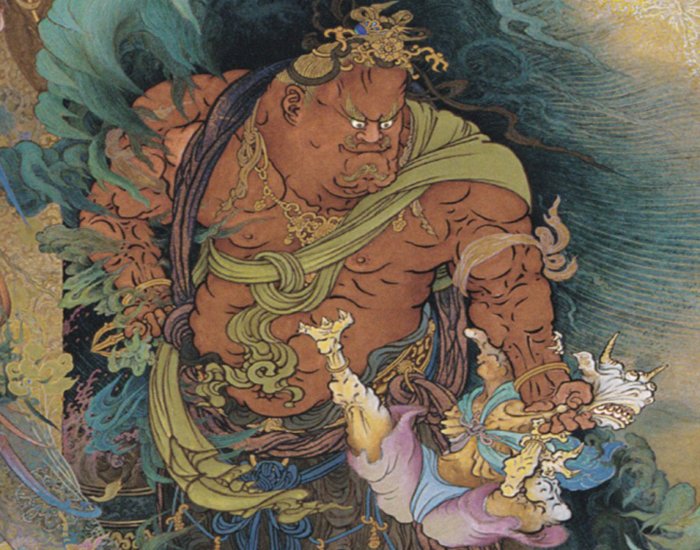 Nio (guardian deity of Buddist shrines, temples, and monasteries) that grabs an Oni. Kano Hogai, 1886. National Museum of Modern Art Tokyo
According to the Japanese lore, the Oni demons eat and drink much displaying excessive behavior without any limits. Although they are known to possess great powers, they do not care much about them. Instead, they are busy to satisfy their bodily needs to the maximum
Their limited intelligence makes them vulnerable to human cleverness and pranks.
A Way To Get Rid Of The Oni
Fortunately, these awful creatures are not immune to Buddhist exorcisms, and through these procedures, the Oni can be successfully converted and begin to live a normal life. Among the Shinto followers, there was an ancient traditional ceremony casting out ghosts. The ceremony is known as the Oni-yarahi, (demon-expelling)’, in which participated actors in terrible masks of demons, was organized annually on the last day of the year.
The people believed that during the Oni-yarahi ceremony, all kinds of diseases, bad-luck, misfortunes, and disasters could be successfully expelled by force, and a new year can start without them.
Written by – A. Sutherland - AncientPages.com Senior Staff Writer
Copyright © AncientPages.com All rights reserved. This material may not be published, broadcast, rewritten or redistributed in whole or part without the express written permission of AncientPages.com
More From Ancient Pages
-
 Roman Tombs Unearthed In Egypt’s Dakhla Oasis
-
 Strange Case Of The ‘Impossible’ Glove Remains Unexplained – The Investigation – Part 2
-
 On This Day In History: Samurai Final Battle of Shiroyama Was Fought – On Sep 24, 1877
-
 North America’s First People May Have Arrived By Sea Ice Highway 24,000 Years Ago
-
 10 Ancient Love Symbols
-
 ‘Our Way Model’ Reveals How First Anatomically Modern Humans Populated Europe
-
 Ancient Fresco Tomb Dated A 1000-Years Ago Was Accidentally Discovered In Northern China
-
 Largest And Most Complete Ancient Egyptian Workshops Found In Saqqara
-
 Never-Before-Seen Face Of A Tattooed Tashtyk Man Hidden Behind A Gypsum Death Mask Revealed
-
 Hagar Qim: “Standing/Worshipping Stones” – Megalithic Complex In Malta Dated To 3600 – 3200 BC
-
 Modern Humans Inherited DNA From A Mysterious And Unidentified Ancestor
-
 Ancient Books, Scrolls And Manuscripts Burned By Church And Evil Emperors
-
 Mirpur Jain Temple: Stunning Artwork Of Ancient Craftsmen Of India
-
 Sarcophagus Of The Amazons: Etruscan Coffin With Paintings Of Dynamic Fighting Scenes Of Greeks With Amazons
-
 Spectacular Square-Headed Creature And 143 New Nazca Geoglyphs – Discovered
-
 Inscribed Fragments Of Stone Slabs Unearthed In Matariya, Ancient Heliopolis
-
 Giant 2,000-Year-Old Cat Geoglyph Discovered At Nazca In Peru
-
 Dispute Between Russia And Poland Over Discovery Of Czarist Officer’s Corpse In Turkey
-
 Radar Reveals ‘Ghost’ Footprints From Pleistocene Era
-
 Fomorians In Irish Myths And Legends: Race Of Demonic Giants Who Inhabited Ireland And Scotland

