
Incamisana Water Temple At Ollantaytambo, Peru: Marvelous Engineering Masterpiece Of Inca
A. Sutherland - AncientPages.com - The Incas were known for their engineering practices, particularly water engineering. Their design of water systems was influenced by their strong beliefs in power of water.
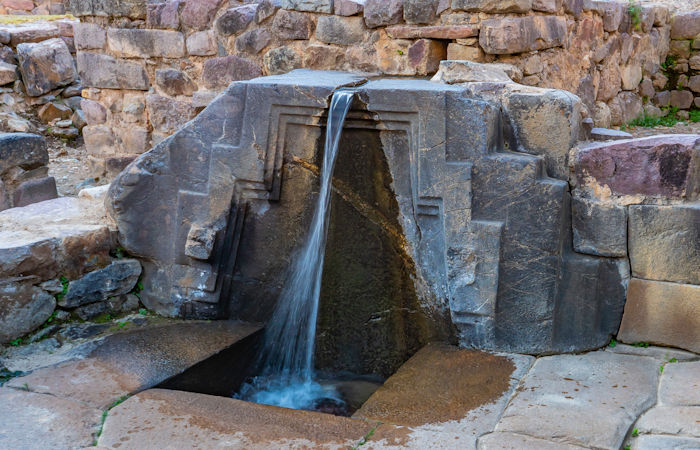
One of many fountains of the Incamisana Water Temple. The fountain called Baño de la Ñusta (Bath of the Princess Fountain) is composed of a stream of water flowing in a single block of stone, and continues over the Inca's sacred stepped chakana symbol, and then, down into a small pool. Credit: Adobe Stock - videobuzzing
They saw water as both a physical and spiritual phenomenon. They considered their great civilization as something that arises from water.
The Incamisana temple at Ollantaytambo in Peru was constructed for the worship of deities who gave the Inca people water and water itself. Even today, in our modern terms, the structure represents the Inca's masterpiece of both civil engineering and construction. It was designed to focus on religious ceremonies and offerings.
It's definitely a truly remarkable achievement, especially if we consider the region's harsh weather and the altitude of 2,792 m (9,160 ft) above sea level.
Flooding that took place in 1679 damaged the temple, but the deposit of sediment, fortunately, preserved the lower portion of it.
The Patacancha Valley is divided into four main basins (the Yuracmayo, San Pablo, Paq'chapata, and Puma Paqcha (or Media Luna). Through these basins, the Inca engineers were able to redesign a canal system extending it for several kilometers.
Many of the channels in the system were originally built by the settlers of Killke (Quillke), pre-Inca culture (900 to 1200 AD). These people occupied the South American region around Cusco, Peru, before the arrival of the Incas in the 13th century. The channels were used mainly as irrigation for the hundreds of terraces scattered across the valley.
Dr. Richard Miksad studied the water sources of Incamisana in Ollantaytambo and led the team of researchers from the University of Virginia, Wright Water Engineers, Wright Paleohydrological Institute, and archaeologists Arminda Gibaja Oviedo and Dr. Gordon McEwan, who conducted reverse engineering field research at the site.
The Incamisana is located north of the Manyaraki canal, in the Sacred Valley of the Incas at almost an altitude of 3,000 meters and approximately 70 kilometers northwest of Cusco. This sophisticated water complex consists of rooms, open spaces, a beautiful complex of pools, ornamental fountains, waterfalls, and buried channels.
The Incas had advanced the understanding of modern hydraulic principles. They were able to design the channels to avoid the so-called hydraulic jumps, or used them if necessary. This was especially difficult since the flow rates occur in different amounts in rainy seasons.
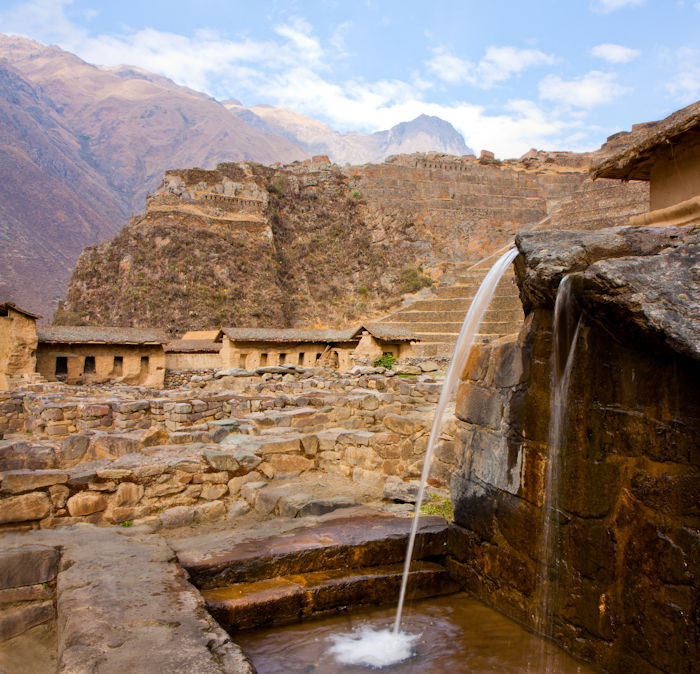
Incamisana, Ollantaytambo, Peru. Credit: Adobe Stock - kcullen
The Incas were also able to develop successful construction methods. For example, impermeable rock coating was used to prevent water from leaking out of the channels. To protect against landslides and erosion of multi-level terraces foundations are connected to drainage channels.
Fourteen Ceremonial Fountains
The excavated temple has fourteen ceremonial fountains and additionally, three others that were never completed, and then the place was abandoned. There are also canals and a well-planned and meticulously engineered conduit/distribution water system.
The Incamisana has platforms and elaborately carved stone niches; channels and fountains are moving water through the temple. The Incamisana played an important role, but in the design of these Inca watery systems, the ruler, as the most important official, would have access to freshwater before other people used it.
The network of roads, carefully planned, engineered, built, and maintained, connected the Incamisama sanctuary with the Inca Empire.
Updated on October 11, 2023
Written by – A. Sutherland - AncientPages.com Senior Staff Writer
Copyright © AncientPages.com All rights reserved. This material may not be published, broadcast, rewritten or redistributed in whole or part without the express written permission of AncientPages.com
Expand for referencesMore From Ancient Pages
-
 On This Day In History: Charter Of The Forest Was First Issued On London – On Nov 6, 1217
-
 Mystery Of Pharaoh Shoshenq III’s Sarcophagus Deepens: Unknown Ancient Egyptian Inscriptions And 225 Royal Ushabti Figurines Discovered In Tanis
-
 Churning Of The Ocean: Great Hindu Story Of Creation From Mahabharata And Purana
-
 The Cyclades And Their Mysterious Society Lost In Time
-
 Ancient Ruins Of Hovenweep: Impressive Puebloan Masonry
-
 Castor And Pollux: Dioscuri Brothers Immortalized In The Night Sky In Greek Beliefs
-
 Neanderthals Were Present In Italy Much Earlier Than Previously Thought
-
 Thousands Of Ancient Tools From A South African Cave Reveal Prehistoric Human Connections
-
 Dispute Between Russia And Poland Over Discovery Of Czarist Officer’s Corpse In Turkey
-
 525-Million-Year-Old Fossil Defies Textbook Explanation For Brain Evolution
-
 A New William Shakespeare First Folio discovered on Isle of Bute, Scotland
-
 Ostrich Eggshell Beads Were Social Currency For People Who Lived 33,000 Years Ago
-
 On This Day In History: Munich Agreement Was Signed – On Sep 30, 1938
-
 Lady Justice (Justitia): Legal And Philosophical Concept Produced In Remote Antiquity
-
 How Climate Change Contruibuted To The Transition From Nomadic Hunter-Gatherers To Settlement And Farming Societies
-
 Bronze Age DNA Shows Direct Genetic Link To Current Inhabitants Of Southern Poland
-
 Capernaum – Was The City On The Sea Jesus’ Home?
-
 Impressive Marble Statue Of A Ram, An Ancient Christian Symbol For Jesus Discovered
-
 Giant Ancient Egyptian Fortress Discovered Along The Route Of Horus In The Sinai Desert
-
 Unusual Burial Ceremony: Bones Of The Dead Were Sorted And Categorized Before Burial

