
Manannán Mac Lir – Irish God Of Sea, Healing, Weather And Master Of Shapeshifting
A. Sutherland - AncientPages.com - Manannán mac Lir (or Manann) - "son of the sea") - is a sea god in Irish mythology and the Welsh tradition; his other name is Manawydan.

Stephen Reid's illustration - Manannán's boat – The High Deeds of Finn and other bardic romances of ancient Ireland by T. W. Rolleston. http://www.gutenberg.org/files/14749/14749-h/14749-h.htm#IL16 - Public Domain
Generally, Manannán mac Lir is a popular figure in Irish mythology, and some Irish traditions even attempted to portray him as a historical figure.
Manannán mac Lir was also a god of the weather and healing. His father was Lir, an old and obscure god of the sea and ocean.
Manannán mac Lir had a beautiful wife, Fand (Fiand), who lived with his consent with a hero, Cuchulainn. Later, when she had to part with him, the god of the sea used to wear their mantle so that they would never meet again.
He raised the god Lugh (Luga) and was a foster father to other children.
Manannán mac Lir never lived on land but dwelled on a legendary island, Tír Tairngiri (' Country of Promise') or Mag Mell (' Plain of Joy').

Manannán mac Lir sculpture by John Sutton at Gortmore, Magilligan, County Londonderry. Credit: Kenneth Allen, Wikipedia, CC BY-SA 2.0
Even Emain Abhlach ('Island of Apple Tree') was associated with this sea god and the island of Avalon in later legends.
Curious Being With No Head Or Torso But Three Legs – Symbol Of The Isle Of Man
The name of this god derives from that of the Isle of Man (also known as Manx). In ancient beliefs, Mac Lir governed this place and protected it from invaders with his misty cloak.
As the legend says, he was the island's first ruler and "lived in a castle on the top of Mount Barrule.
Some stories claim his burial mound can be seen on the seashore beneath Peel Castle on the Isle of Man", and a vantage point looking out to sea was called Manannán's Chair, from which Manannán mac Lir was said to keep watch.
Manx fishermen claimed that, as they mended their nets, Manannán came to them, walking along the seashore followed by a curious being who seemed to have no head or torso but three legs—the symbol of the ever-moving sea and also the crest of the Isle of Man…" (P. Monagan)
On the Isle of Man, the history of the Triskelion ('three legs') dates back to pagan times and is originally a symbol of the sun, power, and life.
Extraordinary Magical Possessions
Manannán has many extraordinary magical powers. He owned a self-propelling boat named Scuabtuinne ("wave sweeper"), a sea-borne chariot drawn by the horse Enbarr ("water foam"), a mighty sword named Fragarach ("the answerer"), and a cloak of invisibility (féth fíada).
The god used a chariot drawn by horses to move across the sea waves, traveling faster than the wind could blow. His attribute was a pig, and he possessed magical pigs that could be eaten each day and appear alive the next day.
The Enbarr (Énbarr) was his horse mentioned in the Irish Mythological Cycle. The creature could traverse both land and sea. It was swifter than wind speed. Lugh Lamh-fada ( Irish: Lug Lámhfhada) had this horse at his disposal.
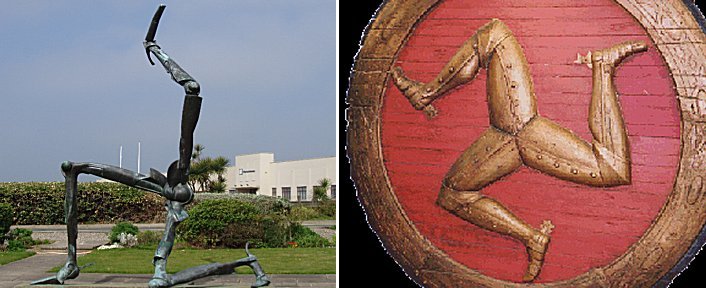
The Three-Legged Isle of Man Emblem, Manx Museum, Douglas.
He could change his form to become any creature he wanted, even a particular mortal if needed. He could grant his supernatural powers to others and create illusions of things to make them numerous or invisible.
Manannán mac Lir And Tuatha Dé Danann
Manannán mac Lir is believed to be older than the Tuatha de Danaan. This lineage is only given to him by a later tradition.
He remained affiliated with both the Tuatha Dé Danann and the Fomorians. However, he did not originally belong to Tuatha Dé Danann, one of the most central deities of ancient Ireland.
Tuatha Dé Danann accepted him. After the Milesians defeated them and they were forced to hide, he helped them.
They could retire to the Otherworld ('Sidhe' or the 'Hollow Hills') and remain invisible to people. The invisibility was brought by magical fog.
Manannán mac Lir gave Tuatha Dé Danann even more, namely, immortality and eternal youth. He also invited them to an extraordinary feast where magical pigs were served and endlessly renewed after being eaten.
Manannán Appeared In Literature And Scottish Folklore
In many Irish and Scottish tales, Manannán is sometimes a merchant mariner or a brave sailor with extraordinary celestial navigational skills, so he is never disoriented or lost at sea. Oral tradition has survived until today on the Isle of Man, and there are still many stories about the sea god Manannán mac Lir.
Written by – A. Sutherland - AncientPages.com Senior Staff Writer
Updated on December 10, 2023
Copyright © AncientPages.com All rights reserved. This material may not be published, broadcast, rewritten or redistributed in whole or part without the express written permission of AncientPages.com
Expand for referencesMoore A. W. The Folk Lore of the Isle of Man
Monagan P. The Encyclopedia of Celtic Mythology and Folklore
More From Ancient Pages
-
 On This Day In History: Noah Webster, Jr. “Father Of American Scholarship And Education” Was Born – On Oct 16, 1758
-
 3,000-Year-Old Fortress Built By The Mysterious Votadini Tribe Discovered On Top Of Arthur’s Seat
-
 Khonsu: Enigmatic Egyptian Moon God, Healer, Protector And His Dark Side
-
 2,000-Year-Old Statue Of Priest’s Head Excavated In Laodicea On The Lycus
-
 Ranikot Fort: Gigantic Great Wall Of Pakistan Shows Greatness Of Indus Valley Civilization
-
 There Is A Problem With The Footprints Claimed As Evidence Of Ice Age Humans In North America – Scientists Say
-
 Huge Pre-Viking Longhouse Discovered At Sem In Norway May Confirm A Scandinavian Myth – A King’s Home?
-
 Bizarre And Unexplained Phenomenon That Defied The Laws Of Nature
-
 Ancient Cosmic Secrets – Mystery Of The ‘Four Sons Of Horus’ And Their Connection To Stars In The Ursa Major Constellation
-
 Mysterious ‘Temple Of The Crossed Hands’ Of Kotosh – One Of The Oldest Structures In Peru
-
 Ancient World’s Second Largest Library Of Codices, Manuscripts Reopened In Sinai
-
 Opium Use Was Widespread In Ancient Egypt – Study Of Alabaster Vase Reveals
-
 Anglo-Irish Explorer Shackleton’s Ship The Quest Found Off Canada’s Coast
-
 Climate Change Behind Early Human Migration To The Americas At Key Intervals – Scientists Say
-
 Don’t Underestimate The Rishis – Ancient Sages Were ‘Probably Great Scientists’
-
 The Untold History Of The Horse In The American Plains Revealed
-
 Ukraine – A Place Where People From Different Cultures Intersected Until About 500 Years Ago
-
 Rare 1,600-Year-Old Wooden Pagan Idol Discovered In Ireland
-
 Does A Baffling Artifact Offer Evidence Of Ancient Extraterrestrial Visitation In New Zealand? – The Discovery – Part 1
-
 Peterborough Petroglyphs Could Offer Evidence Ancient Celts Visited Canada 2,000 Years Ago

