
Alexander The Great Was Crowned Pharaoh And Declared Son Of God Amun
Conny Waters - AncientPages.com - Not all pharaohs were of Egyptian origin. Alexander III of Macedon, known as Alexander the Great (356 - 323 BC), was crowned pharaoh and declared the son of God Amun in ancient Egypt.
In May 334 B.C., Alexander the Great began his invasion of the Persian Empire. In the Battle of the Granicus, he defeated Darius III, the last king of the Achaemenid Empire.
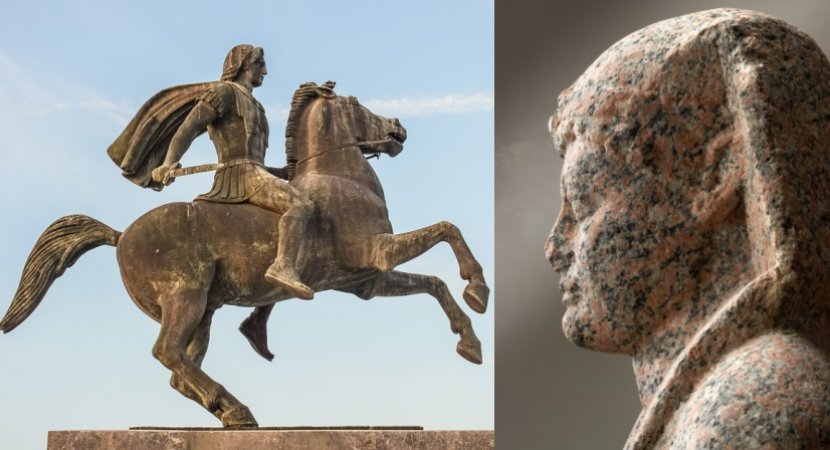
Left: Statue of Alexander the Great, Thessaloniki, Greece, Image Credit: Public Domain. Right: Alexander the Great as pharaoh. Image credit: Public Domain
The battle took place in Northwestern Asia Minor, near the site of Troy, and was the first of three major battles fought between Alexander the Great and the Persian Empire.
It was a battle in which Alexander the Great came close to failure and death. However, he survived, and after the victory, he set eyes on Egypt.
Alexander the Great’s victory over the Persians welcomed ancient Egypt, which was no longer a dominating kingdom after being conquered earlier by the Persians. So, when Alexander the Great entered Egypt, people saw him as a liberator who had freed the Egyptians from many years of brutal oppression at the hands of the Persian Empire.
In the Autumn of 332 B.C., Alexander the Great, who was only 24 years old at the time, was crowned pharaoh in Memphis. He visited the Temple of the Oracle of Amun in the Western Desert of Egypt, not far from the border of Libya. The great Macedonian conqueror was declared the son of the god Amun. This was a special title because Amun was worshiped as the god of the Egyptian creator. He was considered the king of the gods and the physical father of all pharaohs.
Alexander the Great was now the ruler of Egypt, and unlike the Persians, he encouraged people to keep practicing their native religion. Interestingly, he said that he prayed to Egyptian gods for guidance but never revealed what they had told him.
Though Alexander the Great spent two months living as comfortably as a god at the palace, he certainly did not neglect his duties as a ruler.
Acting as a pharaoh and military commander, Alexander the Great restored political power in the country and appointed Egyptians. But he didn’t take unnecessary risks and ensured Egypt’s armies remained under Macedonian command.
Before he left to conquer new lands, he founded the city of Alexandria along the coast of the Mediterranean Sea in the north-central part of Egypt. Famous for its stunning lighthouse and great library, Alexandria was once the second most powerful city of the ancient Mediterranean region, after Rome.
Alexander the Great died in Babylon on June 11, 323 B.C and his death opened a new chapter in the history of Egypt.
Ptolemy I Soter (366 BCE – 282 B.C.), who served as one of Alexander the Great's generals and deputies, became king of Egypt. He was the one who founded the Ptolemaic dynasty, which brought some significant changes to the country.
Ancient Egyptians soon accepted the Ptolemies as the successors to the pharaohs of independent Egypt. The Ptolemaic dynasty ruled Egypt until the Roman conquest. Cleopatra VII Philopator was the last active ruler of the Ptolemaic Kingdom of Egypt, nominally surviving as pharaoh by her son Caesarion.
As mentioned earlier on Ancient Pages, Little Caesar - Caesarion was murdered on August 23, 30 BC, only 17 years old. He was the last King of the Egyptian Ptolemies, most probably the son of Julius Caesar, and his mother was Cleopatra VII.
Updated on October 10, 2023
Written by Conny Waters – AncientPages.com Staff Writer
Copyright © AncientPages.com All rights reserved. This material may not be published, broadcast, rewritten or redistributed in whole or part without the express written permission of AncientPages.com
More From Ancient Pages
-
 Has The Mystery Of The Secret Sarcophagus Found At Notre-Dame Cathedral Been Solved?
-
 Sacred Number Four – Perfect Number And Deep Meaning Behind It
-
 Mysterious Ancient Remains Of The Lady In The Well – An Archaeological Detective Story
-
 Lamplighters In London: An Important Job In The Victorian Era
-
 Queen Teuta: Power-Hungry Villain Who Underestimated The Romans
-
 1,700-Year-Old Statue OF Greek God Pan Unearthed In Istanbul
-
 Paranthropus Robustus Who Lived 2 Million Years Ago Walked Upright Like Modern Humans
-
 Amazing Adventures Of Örvar-Oddr And Encounter With The Mysterious Ögmundr Flóki
-
 What Was Lex Salica?
-
 Re-Evaluation Of Liujiang Skeleton’s Dating Sheds New Light On Human Occupation In China
-
 Why Is The Yarm Viking Helmet Special?
-
 Baalbek: Were The Megaliths Put In Place Under Herod?
-
 Amazing Discovery Of A Wakizashi, Japanese Sword In Berlin-Mitte
-
 Roman-Germanic Mythical Kneeling Figure With A Human Head And Snake’s Body Unearthed At Stuttgart’s Excavation Site
-
 Ancient City Of Carchemish Will Soon Be Ready To Show Its Historical Treasures
-
 Was Alulim, First King Of Sumer And Eridu Biblical Adam?
-
 Incredible Ancient Machines Invented By Hero Of Alexandria – An Engineer Far Ahead Of His Time
-
 Ancient Fresco Tomb Dated A 1000-Years Ago Was Accidentally Discovered In Northern China
-
 Ancient Burial Chambers Decorated With Mythological Figures Of Hercules, Medusa, Eros – Unearthed In Bursa, Turkey
-
 Ancient Chinese Tai Chu Calendar Was Defined By Emperor Han Wu

