
Pyrgi Gold Tablets: A Rare Ancient Bilingual Treasure
Ellen Lloyd - AncientPages.com - Dating back to 500 B.C., the Pyrgi gold tablets were discovered in 1964 in an excavation of a sanctuary in ancient Pyrgi, the port of the southern Etruscan town of Caere in Italy.
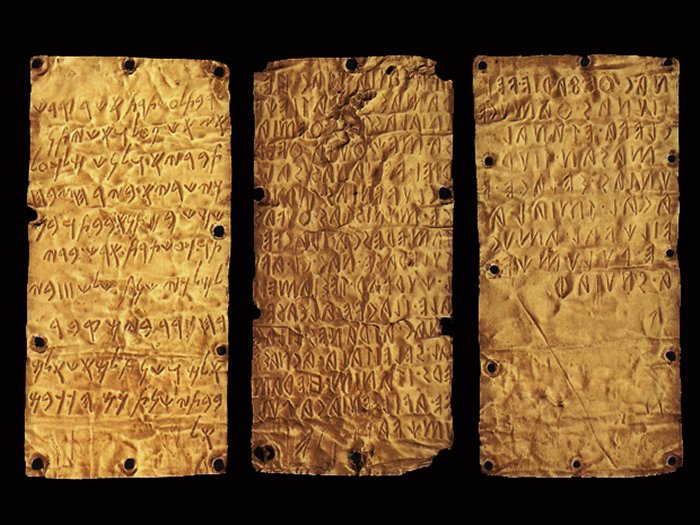
Pyrgi Gold Tablets. Credit: Public Domain
The three gold plates contain holes around their edges, indicating that they were likely bound together at one point. What makes the tablets so unique is that they are bilingual.
Two tablets are inscribed in the Etruscan language, the third in Phoenician, and are today regarded as the oldest historical source of pre-Roman Italy among the known inscriptions. They contain a dedication by King Thefarie Velianas to the Phoenician goddess Astarte, also known as Ishtar.
The cult of the ancient Mesopotamian goddess associated with love, beauty, sex, desire, fertility, war, justice, and political power spread throughout the region. Ishtar was initially worshipped in Sumer as Inanna. In time, she was also honored by the Akkadians, Babylonians, and Assyrians.
The Pyrgi gold tablets are rare and unusual. They are an ancient treasure both from a linguistic and a historical point of view.
The tablets allow researchers to use the Phoenician version to read and interpret the otherwise undecipherable Etruscan.
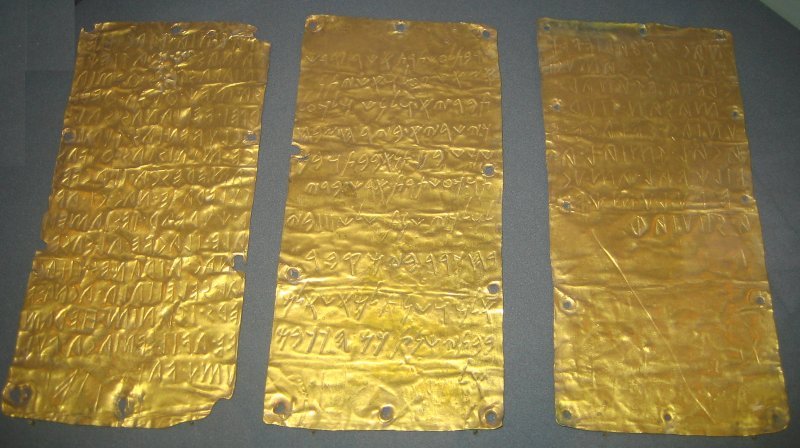
Pyrgi Gold Tablets. Credit: Public Domain
According to William J. Hamblin, a professor of history at Brigham Young University, the three Pyrgi gold tablets are a prime example of the spread of the Phoenician practice of writing sacred texts on golden plates from their original center in Phoenicia, via Carthage, to Italy, and is roughly contemporary with the Book of Mormon’s claim that sacred texts were written on metal plates by the Phoenicians’ closer neighbors, the Jews.
There was no need to decipher these fascinating ancient tablets because the Phoenician text was long known to be Semitic. Though the artifacts may not be regarded as an ancient enigma, they are nevertheless of extraordinary historic value and give us a unique insight into how older people communicated their beliefs and showed worship of their beloved goddess Astarte (Ishtar, Inanna).
The Phonecian inscription reads:
To lady Ashtarot,
This is the holy place, which was made, and which was given by Tiberius Velianas who reigns over the Caerites.
During the month of the sacrifice to the Sun, as a gift in the temple, he built an aedicula (an ancient shrine).
For Ashtarot raised him with Her hand to reign for three years from the month of Churvar, from the day of the burial of the divinity [onward].
And the years of the divinity statue in the temple [shall be] as many years as the stars above.
The Pyrgi gold tablets are now kept at the National Etruscan Museum, Villa Giulia, Rome.
Written by Ellen Lloyd – AncientPages.com
Updated on May 28, 2023
Copyright © AncientPages.com & Ellen Lloyd All rights reserved. This material may not be published, broadcast, rewritten or redistributed in whole or part without the express written permission of AncientPages.com and Ellen Lloyd
More From Ancient Pages
-
 Who Has Stolen Charles Darwin’s Notebooks Worth Millions From The University Of Cambridge?
-
 Did Leonardo Da Vinci Invent Contact Lenses In 1508?
-
 Ancient Hindu High-Tech That Contributed To Modern Science
-
 3,000-Year-Old Settlement Studied By Archaeologists In Cyprus
-
 Shell Trumpets In Neolithic Catalonia Were Used For Effective Long-Distance Communication
-
 Callanish Stone Complex: Sacred Place On The Isle Of Lewis In Scotland
-
 Mystery Of The Ancient Unknown Mining Civilization In North America – Puzzling Archaeological Discoveries – Part 1
-
 Facial Reconstruction Of Chinese Emperor Wu Who Lived 1,500 Years Ago
-
 On This Day In History: Tycho Brahe 1st Sketches “Tychonic System” Of Solar System – On Feb 13, 1578
-
 King Menelaus Of Sparta: Husband Of Helen Of Troy And Key Figure In The Trojan War
-
 Viking Artifacts Discovered In Canada Are More Mysterious Than First Thought
-
 Surprising Discovery Of Oldest Decoratively Carved Wood In Britain
-
 Oldest Golden Jewel In The Caucasus Unearthed In Azerbaijan
-
 Mesoamerican Rubber Ball Game Tradition Existed Earlier Than Thought
-
 Orang Bunian: Mysterious Invisible Whistle People Living In Forests In Malay Folklore
-
 Ancient ‘iPhone-Like’ Artifact Discovered At The Russian Atlantis
-
 Unearthing South Australia’s Oldest Known Shipwreck: The Bark South Australian (1837)
-
 Evolution Study Re-Writes History – Why Were Some Early Male Ancestors Significantly Larger Than Females?
-
 Mysterious Mermaid Mummy Investigated By Scientists
-
 Kuthodaw Pagoda – ‘The World’s Largest Book’ Carved In 729 Marble Slabs

