
Ancient Suda: Massive Anonymous Byzantine-Greek Lexicon Dated To 10th Century
A. Sutherland - AncientPages.com - An anonymous Byzantine Greek lexicon dated to the 10th century is known as “Suda” (from the Byzantine Greek word souda, meaning "fortress" or "stronghold."
The Suda is an enormous historical work, arranged alphabetically and dedicated to the ancient Mediterranean world, which covers the whole of Greek and Roman antiquity.
It also includes Biblical and Christian material written in Greek.
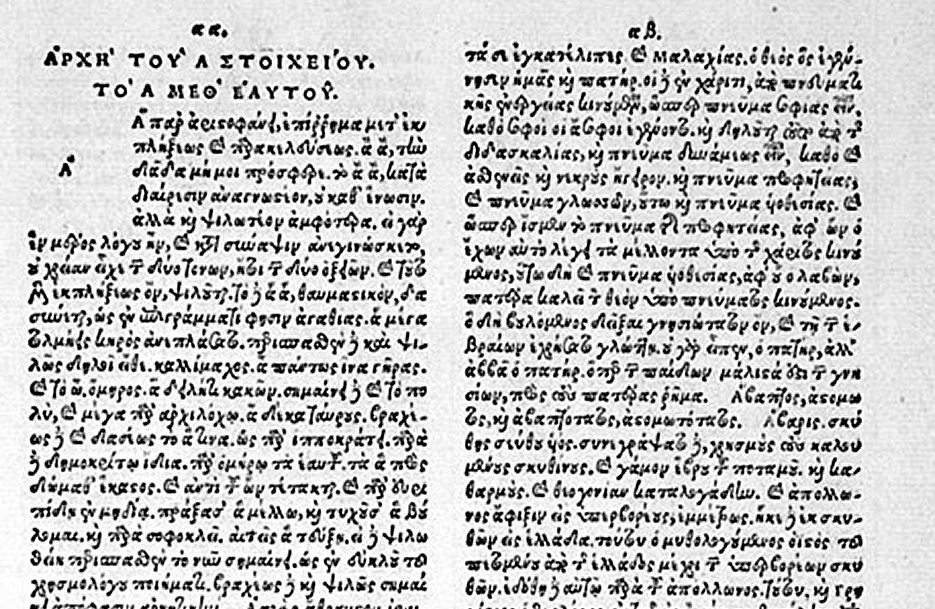
The Suda, which contains much useful information on ancient history and life, it also deals with a variety of biblical and pagan subjects, too.
The Suda (or The Book of Suda) quoted frequently under the Latin title 'Liber Suda' covers 30,000 slogans, of which about 900 are material articles, mostly historical and literary. In the absence of ancient sources, the book is invaluable and in many cases the only source of historical information.
Justus Lipsius, a Flemish historian, and philosopher called this encyclopedia "ram with a golden rune".
Preserved in several medieval manuscripts, this literary masterpiece has been edited and published several times since the end of the 14th century in traditional hard-copy scholarly editions.
The Suda contains a lot of classical knowledge and a great variety of drawings from ancient sources that have since been lost, and often derived from medieval Christian compilers. It is an ancient book of a very special kind (something between a modern encyclopedia and a grammatical dictionary) about Greek and Roman science and medicine.
For those who don't want to be too scientific, there is a lot of information about Apollo, and how he prevented the oracles of the Chaldean Sibyl from being understood by the so-called 'hoi polloi'.

You can learn about, Philoxenos, the tune-bender, who was considered the most courageous literary critic in history. You can find biographies, chronicles, and the best quotations from many ancient writers, historians, and dramatists, such as Homer, Sophocles, and Aristophanes.
The English astronomer Edmund Halley (1656-1742) also studied the Byzantine lexicon "Suda" and
in 1691, he introduced to astronomy an important term 'saros', which defines a whole
series of subsequent eclipses, which divides the 18 years and 8 hours mentioned for 18 years.
The lexicon is arranged alphabetically with only some slight deviations from common vowel order and placed in the Greek alphabet.
The Suda, which contains much useful information on ancient history and life, it also deals with a variety of biblical and pagan subjects, too.
Many scholars and their collaborative work over 16 years finally resulted in the first English translation of the entire Suda lexicon, a massive 10th-century Byzantine encyclopedia.
The Suda is considered “a stronghold of information”.
Written by – A. Sutherland - AncientPages.com Senior Staff Writer
Copyright © AncientPages.com All rights reserved. This material may not be published, broadcast, rewritten or redistributed in whole or part without the express written permission of AncientPages.com
More From Ancient Pages
-
 Did The Babylonian Fish-God Oannes Visit Tiahuanacu?
-
 New Path For Early Human Migrations Contradicts A Single ‘Out Of Africa’ Theory
-
 Rare 2,800-Year-Old Assyrian Scarab Amulet Found In Lower Galilee
-
 Does This Ancient Box Contain Buddha’s Cremated Remains?
-
 Coral Castle Is Among Most Fascinating And Mysterious Buildings In Florida
-
 One Of Egypt’s Oldest Christian Churches Discovered By Polish Archaeologists
-
 Unusual 7,000-Year-Old Jar Decorated With A Horned Face Found In Poland
-
 First Complete Roman Funerary Bed Found In Britain
-
 Skull And Jaw Of Giant Bear Of The Late Pleistocene Found In Buenos Aires
-
 Explorer Discovered A Lost Underground World Beneath Big Sur In North America – But Why Cannot Anyone Else Find It Now?
-
 On This Day In History: Coverdale Bible Printed In English For The First Time – On Oct 4, 1535
-
 A 1,000-Year-Old Bronze Coin Accidentally Discovered By A Little Boy
-
 Secrets Of Ninja Swords – Favorite Weapon Of The Shinobi
-
 Exceptionally Long-Lived Ancient Form Of Hydraulic Engineering Unearthed In The Nile Valley
-
 Daily Life Of Priests And Priestesses In Ancient Egypt
-
 Did The Inca Use The Quipu To Collect Taxes?
-
 Ponte di Cecco – Legend Of A Bridge Built By An Astrologer With The Help Of The Devil
-
 There Is A Problem With The Footprints Claimed As Evidence Of Ice Age Humans In North America – Scientists Say
-
 3,000-Year-Old City Of Sillyon That Alexander The Great Failed To Conquer
-
 The Norimitsu Odachi – Giant Japanese Sword Remains An Enigma

