
Glastonbury Tor – One Of The Most Mysterious Sacred Places In England
A. Sutherland - AncientPages.com - Glastonbury Tor, some 525 feet high (160 m), has been called the 'Heart of England'.
It is an enigmatic sacred landmark, one of the most important early Christian sites in southern Britain, but first of all, a sacred pagan place for many centuries before the legendary arrival there of St. Joseph of Arimathea bearing the Holy Grail.

Glastonbury Abbey - Lady Chapel - image taken around 1900, showing the unrestored interior of the Lady Chapel. photo credits: wikipedia
It is an ancient sacred mound with the ruins of a legendary church standing atop it and dedicated to St. Michael, the Archangel, a warrior against powers of darkness.
The place is surrounded by numerous legends, going back through medieval times and continuing today.
A system of terraces that encircles Glastonbury Tor (Celtic word 'tor' means 'hill or mountain') has long been thought of as a gigantic labyrinth based on ancient pattern.
Was the Tor an important center of a fertility cult based on an earth goddess myth? Or is it the legendary island of Avalon associated with the grave of King Arthur?
Legends and myths, sometimes ancient carvings are our only legacy from secretful and strange places. Avalon was such a place, difficult to imagine and available only to a small circle of people.
Avalon - associated with Glastonbury Abbey - is said to be located in the county of Somerset,
It is sometimes said that the island of Avalon is hidden beneath the water's surface, but there is also a legend that describes the way to Avalon.
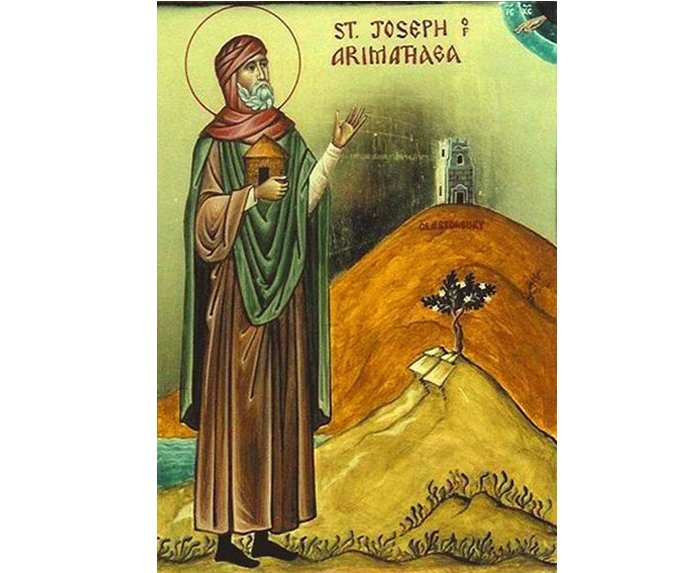
Joseph of Arimathea who brought the Holy Grail, filled with the blood of the crucified Christ, to England.
'One travels over water in a barque, but first one has to learn how to summon the barque and its crew. Only Avalon's inhabitants knew the land road, which never appears in the descriptions, although it is said that some people discover this secret path by mistake.
Cloud cover is another precondition for reaching Avalon, which cannot be entered in clear weather. Those who try to enter on a sunny day find themselves in Glastonbury Abbey.'
One of the greatest mysteries surrounding Glastonbury is whether or not King Arthur is buried here. In 1190, monks recorded that King arthur's mortal remains were placed beneath the abbey along with those of his wife Guinevere.
The king's Celtic grave has a lead cross with a Latin inscription:
"Hic jacet sepultus inclitus rex Arthurus in insula Avalonia" - "Here lies interred the famous King Arthur on the Isle of Avalon."
There is a number of theories regarding the Tor's origin and purpose and many people ask whether the mound is artificial.
'The answer is that it is a natural hill, but one that shows signs of having been artificially shaped. Along its sides are a number of terraces, one above another,' explains Geoffrey Ashe, a scholar and writer in the areas of Arthurian legend and British mythology.'
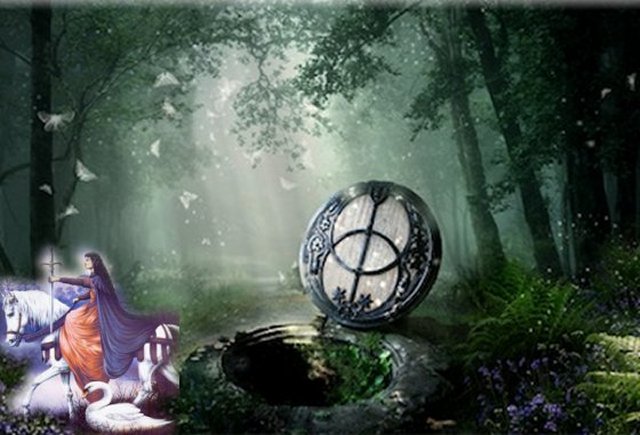
King Arthur's sword, Excalibur, was forged on the mystic Isle of Avalon. When Arthur was wounded in battle, he was carried off to the Isle of Avalon so that his wounds might be attended to.
Geoffrey Ashe, who wrote a book "King Arthur's Avalon" suggests that the Glastonbury Tor was intended as a ritual site that, when walked in procession, gave admittance to an interior world.
According to a theory put forward by Geoffrey Russell, Ashe says, the terraces are the principal remains of a maze: not in the sense of a puzzle, but in the sense of a long, twisting, devious approach to a centre. Made in the remote past for ritual purposes, it spirals round the Tor seven times, and ends - or may be supposed to end - at the summit where the tower now stands.
See also:
Medieval Mythbusting – New Research Rewrites History Of Glastonbury Abbey
Unraveling The Secret History Of King Arthur And Robin Hood
Was Tintagel Castle A Fortress Used By Iconic Hero King Arthur?
Using our imagination, we can see initiates and pilgrims walking along a twisting, seven-circuit path. It reminds an old children's game, in which the object is to take a strictly defined route. without short cuts, from the start 'Hell' to the finish 'Heaven'.
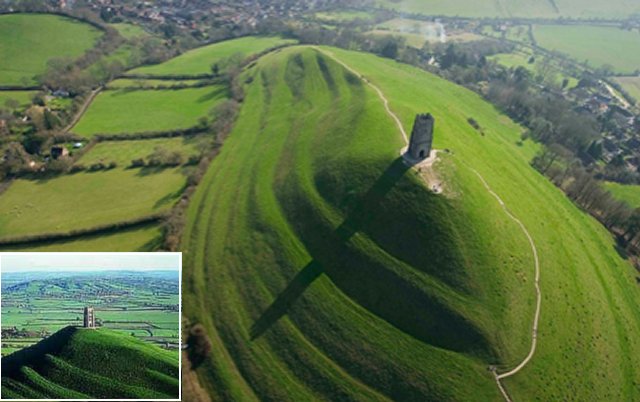
Glastonbury Tor in Somerset, England, enigmatic sacred mound; its rearing volcanic shape is surrounded by man-made serpentine paths
There is an old well the so-called Chalice Well, at the foot of the Tor where the water, blood red from the iron oxide in the surrounding bedrock, bubbles up with a specific sound like the heartbeat.
Legend says the well was built by the Druids to hide the cup used during the Last Supper, the Holy Grail, which was filled with the blood of the crucified Christ and brought to England by Joseph of Arimathea.
Others disagree saying the Chalice Well is probably a Victorian invention.
We know very little about the builders of Glastonbury Tor and its true meaning. Legends and myths cannnot give us satisfactory answers and despite modern theories, this enigmatic place still remains an unsolved enigma.
Written by – A. Sutherland AncientPages.com Staff Writer
Copyright © AncientPages.com All rights reserved. This material may not be published, broadcast, rewritten or redistributed in whole or part without the express written permission of AncientPages.com
Expand for referencesMore From Ancient Pages
-
 Tool Patterns Reveal What Caused The Neanderthals’ Extinction In The Iberian Peninsula
-
 Wonderful Ancient Mosaics In Ancient City Of Zeugma, Turkey
-
 Explorers Of Lost City Of The Monkey God Contract Unusual Flesh-Eating Disease
-
 Ancient Paintings Discovered At Kom Ombo Temple At Aswan, Egypt
-
 They Spoke The Language Of The Gods – Keepers Of Sacred Ancient Knowledge – Part 1
-
 Why Was An Ancient High-Ranking Woman Buried Within The Abandoned Khar Nuur Fortress, Mongolia?
-
 Nude Athletes And Fights To The Death: What Really Happened At The Ancient Olympics
-
 Cup Of Jamshid – Holy Grail Of Ancient Persia Offered Immortality And Visions Of The Future
-
 Mayas Utilized Market-Based Economics – New Study
-
 Visit The Palace Where Alexander The Great Was Born In Pella
-
 Runic Inscription On The Viking-Age Galloway Hoard Deciphered
-
 How The Handbook ‘Hammer Of Witches’ And Then-Existing Networks Inspired Europe’s Witch Craze
-
 Queen Mavia And The Tanukhids Launched A Massive Revolt Against Romans – But Why?
-
 Honey-Collecting In Prehistoric West Africa From 3500 Years Ago – Pottery Examined
-
 31,000-Year-Old Skeleton Missing Foot May Show Oldest Amputation
-
 Buccaneers And Privateers Were Pirates – But What’s The Difference Between Them?
-
 Ancient Giant Amphibians Swam Like Crocodiles 250 Million Years Ago – New Study
-
 Unusual Double Temple Of Kom Ombo Dedicated To Crocodile God Sobek And Falcon-Headed God Horus
-
 Art Historians Solve Mystery Of Raphael’s Tomb By Reconstructing His Face
-
 Ancient Mystery Of The American Southwest – Unusual Skeletons And Mummies – Part 2

