
Katana ‘Soul Of The Samurai’ – Most Famous Japanese Sword With Long Tradition
A. Sutherland - AncientPages.com - Katana is the most famous Japanese Samurai sword. The Japanese Katana sword is considered "the soul of the Samurai" and one of the deadliest-edged weapons used in ancient and feudal Japan by the Samurai, the members of Japan's knightly class.

Its origin, however, is not entirely known. It represents a combination of both Chinese and Japanese craftsmanship, and in its early form, it may originate from China. It is said that the enigmatic katana sword was born in fire. Since ancient times, the blade has been a symbol of faith and authority. It played an essential role as a base for the concept of the "Japanese spirit."
In his book "Katana: The Samurai Sword" Stephen Turnbull writes:
"To a samurai, one's katana was both a weapon and a symbol. Never has the relationship between man and sword been better expressed than in the words of the great shogun (military dictator) of Japan, Tokugawa Ieyasu (1542–1616), who advised his successors that 'the sword is the soul of the warrior.'
No samurai would ever be without his sword, whether he was wearing armor or everyday clothes, and a sword forged by a celebrated master was one of the most precious gifts a warrior could receive. The sword, in its rest position thrust into the belt, would tell the world that its owner was a true samurai – a member of a social and military elite – since 4 members of the lower classes did not carry weapons (theoretically, at least)…."

Old katana next to the koshirae , shirasaya and tsunagi. Image credit: - CC BY-SA 3.0
It also carries the meaning of a protector between the birth and death of a person, protecting them from injury. When the Samurai turned on the sword to pull and chop in one and the same movement, it was undoubtedly awe-inspiring and deadly.
The Japanese word katana only means swords or single weapons, but it is also used as the designation of a particular sword that was used from the 17th century to the late 19th century. The Japanese history of edged weapon craftsmanship stretches back over 2,000 years.
Appearance Of Katana Weapon
In appearance, the katana is a curved, single-edged blade with a circular or squared guard and a long grip to accommodate two hands.
The mythical weapon is made of three kinds of steel with different hardness such as soft (shigane), medium-haired (kawagane), and hard steel (hagane). The process was very complicated and time-consuming and included the treatment of iron ore, which was hammered to a rod, bent in the middle, whipped together, and then bent again (up to sixteen times to get hard steel).
A katana blade - approximately 60-80 cm tall and weighs 1.1-1.3 kg - does not differ much from its immediate predecessor, the tachin, which was usually slightly lighter concerning its length and had a more curved blade that narrowed towards the tip.
What distinguished the katana from the earlier tachin was a change in how the Samurai carried the sword.
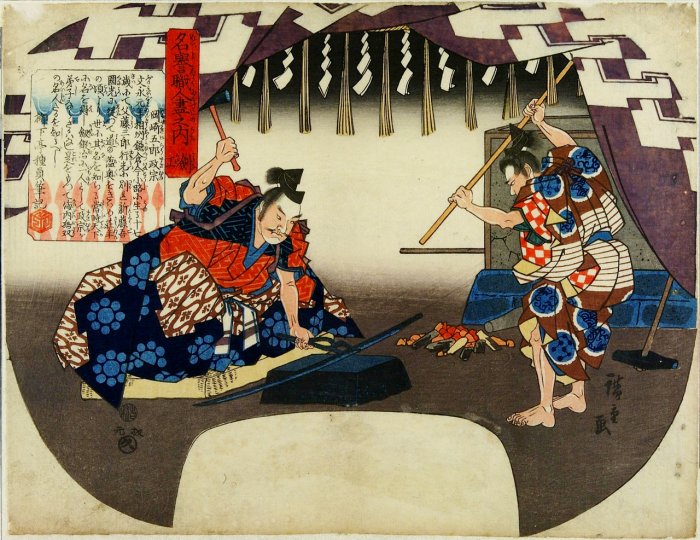
Masamune forges a katana with an assistant (ukiyo-e). Image credit: Celestial Sentinel - Public Domain
Previously, the tachin sword was traditionally worn with the cutting edge down. However, during the Muromachi Period (1392–1573), the katana was worn with the cutting edge up by the Samurai.
Advantage Of Katana Over Other Weapons In Critical Situations
Using the katana, a skilled Samurai could draw and slice his opponent with a single motion in the blink of an eye. It was essential in close-combat warfare, where victory depended heavily on short response times.
The maneuver wasn't possible with the tachin, the ancient predecessor of the katana.
Samurai warriors did not exclusively wear the katana sword. However, after 1588, only Samurai wore a katana in combination with another shorter weapon, known as "wakizashi," but this combination was legalized until 1871.
Ancient secrets of the traditional technique of Japanese swordsmithing are today known only to about 300 swordsmiths. The swordsmithing tradition has significantly declined in Japan.
However, at the beginning of the 15th century, there were about 3,550 active swordsmiths, and swords had both outstanding quality and highly artistic appearance. To receive such a sword was a great honor.
Written by – A. Sutherland - AncientPages.com Senior Staff Writer
Updated on September 5, 2022
Copyright © AncientPages.com All rights reserved. This material may not be published, broadcast, rewritten or redistributed in whole or part without the express written permission of AncientPages.com
Expand for referencesMore From Ancient Pages
-
 On This Day In History: Maximilien Robespierre Sent To The Guillotine – On July 28, 1794
-
 Two Knights, One Horse − How A Legendary Knights Templar Symbol Has Puzzled And Fascinated Since The Middle Ages
-
 Independent Innovations In Stone Tool Manufacturing Across Europe And The Middle East
-
 Naqsh-e Rostam: Spectacular Tomb Complex With Rock Reliefs From Elamite To Sasanian Times
-
 Ancient DNA Reveals Surprising Stories About Migrations And Genetic Mixing Of Our Ancestors
-
 On This Day In History: Myles Coverdale Who Printed First English Bible Died – On Jan 20, 1569
-
 Ancient Egyptians Invented World’s Oldest Egg Ovens And They Are Still In Use
-
 Enigma Of Skull From Petralona Cave In Greece Is Solved And Changes The Human Evolution’s History
-
 6,000-Year-Old Village Unearthed In Kurdestan
-
 Disappearance Of The El Argar Civilization – Why Has No One Lived In The La Almoloya Region Again?
-
 Evidence Oldest Bone Spear Point In The Americas Is 13,900 Years Old
-
 Giant Mimir And The Well Of Wisdom In Norse Beliefs
-
 On This Day In History: Captain James Cook Discovers Hawaiian Islands – On Jan 18, 1778
-
 13,000-Year-Old Engraving May Depict First Paleolithic Social Group Of Humans
-
 183-Million-Year-Old Fossils: Jurassic Marine World In A Farmer’s Field
-
 New Archaeological Discoveries In The Temple Of Khnum At Esna, Luxor
-
 Huge Lost Ancient Underground City Of Samen Finally Reveals Its Secrets
-
 Oldest Evidence Of Maya Calendar Discovered In Guatemala
-
 Elizabeth Woodville: Mother Of The Princes In The Tower And Commoner Queen
-
 Has The Burial Place Of Mysterious Dark Age King Cerdic Of Wessex Been Located?


