
Magical Ring Of Gyges And Its Power To Be Invisible At Will
A. Sutherland - Ancient Pages.com - Gods and other mythical creatures often had the help of magical and powerful objects.
In myths and legends, these objects are often forged by dwarfs who are highly skilled craftsmen and can also provide magical functions to their works.
One such famous object is Andvaranaut, a magical ring that worked like a magnet to attract gold. The dwarf Andvari owned this ring, but it was stolen by the trickster god Loki. It forced Andvari to put a curse upon his golden treasure, including Andvaranaut. His curse meant the owner's accident and terrible death.
Another unique magical ring was Draupnir (Draupner – 'the dripper') in Norse mythology. It belonged to the god Odin and was also forged by dwarfs. Draupnir could multiply itself, meaning every ninth night, eight new rings 'drip' from Draupnir, each of the same size and weight as the original.
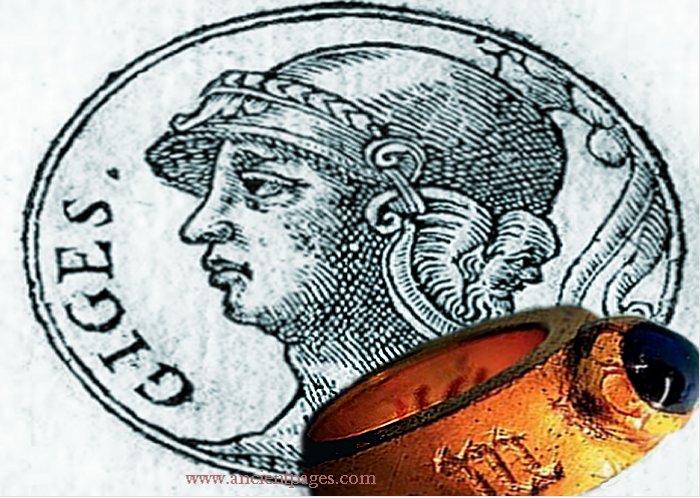
The Ring of Gyges is another magical artifact mentioned by the philosopher Plato in Book 2 of his work 'Republic.' It granted its owner the ability to become invisible at will.
Gyges was the founder of the Mermnad dynasty of Lydian kings, and also the first known king of the Lydian kingdom to have attempted to transform it into a mighty empire. Gyges reigned c. 680-644 BC. There are different accounts of his rise to power, but one is that of Glaucon (c. 445 BC – 4 BC), an ancient Athenian and the philosopher Plato's older brother.
His version of the story is that an unidentified ancestor of Gyges was a shepherd who served as the ruler of the ancient kingdom of Lydia (today, modern-day Turkey). After an earthquake, a cave was exposed in a mountainside where he was feeding his flock. The shepherd entered the cave and found a tomb with a bronze horse containing a corpse larger than a man wearing a golden ring.
He took the ring, and when he carried it, he suddenly realized something unusual had happened.
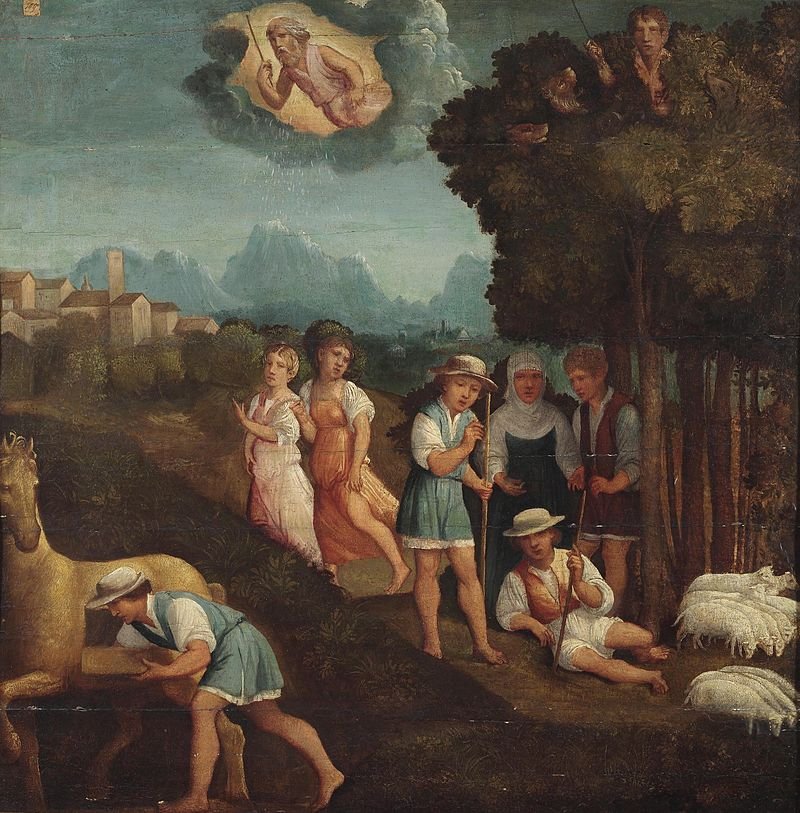 A rare depiction of the legend of Gyges finding the magic ring, Ferrara - 16th century. Author - anonymous source: dorotheum - Public Domain
The ring gave him the power to become invisible by adjusting it. Then, he was chosen as one of the messengers who reported to the king the status of the flocks. With his power of invisibility, he seduced the queen, who helped him to murder the king. Thus, the shepherd became king of Lydia himself.
The magical ring known as the 'Ring of Gyges' is perhaps a mythical object, but Gyges himself existed and was a historical figure, though barely anything is known about his life and reign.
According to 'The Histories of Herodotus,' Gyges, a subordinate of King Candaules of Lydia, killed this royal figure and seized the throne. He had seduced Candaules' Queen before killing him and married her afterward.
There are different interpretations of this legend about the 'Ring of Gyges.' Through the story of this ring, one asks whether a person who finds such a ring will misuse its power.
Was it the magical ring that helped him to obtain these achievements?
In Plato's 'Republic, the role of the legend about the ring has a moral meaning. One important question arises: whether any man can be so honorable and promising that he could resist the temptation of being able to perform any act without being known or discovered.
If we assume that morality is only a social construction, the source of which is the desire to maintain one's reputation for virtue and justice, what would happen if that sanction was removed?
Would one's moral character fade away? Would an intelligent person be honest if he did not fear being caught and punished for his deeds?
The story raises several interesting moral issues. How far would we go if granted the power to become invisible?
The 'Ring of Gyges' story became food for thought for thinkers and authors. Examples include 'The Invisible Man' by H.G. Wells and the story of the ring by JRR Tolkien.
Written by – A. Sutherland AncientPages.com Staff Writer
Updated on Oct 3, 2023
Copyright © AncientPages.com All rights reserved. This material may not be published, broadcast, rewritten or redistributed in whole or part without the express written permission of AncientPages.com
Expand for referencesMore From Ancient Pages
-
 Curious Giant Shaped Rock In China – An Ancient Man-Made Construction Or Natural Formation?
-
 Secret Tunnels Used By Knights Templar Leading To The Treasure Tower – Discovered
-
 Hypatia Of Alexandria – Brilliant, Controversial Scientist And Her Dramatic End
-
 Mystery Of An ‘Impossible’ Event In Georgia Linked To An Unusual Woman
-
 Lagina Sanctuary Of Goddess Hekate: Archaeologists Found Ceremonial ‘Sacred Road’
-
 On This Day In History: Ferdinand Magellan Discovers Guam – On Mar 6, 1521
-
 Archaeologists Encounter A 1,500-Year-Old Mystery In Kent, UK
-
 Why Is Europe Called Europe?
-
 Search For A Viking Cemetery Near Truso Settlement In Janow, Poland – Continues
-
 Looking Into The Secrets Of Parthenon’s Illumination That Enhanced The Sense of Awe And Religious Experience
-
 Tutankhamun Had An Ancient Dagger From Outer Space
-
 Mystery Of Pharaoh Shoshenq III’s Sarcophagus Deepens: Unknown Ancient Egyptian Inscriptions And 225 Royal Ushabti Figurines Discovered In Tanis
-
 Hypnos: God Of Sleep Who Owns Much Of Our Lives In Greek Mythology
-
 Hyksos: 15th Dynasty Rulers Of Ancient Egypt, Were An Internal Takeover
-
 Legend Of Tarenyawagon Who Came From The Heavens And Ascended To The Stars In His Fast Flying Shining Canoe
-
 Height Differences Among Neolithic People Was Caused By Environmental Stress Not Genetics
-
 Unknown Sketch Of Jesus Christ By Leonardo Da Vinci Could Be The Holy Grail Of Art
-
 Who Made The Intriguing Wawa Runestone Found In Ontario, Canada?
-
 Aegir – Jotun Lord Of The Stormy Seas Revered And Feared By Norsemen
-
 Ancient Doll And Mythical Animal – 4,500-Year-Old Toys Discovered In Siberia

