
Infamous Queen Jezebel And Her Ancient Seal
A. Sutherland - AncientPages.com - In the 1960s, a fascinating ancient and large seal was discovered by the Old Testament scholar Dr. Marjo Korpel.
Scholars assumed that the seal belonged to the biblical figure, Queen Jezebel (Izebel), the Phoenician pagan wife of the Israelite King Ahab (9th century BC).
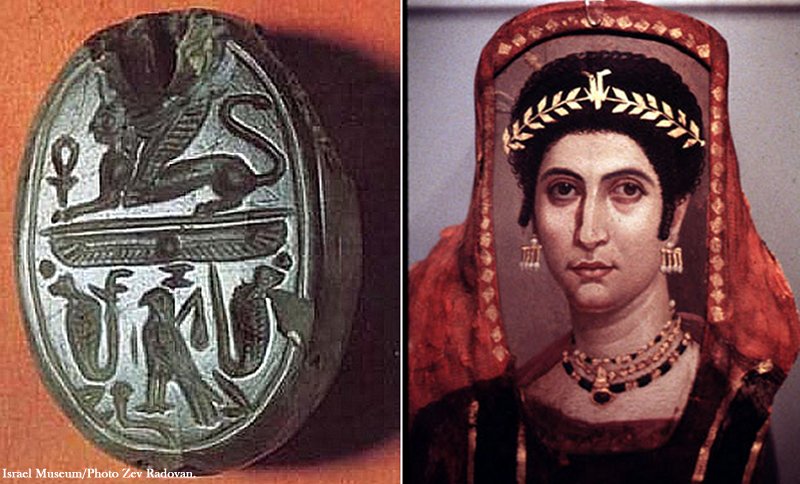 Four paleo-Hebrew letters—two just below the winged sun disk at center, two at bottom left and right—spell out the name YZBL, or Jezebel, on this seal. The Phoenician design, the dating of the seal to the ninth or early eighth century B.C.E. and, of course, the name, have led scholars to speculate that the Biblical queen may once have used this gray opal to seal her documen.
Four paleo-Hebrew letters—two just below the winged sun disk at the center, two at the bottom left and right—spell out the name YZBL, or Jezebel, on this seal.
The Phoenician design, dating the seal to the ninth or early eighth century B.C.E. and, of course, the name, have led scholars to speculate that the Biblical queen may once have used this gray opal to seal her documents.
Many say she indeed was an evil person. Jezebel's name has been used for thousands of years to describe cunning, ruthless,s and reprehensible women.
Some believe she symbolizes evil, and her name has also become synonymous with idolaters, prostitutes, and sorcerers. The Bible portrays Queen Jezebel as a woman who, in the background, exerted enormous influence, including on her husband (1 Kings 21:25).
She saw the opportunity to bend the country's affairs to her will by devious means, including using her husband's seal (1 Kings 21:8) to forge letters.
'...So she wrote letters in Ahab's name, placed his seal on them, and sent them to the elders and nobles who lived in Naboth's city with him.' 1 Kings 21:8
And, owning her seal, she could deal with various important matters independently of her husband, Ahab.
Seal Engraved With 'Yzbl' And Did It Belong To Jezebel?
The seal - engraved with the name yzbl in ancient Hebrew - was large compared to the seals commonly possessed by ordinary citizens. The artifact not only bears symbols that indicate a woman but also symbols that designate a female royal owner.
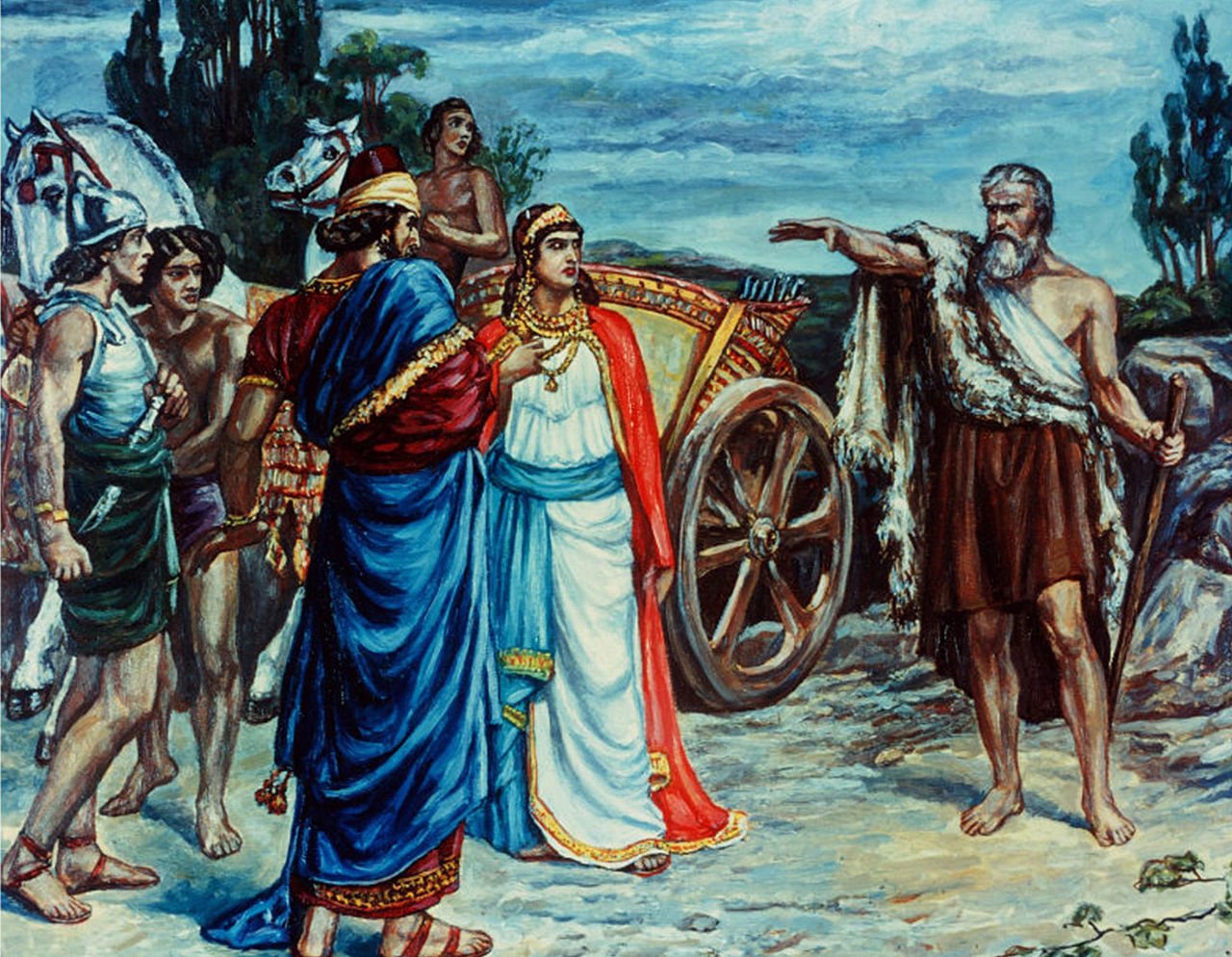 Jezebel and Ahab meeting Elijah, print by Sir Francis Dicksee (1853-1928). Piblic Domain
The spelling of the name was erroneous, and the personal seal could have belonged to another woman of the same name. There was uncertainty regarding the original owner.
A new and more thorough investigation by the Utrecht Old Testament scholar Marjo Korpel finally confirmed that the seal must have belonged to the infamous Queen Jezebel.
Comparing the artifact to other, similar seals revealed that the upper edge of the seal must have carried two broken-off letters that point to Jezebel as owner and lead to the correct spelling of Jezebel's name (in mirror image).
The Death Of The Evil Queen Jezebel
The death of Queen Jezebel was as dramatic as her life, characterized by intrigue, sex, cruelty, and murder.
Jezebel's marriage to King Ahab was not based on love. It was an arranged union to gain political powers bringing advantages to both nations. Together they ruled as King and queen of Israel, but Jezebel continued to worship Baal and, in doing so, earned many enemies. Jezebel used her influence over King Ahab to foster the spread of her Baal religion with its many gods, ritual sex, and temple prostitutes. She hated the monotheistic Hebrew religion
Under his wife's evil influence, King Ahab protected and encouraged pagan rituals, prompting Yahweh to inflict a three-year drought in a land where people disregarded him. Seizing the initiative, Jezebel imported 450 priests of Baal from her native Phoenicia and had many of Yahweh's prophets murdered.
The story of Naboth is perhaps the best-known story of Jezebel's life. Naboth was an ordinary landowner who lived close to the King's residence. One day he was asked to give his land to King Ahab in exchange for some compensation.

Jezabel and Ahab (c. 1863) by Frederic Leighton. Image credit: Frederic Leighton - Public Domain
Because of Jewish law, Naboth refused to give up his family's ancestral land. Incited by Naboth's refusal to King Ahab, Jezebel falsely charged him with treason and blaspheming "God and the king" and had him condemned to death by stoning. She then took his plot of land for the King. At this point, Elijah arrived and confronted King Ahab about this brutal transgression and then predicted that Ahab and all of his heirs would be killed and that dogs would eat Jezebel, according to the famous story.
Some years later, King Ahab died in a battle against the Syrians, and a man named Jehu was promised the crown if he killed Jezebel's son, thus taking Jezebel's power.
What happened next is still a mystery. Jehu headed to Jezebel's palace to murder her. Jezebel was expecting him. She had dressed in nice clothes and put on plenty of make-up. Why she did it, it is unknown. Some believe her dress was a preparation for her death. Others think it was an attempt to seduce Jehu and become his mistress. We may never know her intentions, but the whole event ended in that Jezebel was thrown out of her bedroom window, trampled by horses, and eaten by dogs.
Queen Jezebel has always been considered a controversial figure; in the centuries since her death, she's become even legendary. In Christian lore, a comparison to Jezebel suggested that a person was a pagan or an apostate masquerading as a servant of God. In particular, Christians associated Jezebel with immortality. In modern usage, Jezebel is sometimes used as a synonym for reckless and controlling women.
Eventually, Jezebel suffered a horrific death.
Written by – A. Sutherland - AncientPages.com Senior Staff Writer
Updated on August 26, 2022
Copyright © AncientPages.com All rights reserved. This material may not be published, broadcast, rewritten or redistributed in whole or part without the express written permission of AncientPages.com
Expand for referencesIvan Egnell & Anton Fridrichsen, Svenskt Bibliskt Uppslagsverk I-II
More From Ancient Pages
-
 Mead: Secret Drink Of The Vikings And Gods – Was It An Ancient Antibiotic?
-
 God Of The Gallows And How Odin Hanged Himself From Yggdrasil To Know Secrets Of Runes
-
 Ancient Wall Of Lolei Temple Built In 893 BC Unearthed In Siem Reap, Cambodia
-
 Hyksos: 15th Dynasty Rulers Of Ancient Egypt, Were An Internal Takeover
-
 Treasure Hoard Of Rare Gold Coins From The Crusader Conquest Discovered In Caesarea, Israel
-
 Petroglyphs Hold Secrets To 14,000 Years Of Human Life In Iran
-
 Mesha Stele: One Of The Most Valuable Biblical Artifacts
-
 Exciting Find In The Swiss Alps – First Furrows And Animal Tracks Are Evidence Of Prehistoric Plowing
-
 Underground Hellenistic Necropolis With Tombs With Frescoes, Reliefs Unearthed In Naples, Italy
-
 Extraordinary Collection Of Ivory Plaques Dated To The First Temple Period Unearthed In Jerusalem
-
 More Sophisticated Manufacturing In The Bronze Age – New Evidence
-
 Ancient City Of Koh Ker Was Occupied Much Longer Than Previously Thought
-
 Mysterious Stone Age Cemetery Found Near The Arctic – Why Are The Graves Empty?
-
 Ravana: Ten-Headed And Multi-Armed Demon King Of Lanka And Chief Antagonist In Epic Ramayana
-
 207-Year-Old Whaling Shipwreck Discovered In Gulf Of Mexico
-
 On This Day In History: Planet Neptune Officially Discovered – On Sep 23, 1846
-
 Mysterious Gympie Pyramid: Evidence Of An Ancient Lost Civilization In Australia?
-
 Rakshasas: Night Wandering Race Of Demons And Warriors Fuelled By Kundalini In Hindu Beliefs
-
 Norse Shamanism: A Völva And Her Prophecies Were Feared Among Norse Gods And Vikings
-
 Hellenistic Decorated Tombs And Tombstone Probably Used As A False Door Unearthed In Egypt

