
Sumerian King List – Ancient Record Of Kingship That Has Long Been Of Great Interest
A. Sutherland - AncientPages.com - One of the most intriguing ancient documents representing Sumerian literature is the Sumerian King List, produced at the end of the third millennium BC (most probably during the reign of the third dynasty of Ur).
According to the Sumerian King List, when the gods first gave human beings the gifts necessary for cultivating society, they did so by establishing the city of Eridu in the region of Sumer.
The clay tablet that survived was dated by the scribe who wrote it in the reign of King Utukhegal of Erech (Uruk), which places it around 2125 BC.
Utukhegal was one of the first native kings of Sumer after centuries of Akkadian and Gutian dominance.
The discovery of the Sumerian King List
The first considerable fragment of the Sumerian King List was published in 1906.
It was found in the temple library of Nippur, an ancient city of Mesopotamia, now in southeastern Iraq at the turn of the century. Since that date, more than 15 different fragments and at least one fairly complete list have been found and published.
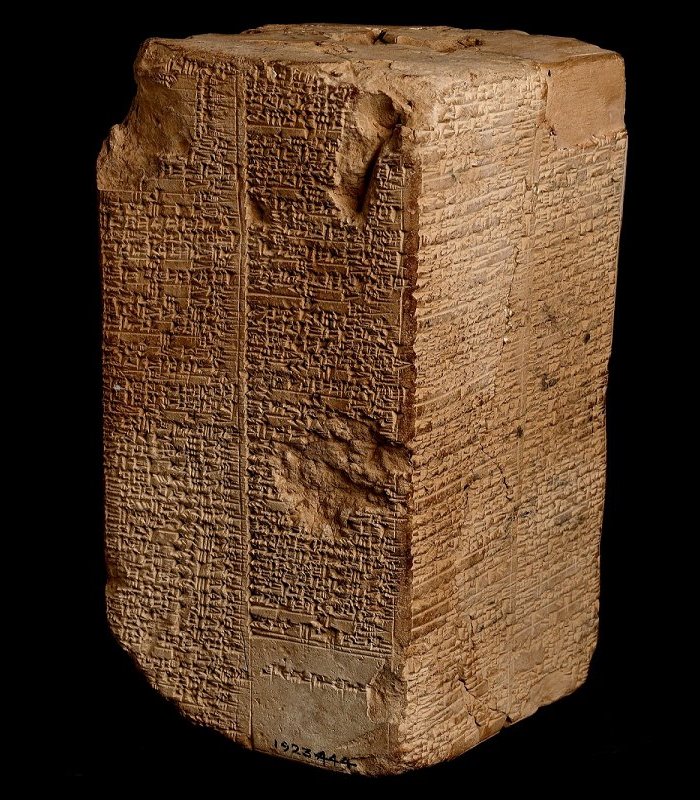
The clay tablet that survived was dated by the scribe who wrote it in the reign of King Utukhegal of Erech (Uruk), which places it around 2125 BC. Photo: Ashmolean Museum
Most of these manuscripts have been dated to the 1st dynasty of Babylon. All the documents show an extensive and detailed agreement among themselves.
Thus it appears that the extant texts ultimately descend from a common original, i.e., that they are copies, or even copies of copies, of a single original document. The initial section deals with kings before the Flood and the list and records the lengths of reigns of the kings of Sumer. Two main versions exist, the surviving tablets being known as Weld-Blundell (W-B) 62 and 144 respectively, and both are thought to have been originally compiled around the start of the second millennium BC.
There is also a third version, a much later compilation by Berossus from the third century BC.
The kingship descended from heaven and created Eridu, the seat of the kingship
The document begins at the beginning of history, the time when ‘kingship descended from heaven and made Eridu the seat of the kingship.
The list is characterized by extremely long durations for the different reigns, especially the earlier ones. One-quarter of a million years is assigned to the first eight kings before the Flood and more than 25,000 years for the first two dynasties after the Flood.

Ruins of Uruk — The New York of Ancient Mesopotamia/Deutsche Orient-Gesellschaft
In the seat of the kingship Eridu, Aululim reigned 28,800 years as king. Alalgar reigned 36,000 years. Two kings reigned 64,800 years. Then Eridu fell and the kingship was taken to Bad-tibira. In Bad-tibira, king En-men-lu-Anna reigned 43,200 years, En-men-gal-Anna reigned 28,800 years and Dumuzid, the Shepherd ruled the city for 36,000 years.
Then Bad-tibira fell and the kingship was taken to Larag where En-sipad-zid-ana became king for a period of 28,800 years. He was the only ruler of Larag before its fall. The next kingship was established in Zimbir where En-men-dur-ana reigned for 21,000 years. Then Zimbir fell and the kingship was taken to Shuruppag and Ubara-Tutu reigned there for 18,600 years. According to the Sumerian king list before the Great Flood, there were five cities and eight kings who reigned 241,200 years!
What happened after the Great Flood?
After the Flood had swept over, and kingship had descended from heaven, Kish became the seat of Kingship. In Kish, there were twenty-three kings who reigned 24,510 years, 3 months, 3 1/2 days. When Kish was defeated, the kingship was carried off to Eanna.
In Eanna, Meskiaggasher, the son of (the sun god) Utu reigned as En (Priest) and Lugal (King) 324 years--Meskiaggasher entered the sea, ascended the mountains.
Enmerkar, the son of Meskiaggasher, the king of Erech who had built Erech, reigned 420 years as king. Lugalbanda, the shepherd, reigned 1,200 years. Dumuzi the fisherman, whose city was Kua, reigned 100 years. Gilgamesh reigned 126 years. Urnungal, the son of Gilgamesh, reigned 30 years.
Labasher reigned 9 years. Ennundaranna reigned 8 years. Meshede reigned 36 years. Melamanna reigned 6 years. Lugalkidul reigned 36 years. When Erech was defeated, its kingship was carried off to Ur.
The length of reigns of the Sumerian kings before and after the Flood differs very much. Unfortunately, none of the pre-dynastic antediluvian rulers mentioned in the Sumerian King List has been verified as historical via archaeological excavations, epigraphical inscriptions, or otherwise. While there is no evidence they ever reigned as such, the Sumerians purported them to have lived in the mythical era before the Great Flood and the lifespan of these beings was extremely long.
The Sumerian king list remains one of the most valuable and important ancient documents that can shed light on the ancient history of the Near East.
Written by – A. Sutherland AncientPages.com Staff Writer
Copyright © AncientPages.com All rights reserved. This material may not be published, broadcast, rewritten or redistributed in whole or part without the express written permission of AncientPages.com
Expand for referencesMore From Ancient Pages
-
 Will The Oven Bricks Of The Tudor Warship The Mary Rose Be Preserved Before It’s Too Late?
-
 The Majestic Lion: Ancient Symbol Of Power And Royalty Found World-Wide
-
 2,700-Year-Old Face Cream For Men Found In Chinese Tomb
-
 DNA Shows First Scandinavians Followed Two Distinct Migration Routes
-
 The Sistine Chapel Cypher – Secret Messages In The Art Of Michelangelo
-
 Ancient Maya People Used Volcanic Ash To Build Pyramids When Huge Eruption Occurred
-
 On This Day In History: Howard Carter Discovered King Tut’s Tomb In The Valley Of The Kings – On Nov 4, 1922
-
 Enigmatic Footprints Reveal Humans Were In Spain 200,000 Years Earlier Than Previously Thought
-
 Archaeological Evidence Of Human Presence In America 250,000 Years Ago?
-
 Genetic Evidence Retrieved From 800,000-Year-Old Human Tooth
-
 The Cyclades And Their Advanced And Mysterious Society Lost In Time
-
 Riddle Of The Hanging Gardens Of Babylon – Ancient Place Still Shrouded In Mystery – Part 1
-
 Sator Square: Mysterious Ancient Magical Word Puzzle Remains Unsolved
-
 Kingdoms Of Judah And Babylon Remained In Long-Lasting Conflict
-
 Mysterious Kofun – Ancient Japanese Tombs Were Aligned Towards The Rising Sun And Goddess Amaterasu – Satellite Images Reveal
-
 Giant Ancient Minoan Axes Used For Unknown Purposes
-
 Magnificent Trumpington Cross And Highly Unusual Anglo-Saxon ‘Bed Burial’ In Cambridge Offer Unique Insight Into English Christianity
-
 Kelpie – Supernatural Horse-Liked Creature Lures Humans To Death In Scottish Lore
-
 Huge 2,000-Year-Old Roman Basilica Discovered In Israel May Have Been Built By Herod The Great
-
 Mysterious 2,000-Year-Old Lost City Of Natounia May Have Been Found!

