
Evidence Scots And Irish Settled Iceland A Century Before The Vikings?
AncientPages.com - Remarkably similar carvings and simple cross sculptures mark special sites or places once sacred, spanning a zone stretching from the Irish and Scottish coasts to Iceland. We can look to Skellig Michael, which rises from the sea 12km off the southwest Irish coast; to Aird a’Mhòrain on the Outer Hebridean island of North Uist; to the Isle of Noss, Shetland; and to Heimaklettur cliff face in Iceland’s Westman Islands.
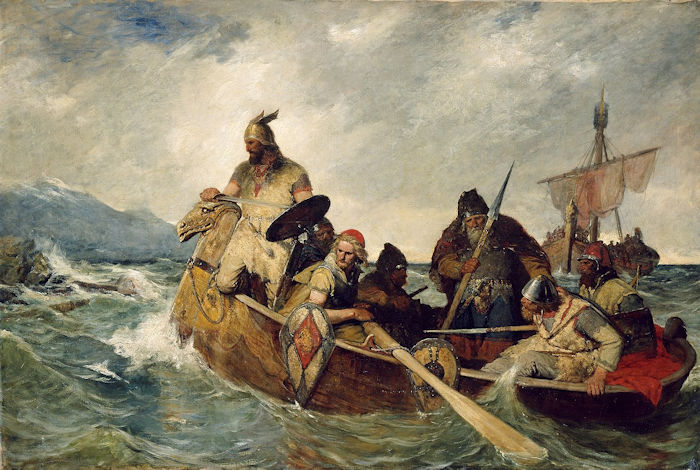
The Norwegians land in Iceland year 872. Credit: Oscar Wergeland - Public Domain
Also in southern Iceland, a number of the 200 man-made caves found there are marked by similar rock-cut sculpture. And these dark remote places suggest a different answer to a puzzle that we thought we had solved a long time ago.
Iceland was one of the last island groups on Earth to be settled by people. As you might expect, the late-ninth-century settlement by Viking-Age Scandinavians has long been of keen interest to the local people. These artificial caves suggest that we should re-think our traditional histories. The Viking arrival may indeed have been pre-dated by Celtic-speaking people from Scotland and Ireland in around AD 800.
Crosses mark the spot

Iceland cross carving. Credit: Kristján Ahronson
Our search for answers to these questions took Dr Tõnno Jonuks and myself to the Westman Islands, which lie a few kilometres south west of the Icelandic mainland. We found our way up the Heimaklettur cliff on Heimaey, the largest of the islands, on the hunt for one of these enigmatic cross sculptures.
And we found what we were looking for: a large cross carved into a small alcove on the otherwise exposed cliff face – similar to other rock-cut crosses in some of the 200 artificial caves clustered around farms in southern Iceland. Then to our surprise, two more crosses, along a high ledge overlooking the harbour and the bustling fishing town of Heimaey – all of them key exhibits towards the team’s imminent discoveries.

Isle of Heimaey. Credit: Thomas Quine, CC BY-SA
These contributed to research focused on Seljaland, which is nearby on the mainland and now appears to be Iceland’s earliest dated settlement, at around AD 800. What we were also able to reveal was that the 24 large cross sculptures inside the Seljaland caves (and also found elsewhere in southern Iceland) are related to early medieval sculpture in Britain and Ireland.
Islands off the west coast of Scotland have long been known as a core area for the early medieval monastic communities that produced these simple cross sculptures - and each sculpture is thought to result from an impulse of religious devotion. What has been unclear is the nature and extent of their settlements beyond the Gaelic-speaking world.
The flowering of Gaelic monasticism is well established for the early medieval period, with individuals and monastic foundations of the “Irish school” penetrating large areas of Europe and accounts of north Atlantic travels and settlements. So too is the religious impulse to seek a “desert” or wilderness in the ocean. But we had been left wondering whether this impulse took these communities to Iceland before the Old Norse-speaking Vikings that later came to dominate this Atlantic zone.
How we made our discovery
Working with world-leading Edinburgh illustrators and analysts Ian G Scott and Ian Fisher, we found striking stylistic similarities in Iceland with the early medieval sculpture of the western Highlands and islands of Scotland. This area includes the important monastery of Iona in Argyll, as well as extreme locales for Scotland’s early Christian communities, such as at St Molaise’s Cave on Holy Isle (off Arran in the Firth of Clyde) and at isolated north Atlantic places such as the tiny island of North Rona (north of Lewis).
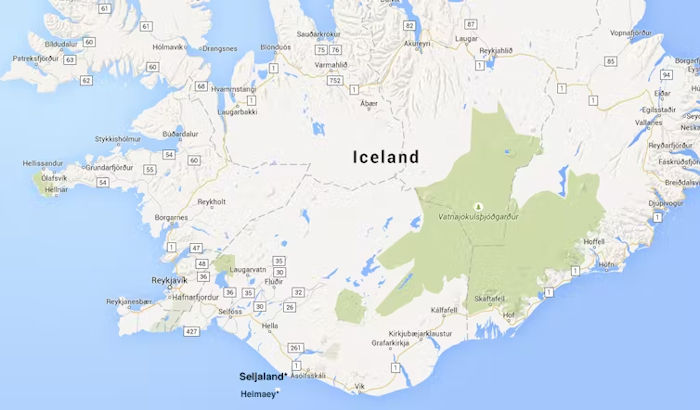
Seljaland’s caves are remarkable in their own right for their concentration of sculpture and because they have been dug out of the rock, forming part of a poorly understood yet distinctively Icelandic phenomenon. We were able to accurately date one of these caves by finding construction waste from where it had been excavated from the Icelandic rock.
Myself and Dr Kate Smith of Exeter University related this waste material to layers of volcanic airfall, ash layers that have been dated by international teams of researchers with remarkable precision and are a powerful dating tool for this part of the world. And we developed new methods to study the surface of volcanic ash layers that helped us to better understand the processes by which people cleared and managed that woodland, and contributed to creating the pastoral landscape that we recognise today. Again, these human activities can be accurately dated and chime with the our other lines of investigation.

Seljalandshellar cave in the Westman Islands. Credit: Kristjan Ahronson
What must it have been like, to undertake Atlantic journeys to this wild northern island with its coastal woodland? Were early travels inspired by observing migratory bird routes from Scotland and Ireland, which nowadays include those of the barnacle goose and pink-footed goose?
What were the challenges for early life, and how and when did people set about transforming the forested landscape into the grasslands needed for sheep, goats, pigs, cattle and horses? Were pigs especially useful for clearing woodland, or perhaps fire? Did pioneer-life present special opportunities, and how did this relate to life back home? And finally, how did this early phase relate to the large-scale Scandinavian Viking settlement that followed 100 years later? These are just some of the questions to be answered now that we can say that Iceland’s human habitation story is not quite what we previously believed.
Written by Kristján Ahronson, Lecturer in Archaeology, Bangor University
Provided by The Conversation
This article is republished from The Conversation under a Creative Commons license. Read the original article.
More From Ancient Pages
-
 What The Egg Crisis Reveals About Our Food System
-
 Karelian-Finnish God Ukko Helped His People In Times Of Need But Was Never Seen In Human Form
-
 Smallest Arm Bone In Human Fossil Record Illuminates Homo Floresiensis Origin
-
 Remarkable 700-Year-Old Ship Found In Estonia Is One Of The Most Important Archaeological Discoveries In Europe – Scientists Say
-
 Cuchulainn: Irish Mythical Hero And His Cruel Magical Spear Gae Bolg
-
 Mysterious Advanced Underground Civilization And A Secret Society – Dangerous Knowledge And Verdict – Part 3
-
 Choctaw Indians’ Legend Of Nanih Waiya Cave Mound – Mysterious Underground Realm Of Their Ancestors And Their Battle With Giants
-
 A Mudbrick Building And Unique Coptic Wall Paintings Dated To 6th–7th Century AD Discovered In Assiut, Upper Egypt
-
 Why Did Vikings Carry Decorative Swords That Were Useless In Combat?
-
 Scribes: One Of The Noblest And Highly Recommended Professions In Ancient Egypt
-
 Does This Ancient Box Contain Buddha’s Cremated Remains?
-
 Legend Of Brigadoon: Mythical Village Where Time Stands Still
-
 Stone Slab c. 9,000-Year-Old Used In Making Fire Discovered Not Far From Jerusalem, Israel
-
 Great Viking Fortresses Built By King Harald Bluetooth
-
 Impressive Study Highlights Female-Led Migration Into Bronze Age Orkney And Wins Prestigious Award For 2023
-
 Viking Wealth Acquisition Was More Complex And Interconnected Than Previously Thought
-
 Has The Mystery Of Cerne Abbas Giant Been Solved?
-
 7,000-Year-Old Kilns From Ceramics Workshop Unearthed In Northeast Bulgaria
-
 Ancient Stone Kitchens And Unlocking A Treasure Trove Of Culinary Secrets
-
 Mythical Underground Labyrinth And Legendary Long-Lost Golden Tomb Found In Italy?

