
Scientists Decipher 2,300-Year-Old Chemistry Formulas Revealing Ancient Metallurgy Was More Complex Than Previosuly Thought
Jan Bartek - AncientPages.com - Researchers have identified the ingredients in chemistry formulas from a 2,300-year-old Chinese text, revealing ancient metallurgy was more complex than expected.
The Kaogong ji was written in China around the middle of the first millennium BC and is the oldest known technical encyclopedia. It details items ranging from swords to musical instruments and how to make them, including six chemistry formulas for mixing the bronze.

Knife coins, in use in China around 400 BC, were some of those studied. Credit: The Trustees of the British Museum / CC-BY-SA 4.0
"These recipes were used in the largest bronze industry in Eurasia during this period," said Dr. Ruiliang Liu from the British Museum, "Attempts to reconstruct these processes have been made for more than a hundred years, but have failed."
Researchers had been unable to identify the two main ingredients: Jin and Xi. It was thought they were copper and tin, two key components of bronze, but recreating the recipes with them produced metal that did not match the composition of ancient Chinese artifacts.
Now, research by Dr. Liu and Professor Pollard, from the University of Oxford, may have finally identified Jin and Xi. Their work, published in the journal Antiquity, shows they were likely pre-mixed alloys.
The discovery was made whilst studying the chemical composition of Chinese coins from around the time the Kaogong ji was written. It was thought that these were made by diluting copper with tin and lead to create the desired form of bronze.
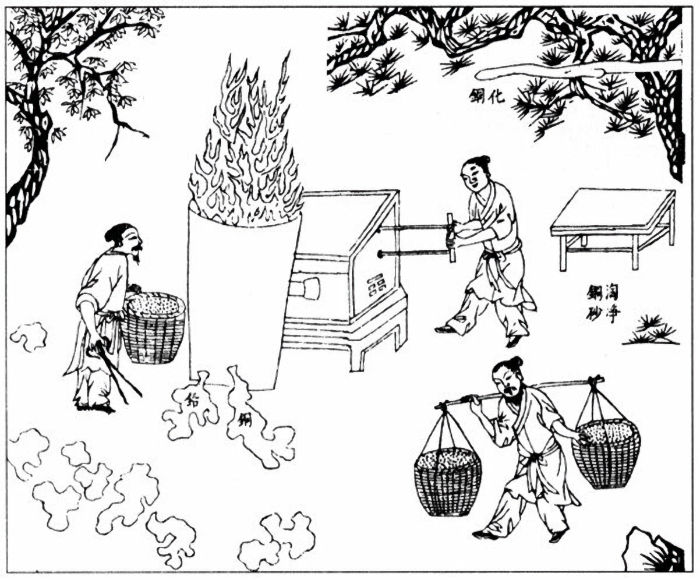
Depiction of a Chinese furnace producing copper and lead from a later text, Tian Gong Kai Wu from the Ming Dynasty. Credit: Dr. Liu
However, Professor Pollard and Dr. Liu found that the composition of the coins did not match this technique. Instead it indicated the coins were made by mixing two pre-prepared metal alloys: a copper-tin-lead alloy and a copper-lead alloy.
This shows that ancient Chinese bronze production involved the combination of alloys, rather than pure metals. As such, Professor Pollard and Dr. Liu argue that this method of making bronze was also have been what the Kaogong ji was describing and Jin and Xi refer to these pre-mixed alloys.
"For the first time in more than 100 years of scholarship, we have produced a viable explanation of how to interpret the recipes for making bronze objects in early China given in the Kaogong ji," said Professor Pollard.
As well as shedding light on the enigmatic ancient recipe, this discovery also indicates ancient Chinese metallurgy was more complex than expected.
See also: More Archaeology News
"It indicates an additional step—the production of pre-prepared alloys—in the manufacturing process of copper-alloy objects in early China," said Dr. Liu, "This represents an additional but previously unknown layer in the web of metal production and supply in China"
It also shows how science and analysis can help solve linguistic mysteries. The researchers hope further studies like this can continue to shed light on ancient texts.
Written by Jan Bartek - AncientPages.com Staff Writer
More From Ancient Pages
-
 T. Rex’s Direct Ancestor Crossed The Bering Strait From Asia To North America 70 Million Years Ago
-
 DNA Reveals Neanderthals’ Own Blood May Have Led to Their Demise, Scientists Say
-
 New Study: Fossils Reveal Human Ancestors’ Hearing Abilities
-
 Unique 150-Year-Old Necropolis Reveals Some Secrets About Who The Christians Were In Medieval Pagan Vilnius City, Lithuania
-
 Unearthing South Australia’s Oldest Known Shipwreck: The Bark South Australian (1837)
-
 Extremely Rare 1,400-Year-Old Folding Chair Discovered In A Woman’s Grave
-
 ‘Sensational’ Discovery Of Large Untouched 4,000-Year-Old Grave In Norway
-
 At Least 20 Ancient Colored Wooden Coffins Discovered In Asasif Necropolis, Luxor
-
 Stone Age Hunter-Gatherers Were Far-Traveled To Find Tool Material In Striking Colors
-
 Previously Uncounted Copies Of Newton’s Groundbreaking ‘Principia’ – Discovered
-
 On This Day In History: England’s Act Against Multipliers Signed Into Law – On Jan 13, 1404
-
 X-Ray Reveal Ghostly Portrait Of Mary Queen Of Scots Hidden Underneath 16th Century Painting
-
 Unique Find: Sacred Gate Found At The Minoan Palace Of Archanes In Crete
-
 USC Archeologist Discovers Maya Royal Burial Site
-
 Mass Production Of Stone Bladelets Led To A Cultural Shift In Paleolithic Levant
-
 18,000-Year-Old Relics Discovered In Oregon – Oldest Home In North America?
-
 ‘Incredibly Mysterious’ Bronze Age Gold Penannular Ring Found In Norfolk
-
 Ancient Bronze Age Tomb With Highly Unusual Features – Discovered On Dingle Peninsula, Ireland
-
 40 Elite Graves Of Men, Women And Children Unearthed On Danish Island Of Bornholm
-
 Harappan Civilization Built Massive Protection Walls Against Tsunami 5,000 Years Ago

