
Why Have The Leibniz Keks 52 Teeth And Are Named After Philosopher Gottfried Wilhelm Leibniz?
Conny Waters - AncientPages.com - The Leibniz-Keks remain now as popular as ever. Most have tasted these delicious butter biscuits found in almost every modern supermarket.
The production of the Leibniz-Keks started in 1891, and today, we can enjoy the original Butterkeks, but there are also several varieties of biscuits these days. The keks delight all chocolate lovers or anyone who can't resist a tasty biscuit.
But why do the Leibniz-Keks have 52 teeth, and why are they named after philosopher Gottfried Wilhelm Leibniz?
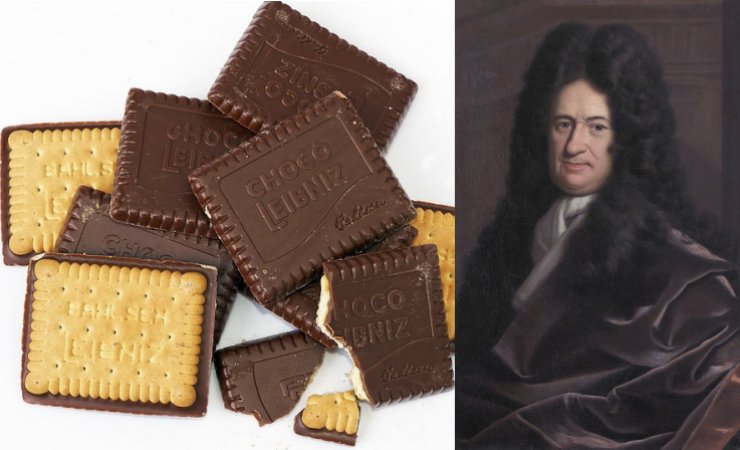
Left: Leibniz-Keks. Credit: Publix Domain - Right: Gottfried Wilhelm Leibniz. Credit: Publix Domain
Every cake or biscuit has its history, and the story of the Leibniz-Keks started in Queen Victoria's England when Hermann Bahlsen (1859-1919) worked as a sugar trader there. Bahlsen decided he wanted to produce his unique biscuit, so he did. He traveled to Hannover in Germany, founded the Hannoversche Keksfabrik, and started the production of the Liebnitz-Keks. Bahlsen's biscuit rivaled a similar French biscuit, the Petit-Beurre.
Initially, the name of Bahlsen was Leibniz Butter-Cakes, but very few people in Germany understood English, and German customers regularly mispronounced "Cakes "(as "Ka-kes "). So he changed the name to Leibniz-Keks.
When mentioning the name, we automatically think of philosopher Gottfried Wilhelm Leibniz (1646 -1716). It's widespread to name foods after famous personalities. For example, the Garibaldi biscuit, which consists of two soft rectangular slabs of biscuits sandwiched in a bed of currants, is named after Giuseppe Garibaldi, Italy's military leader and folk hero.
It is because "during the time Garibaldi spent in Britain, he became a celebrity. It is said the country shut down for three days when Garibaldi visited London in 1864. Higher and lower-class people received him, except for Queen Victoria and the royal family. One could find prints and busts of him in many Victorian homes.
His name was well-known and so popular that 1861 a new biscuit was made in his honor – the Garibaldi biscuit." 1
The prominent German polymath Gottfried Wilhelm Leibniz has very little in common with the popular biscuit Bahlsen started to produce.
Historians have tried to find a connection between the Leibniz-Keks and the biscuits, but frankly, there isn't one. The only thing these two have in common is that philosopher Leibnitz was born in Hannover, the same city where Bahlsen started the production of the biscuits. Who knows, maybe Bahlse admired the German philosopher's works?
Why Have The Leibnitz-Keks 52 Teeth?
What makes the Leibnitz-Keks unique and famous, except for the taste, is that each biscuit has 52 teeth. You may never have thought about it and perhaps not even bothered to count them, but next time, look closer, and you can see the butter biscuit has 52 teeth. Why is that, one can wonder?
There is no particular history behind this number. The shortbread biscuit has 52 teeth for purely aesthetic reasons. Bahlsen thought the teeth gave the biscuit a more attractive appearance.
The Choco Leibniz you often see in the shop is a crisp butter biscuit of our Choco Leibniz, dating back to 1889. It is coated in a layer of sumptuous, creamy chocolate. Currently, the company offers various biscuits with milk, dark, or orange-flavored milk chocolate. You might have guessed already – no matter what taste, all varieties of the Leibnitz-Keks have 52 teeth.
Written by Conny Waters – AncientPages.com Staff Writer
Updated on January 4, 2024
Copyright © AncientPages.com All rights reserved. This material may not be published, broadcast, rewritten or redistributed in whole or part without the express written permission of AncientPages.com
Expand for referencesMore From Ancient Pages
-
 Old Norse Settlers Traded Walrus Ivory With Kyiv – Spectacular Archaeological Finds Reveal
-
 Tumlehed Rock Art And Seafaring In Stone Age’s Sweden
-
 First European Farmers’ Heights Did Not Meet Expectations
-
 Beautiful 2,300-Year-Old Gold Ring Found In The City Of David
-
 Giants Of The Jurassic Seas Were Twice The Size Of A Killer Whale – New Study
-
 Researchers Will Search For “Fingerprints” Of Thera/Santorini Eruption In Tree Rings
-
 Mystery Of The Ancient Foggaras: Sahara’s Incredible Masterwork Of Antiquity
-
 ‘Long-Lost’ Troy Story Depicted On Roman Mosaic In Rutland, UK
-
 1,000-Year-Old Multi-Shaped, Double-Sided Mold For Jewelry Found In Swiss City Of Chur
-
 Mysterious Biblical Celestial City And Its Connection To The North Star – The Arrival – Part 2
-
 On This Day In History: Antarctic Explorer Lawrence “Titus” Oates Born – On Mar 17, 1880
-
 Power Of Water In Beliefs Of Ancient Cultures
-
 Sea Sequin ‘Bling’ Links Indonesian Islands’ Ancient Communities
-
 Forgotten Richly Decorated Rock-Cut Cave Churches Of Goreme And Cappadocia
-
 Hidden Ancient Citadel In The Mayan City Of Tikal Discovered By LIDAR
-
 Pooka: Solitary Spirit And Not Entirely Benevolent Prankster In Irish Folklore
-
 Did Ancient Lead Exposure Change The Evolution Of The Human Brain?
-
 Mysterious Megaliths Of Russia May Offer Evidence Of An Ancient Advanced Lost Civilization
-
 World’s Largest Complex Of Borobudur – Spectacular Buddhist Masterpiece
-
 The 100-Kilometer-Long Stone Highway That Connected Ancient Maya Cities Revealed By LIDAR

