
3,500 Underground Man-Made Maresha/Beit Guvrin Caves And Tunnels In The Holy Land
A. Sutherland - AncientPages.com - The Beit Guvrin caves are a dark and beautiful ancient place, known as “the land of a thousand caves,” all covering approximately 1,250 acres of rolling hills in the Judean lowlands. This incredible ancient tunnel system is like an unending labyrinth. The caves, which are very difficult to find are located at the Beit Guvrin National Park.

Bet Guvrin was a prominent city in the period of the Second Temple. It rose to importance after the destruction of Maresha (Marissa) by the Parthians in 40 B.C It replaced the city of Maresha, which was one of the Judean cities mentioned in the Bible (Joshua 15:44 and Chronicles 2, 11; 5-8) as a city fortified by Rehoboam, a son of and the successor to Solomon, a grandson of David and the first king of the Kingdom of Judah. Thus, the city could withstand the Egyptian attack.
The city of Bet Guvrin began expanding following the Bar Kokhba (132 - 135 CE) revolt, during the second half of the second-century CE., with the construction of public and administrative buildings. In 199/200 C.E. Septimus Severus conferred on it the privileges of a Roman city and called it Eleutheropolis ("the city of freemen").
The city of that period covered an area of about 160 acres, and topographically it extended mainly over a hill located south of the present-day highway between Bet Shemesh and Ashkelon, with the northern extension of the city built on a low plain.
Two aqueducts and an underground tunnel supplied water to the city, which also had its own system of dating and coinage.
Archaeological excavations in the area revealed a mosaic pavement of a Roman house from the fourth-century CE. which depicts a hunting expedition, with representations of animals and the personifications of the four seasons.
The mosaic attests to the wealth of the city's inhabitants. The vast ancient tunnel system consists of thousands of man-made caves which were cut as quarries for the buildings which were built above them. This network of tunnels was often reached through trap doors in Jewish villages, giving the sense of how the Jewish rebels lived and fought during two revolts against the Romans.
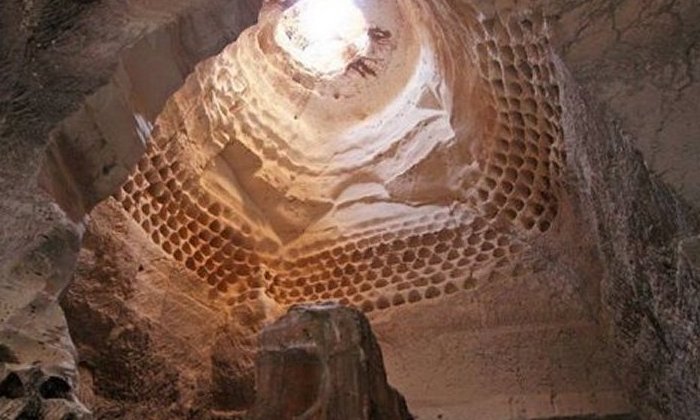
Today, there are some archaeological sites in the area of these ancient tunnels, while others have been completely destroyed. As to the Beit Guvrin Caves, one of them is very large (over 60 feet high), airy, easily accessible, and its walls are made of beige-colored limestone.
While there are numerous bell caves within the park grounds, events are only held in one of these caves. It is one of about 800 bell-shaped caves located in the area.
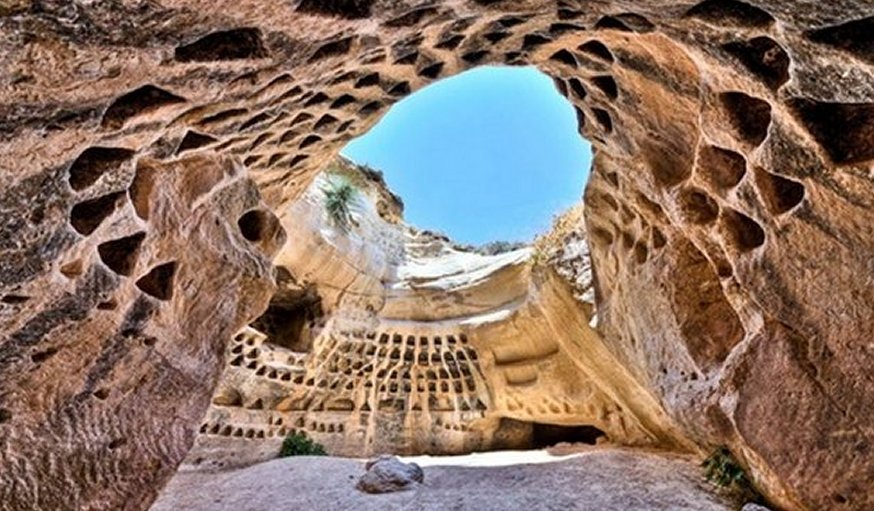
The Beit Guvrin ancient tunnel system and remarkable caves can easily be labeled as a true wonder of the Holy Land, where archaeologists discovered ancient weapons, trap doors, and olive presses during their surveys. Also, earlier caves have been found farther north in the Galilee region, where team members were called to explore a tunnel system found just a few months ago.
Archaeologists had uncovered what they thought was a standard, eight-meter-deep water cistern, but later noticed it had narrow crawl spaces shooting off its base.
With a metal detector and laser measuring tools, they spent hours mapping just a fraction of the tunnels. Researchers have also mapped many of the nearby cavern hideouts that dot the cliffside of Mount Arbel overlooking the Sea of Galilee.
Roman historian Josephus described in his writings how King Herod lowered his men in chests from the cliff to the cave openings and, using fire, overtook the rebels.
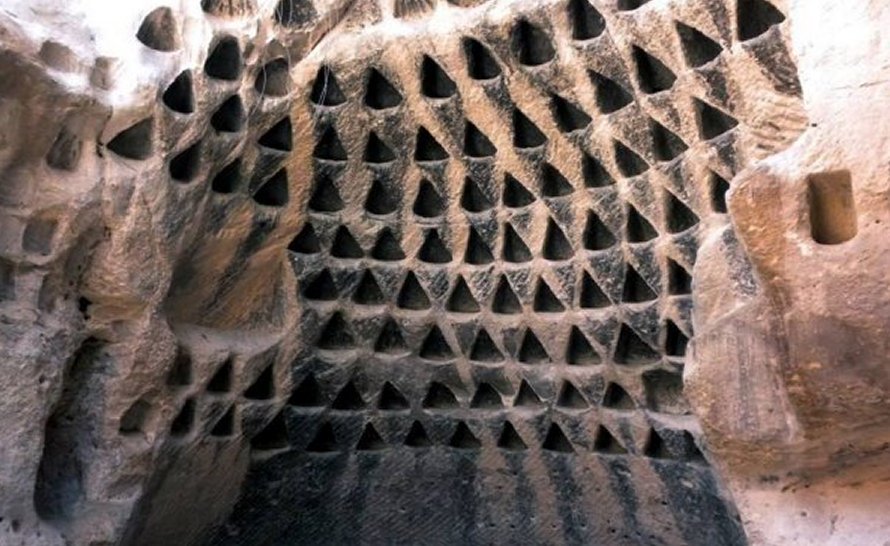
Caves of Maresha and Bet-Guvrin in the Judean Lowlands - situated on the crossroads of trade routes to Mesopotamia and Egypt - contain approximately 3,500 underground chambers spread out across complexes carved in the thick chalk.
This place witnessed many cultures and their evolution over more than 2,000 years from the 8th century BC when Maresha town (older than Bet-Guvrin) was built - to the time of the Crusaders.
In the Late Roman period (AD 200), Bet Guvrin became Eleutheropolis (“City of the Free”) when Roman Emperor Septimus Severus contributed to the town's development and turned it into a major administrative center.
Written by: A. Sutherland - AncientPages.com Senior Staff Writer
Copyright © AncientPages.com. All rights reserved. This material may not be published, broadcast, rewritten or redistributed in whole or part without the express written permission of AncientPages.com.
Expand for referencesMore From Ancient Pages
-
 Thousands Of Spectacular Stolen Ancient Treasures Discovered Hidden In Major Bust
-
 British Columbia’s Mysterious Ancient Underground People Who Avoided Daylight And Owned Strange Magical Objects
-
 On This Day In History: Unbelievable Flight Took Place – On Apr 28, 1939
-
 400 Mysterious Stone Formations That Could Be 7,000 Years Old Spotted In Google Earth Satellite Images Over Saudi Arabia
-
 Has World’s Oldest Image Of Virgin Mary Been Discovered In Dura-Europos Church?
-
 How Did Mesopotamia Change The World?
-
 Cerberus – Giant Multi-Headed Dog Guards The Underworld Of God Hades In Greek Mythology
-
 Denisovan DNA May Explain Why Tibetan Women Thrive In Low Oxygen At High Altitudes For Over 10,000 Years
-
 Large 1,500-Year-Old Winepress Unearthed In Area Once Known For Wine production.
-
 ‘Completely Unique’ Seal Matrix Found Near Norwich, UK
-
 Imet: A Long-Forgotten Ancient City In Egypt’s Eastern Nile Delta – Discovered
-
 Hidden Mega-Monument Discovered At Laona, An Ancient Burial Mound In Cyprus
-
 Anu: Supreme Ruler Of The Heavenly Abode In Sumerian Pantheon Of Gods
-
 Huge, Stunning 2,000-Year-Old Marble Statues Restored In Ashkelon, Israel
-
 Aboriginals Finely Serrated And Perforated Shell Artifacts – Evidence From The Murray River, Australia
-
 Is North America’s Oldest House In Ohio A 12,250-Year-Old Clovis Dwelling? Archaeologists Re-Investigate The Paleo Crossing Site
-
 Mystery Of The Candelabrum: One Of The Most Enigmatic Ancient Giant Ground Drawings In The World
-
 Unearthing Vadnagar And The Search For Hueng Tsang’s 10 Monasteries
-
 Controversial Unexplained Ancient Mystery In Mongolia – Horrifying Sight – Part 2
-
 Ancient City Of Aizanoi: Statue Heads Of Greek Gods Unearthed In Excavations

