
Gordian Knot And How Alexander The Great Managed To Outmaneuver The Problem
A. Sutherland - AncientPages.com - The Gordian Knot is a metaphorical expression that means a complicated problem or deadlock when we have an unsolvable problem, which is our "impossible knot."
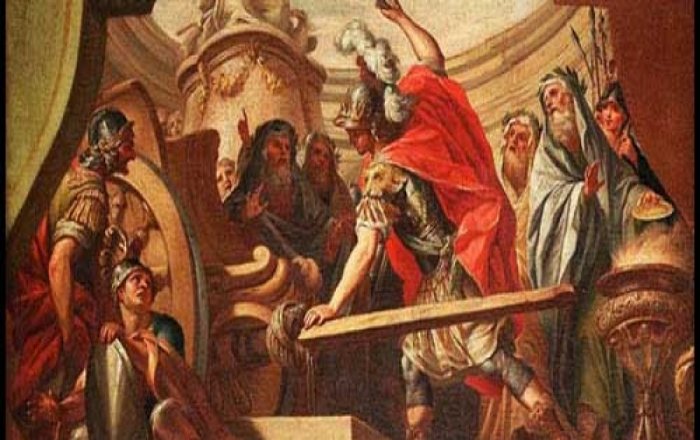
Alexander the Great slicing the Gordion knot with a sword-stroke. Credit: Public Domain
It began long ago when the Phrygians had no ruler and plunged into a civil war. An ancient prophecy of the oracle was announced at Telmissus (the ancient capital of Lycia).
It said that the new king would be the one who would enter the city in a simple ox-cart.
The first through the city's gates were Gordias, a poor peasant who came to the town with a cart drawn by an ox with his wife. He tied its yoke to a post with a highly sophisticated knot called the Gordian Knot. Gordias was declared king, and his grateful son, Midas, dedicated the ox-cart to the Phrygian god Sabazios (identified with Zeus).
Roman historian Quintus Curtius Rufus later described the knot as a masterwork. It comprised "several knots all so tightly entangled that it was impossible to see how they were fastened."
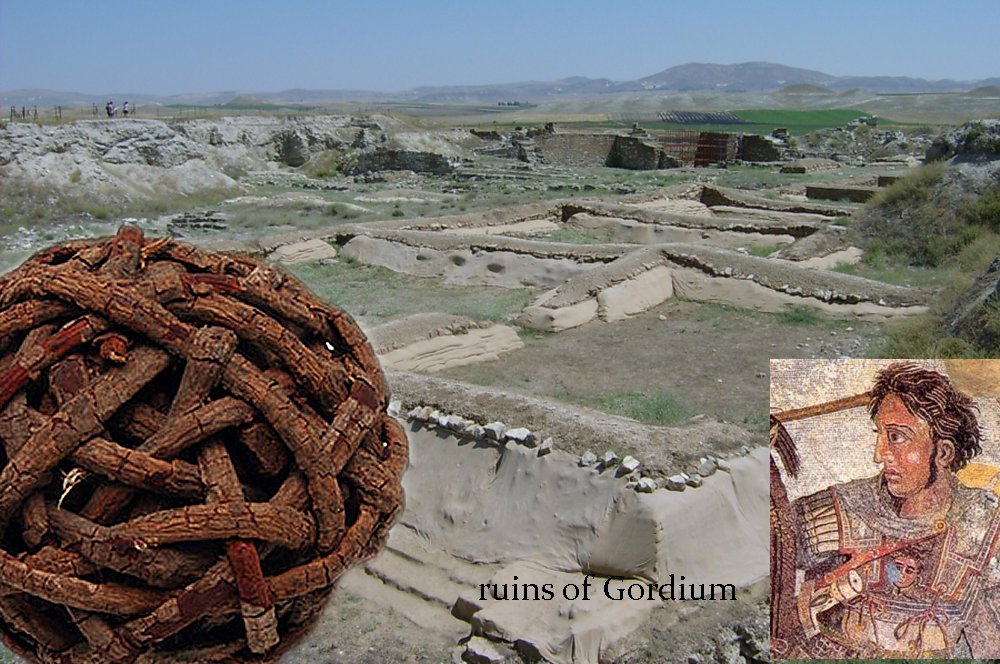
Gordias founded the city of Gordium, which became the Phrygian capital, and his ox-cart was preserved and remained in the royal palace. According to the oracle's prophecy, a man who untied the knot would receive power over Asia Minor or all of Asia.
In the 4th century BC, Alexander the Great reached Phrygia and Gordium, allegedly Midas's capital. After taking the city of Gordium, Alexander was shown the chariot of Gordias, founder of the old Phrygian monarchy, and was told about the prophecy.
Alexander wanted to untie the knot, but he had no idea how to do it, so he drew his sword and sliced it in half with a single stroke, or as another version says, he loosed the knot by pulling the linchpin from the yoke.
Aristobulus, an early historian, architect, and military engineer, as well as a close friend of Alexander) later claimed that untying the knot was easy for Alexander; he removed what they call the pole-pin, with which the yoke-knot was held together, and then drew back the yoke.
We will never know what really happened in the palace in Gordium and whether Alexander managed to untie the complex knot.
Norman F. Cantor, in his book "Alexander the Great Journey to the End of the Earth" writes:
"Shortly after one of Alexander's first victories, the Battle of Granicus, he learned that a few miles away, a certain King Gordias had left as a legacy a very difficult knot to untie. It was said (probably by Alexander's propagandists) that whoever untied the knot would conquer all of Asia. Sources disagree about what happened.
Some say that Alexander cleverly untied the knot, others that he simply unsheathed his sword and cut it. But one way or another, he untied or "cut the Gordian knot."
Fox relates the tale this way:" On the day before leaving Gordium, he went up to the acropolis meaning to try the chariot which he had saved for his farewell; friends gathered round to watch him, but hard though he pulled, the knot round the yoke remained stubbornly tight. When no end could be found, Alexander began to lose patience, for failure would not go down well with his men. Drawing his sword, he slashed the knot in half, producing the necessary end and correctly claiming that the knot was loosed, if not untied. The aged Aristobulus (one of Alexander's early historians)… later claimed that Alexander had pulled a pin out of the chariot link and drawn the yoke out sideways through the knot, but the sword cut has the weight of authority behind it and is preferable to an eighty-year-old historian's apology; either way, Alexander outmaneuvered, rather than unraveled, his problem.
He also managed to arouse an interest in what he had done."
"There were thunderclaps and flashes of lightning that very night," conveniently signifying that Zeus approved, so Alexander offered sacrifice to the "gods who had sent the signs and ratified his loosing of the knot..." (Robin Lane Fox, Alexander the Great)

Tough, resolute, fearless. Alexander was a born warrior and a ruler of passionate ambition who understood the intense adventure of conquest and of the unknown. When he died in 323 B.C.E. at age thirty-two, his vast empire comprised more than two million square miles, spanning from Greece to India. His achievements were unparalleled—he had excelled as a leader to his men, founded eighteen new cities, and stamped the face of Greek culture on the ancient East. The myth he created is as potent today as it was in the ancient world. Robin Lane Fox's superb account searches through the mass of conflicting evidence and legend to focus on Alexander as a man of his own time. Combining historical scholarship and acute psychological insight, it brings this colossal figure vividly to life.." Read more
Alexander later went on to conquer Asia as far as the Indus and the regions of the Oxus, a major river in Central Asia. The prophecy was fulfilled.
Written by – A. Sutherland AncientPages.com Staff Writer
First version of this article was published on July 20, 2020
Copyright © AncientPages.com All rights reserved. This material may not be published, broadcast, rewritten or redistributed in whole or part without the express written permission of AncientPages.com
More From Ancient Pages
-
 Mama Pacha: Respected And Feared Supreme Goddess Of The Andean People
-
 Archaeological Site Along The Nile Reveals The Nubian Civilization That Flourished In Ancient Sudan
-
 Exploring Future Evolution: How Will Humans Change In The Next 10,000 Years?
-
 Vikings Feared Climate Change 1,200 Years Ago – Famous Rök Stone Reveals
-
 Cinnabar And Hematite Were Used In Early Teotihuacan Murals – INAH Researchers Say
-
 Thousands Of Petroglyphs And Inscriptions In Wadi Rum, Jordan – 12,000 Years Of Human Occupation
-
 Curious Story How Sæmundur The Wise Tricked The Devil Three Times
-
 Little People: Ancient Race That Pre-Dates Native Americans, Celts, And Other Settlers Worldwide
-
 Mystery Of Gigantic Lion Sculptures Dated To The Hittite Era
-
 Deadly Ancient Secrets Of Queen Hatshepsut’s Flacon
-
 9,500-Year-Old Baskets And 6,200-Year-Old Sandals Found In Spanish Cave
-
 A 1,500-Year-Old Basilica Re-Emerged Due To Withdrawal Of Waters From Lake Iznik
-
 On This Day In History: Macbeth, King of Scots Killed At The Battle Of Lumphanan – On August 15, 1057
-
 Controversial “Life Of St. Issa” Scroll Reveals Jesus Spent Several Years In India And Tibet
-
 First Solid Scientific Evidence That Vikings Brought Animals To Britain
-
 Ancient Mystery Of The Biblical Canaanites – New DNA Insight
-
 Joseph Pujol – The Professional Farter Who Entertained People
-
 Why Was The Face Of Mysterious Ust-Taseyevsky Stone Idol Suddenly Changed?
-
 Ancient Cotton Fibers Dating Back 7,000 Years Discovered In NE Israel
-
 Diver Says He Found Mysterious Underwater Ancient Tomb, Ruins And Artifacts Of An Unknown Advanced Civilization

