
Inscription On Pokotia Monolith Reveals Sumerians Visited Peru Thousands Of Years Ago
Ellen Lloyd - AncientPages.com - This time our quest for the hidden history of mankind takes us to Peru where we encounter an enigmatic inscription that offers evidence Sumerians crossed the ocean thousands of years ago and left traces of their civilization.
On the site of Pokotia that is located about 2 km from the city of stone Tiahuanaco, there is a monolith that was discovered around 1960. The Pokotia monolith is not very high. It measures only 170 cm, but it is intriguing nevertheless.
In 2002, several researchers analyzed the monolith and discovered the stone had inscriptions on the front and on the back.

Credit: Clyde Winters
It has been suggested that the monolith Pokotia may have been carved in a period prior to the flourishing of the civilization Pukara. According to the official linguistic term, Pukara comes from Quechua and means fortress or strategic place from where you can control a valley or the confluence of two rivers.
The place where the Pokotia monolith was discovered has been identified by some researchers as a sacred site or an oracle.
Is the Pokotia monolith a depiction of an ancient god of great importance perhaps?
American epigraphist Clyde Winters who deciphered the inscription on the Pokotia monolith concluded the writing is of proto-Sumerian origin. According to Winters in the monolith of Pokotia, there are various inscriptions (proto-Sumerian origin), but the most important ones are below the hands (which are resting on thighs), and in the dorsal part (in the back of the statue). The signs used to write the messages on the Pokotia monolith were non-liguture Proto-Sumerian symbols.
The inscription under the hand on the Pokotia figure is very interesting:
"The oracle Putaki conducts man to truth. (This) esteemed (and) precious oracle to sprout esteem, (now) witness (its) escape".
The Decipherment of the back inscription of Putaki is below. The writing on the back is written in Proto-Sumerian. The language used to read the inscriptions was Sumerian.
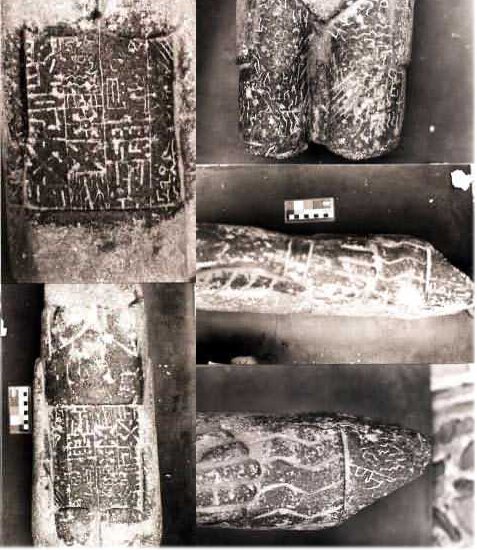
Credit: Clyde Winters
"Proclaim the establishment of character. The strong father (Putaki) to send forth the divination. Strong wisdom (in this) phenomenal area of the deity's power. Capture the speech (of the oracle). (The oracle is ) very strong to benefit (and) nourish the sprouting (of) character. Tell human being(s) (the oracle's) benefit. The oracle to open (up) much (benefit for all)."
"The ideal norm (is the) oracle (of Putaki). (This) oracle is (in) a phenomenal area of the deity's power". Distribute to all humanity (the divine decree). Snare a portion (of the) pure voice. (The oracle to) send forth gladness. Agitate the mouth (of the oracle), to send forth the divination. The diviner speaks good."
"The ideal norm (is this) oracle. (This) oracle (gives) divine decree. Distribute to all humanity (the divine decree). Snare a portion (of the) pure voice. (The oracle to) send forth gladness. Agitate the mouth (of the oracle), to send forth the divination. The diviner speaks good."
"The divine decree to become visible and glisten (from the oracle's own) mouth. Open up the divination. Agitate the oracle (to) send forth (now) wisdom and character. Open (the oracle) to distribute the divine decree (for all it is) lawful and righteous Good. Send forth the sustenance of the pure oracle. Stand upright (Oh oracle) to appear as a witness speaking purity. The oracle (of Putaki) to open (up and) send forth gladness and character".
"(Putaki) speaks (in) true measure, to send forth gladness (for all). Send forth nourish(ment). (The oracle Putaki is) the father of wisdom (and) benefit (for all). (The oracle) to become a visible witness of the diving decree and knowledge. (This) pure oracle speaks the divine decree (and) makes (it) a visible witness (of the deity's power)."
"The inscriptions on the back of the Pokotia statue define the role of the Putaki oracle in the community. It would appear that the people should recognize this oracle as a source of "truth" and glad tidings. Its additional role was to establish rigtheousness, wisdom and good character for the members of the community who might use this oracle to communicate with the gods.
Throughout this inscription, the Putaki oracle is called the "father". For example, in column 1, it was written that: "Proclaim the establishment of chracter.
The strong father (Putaki) to send forth the divination". And, in column 4, we discover that [Putaki is] the father of wisdom (and) benefit (for all).
This suggest that Putaki was recognized as the great ancestor of other oracles in the region.
This suggest that offspring of this oracle was probably situated in other parts of Peru-Bolivia, where the people went to divine the future, communicate with the gods or ancestors, or simply obtain blessing and glad tidings from the oracle, "Winters said.
Based on these inscriptions Winters, concluded that the monolith of Pokot was an oracle whose name was Putaki. Since the inscriptions are of proto-Sumerian origin it means Sumerians crossed the oceans and visited Peru in ancient times.
Written by - Ellen Lloyd - AncientPages.com
Copyright © AncientPages.com All rights reserved. This material may not be published, broadcast, rewritten or redistributed in whole or part without the express written permission of AncientPages.com
More From Ancient Pages
-
 Andalusia Was First Inhabited By Neolithic People From The Southern Part Of The Iberian Peninsula 6,200 Years Ago
-
 The Ancient ‘Flying Machines’ Of Icarus and Daedalus
-
 Rare Discovery Of Ancient Artifact Depicting Norse God Loki In Denmark Remains A Mystery
-
 Catequil – Inca God Of Thunder And Lightning Who Predicted The Future And Was Cultural Hero Of Inca People
-
 Rare 2000-Year-Old Celtic Sword Unearthed In East Bohemia
-
 Årsgång – Year Walk In The Forest – Mystical Journey To Gain Knowledge About The Future – An Ancient Swedish Ritual
-
 The Untold Story Of The Inca – Mysterious Place Of The Raised Stones – Part 2
-
 Archaeological Enigma On The Træna Islands – What Happened To The Local Community?
-
 Unusual Find – Headless Skeletons Discovered In A 7000-Year-Old Mass Grave In Slovakia
-
 Mystery Of Ancient “Magical” Mirrors – Some Of The Strangest Objects In The World
-
 Headteacher’s Sarcophagus Unearthed In Ancient City Of Aigai, Turkey
-
 Discovery Of Queen Nefertiti’s Mummy Will Be Announced Next Month – Zahi Hawass Says
-
 Four Canopic Jars Dated To The 26th Dynasty Unearthed At South Asasif Necropolis, Luxor
-
 2,500-Year-Old Illyrian Helmet Unearthed From Burial Mound In Croatia’s Peljesac Peninsula
-
 Lost City That May Have Defeated King Midas’ Kingdom Phrygia – Found Accidentally
-
 Child Finds Impressive 1,800-Year-Old Ring Engraved With Goddess Minerva On Mount Carmel, Israel
-
 Kültepe: Once Part Of The Kingdom Of Hittites And The Center of a complex network of Assyrian trade colonies in the 2nd millennium B.C.
-
 Roman Treasures Unearthed At Ancient Site Of Tiel, Netherlands
-
 Boobrie: Shape-Shifting Mythical Horror Bird From Scottish Highlands
-
 ‘Cradle Of The Scythians’ Studied By Russian-Polish Archaeologists

